Join us on a literary world trip!
Add this book to bookshelf
Grey
Write a new comment Default profile 50px
Grey
Subscribe to read the full book or read the first pages for free!
All characters reduced
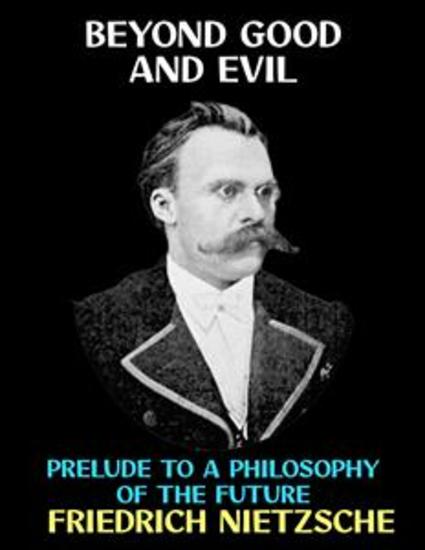
Beyond Good and Evil - Prelude to a Philosophy of the Future - cover

Beyond Good and Evil - Prelude to a Philosophy of the Future

Friedrich Nietzsche

Publisher: Diamond Book Publishing

  • 0
  • 0
  • 0

Summary

Beyond Good and Evil: Prelude to a Philosophy of the Future is a book by philosopher Friedrich Nietzsche, first published in 1886. It draws on and expands the ideas of his previous work, Thus Spoke Zarathustra, but with a more critical and polemical approach. In Beyond Good and Evil, Nietzsche accuses past philosophers of lacking critical sense and blindly accepting dogmatic premises in their consideration of morality. Specifically, he accuses them of founding grand metaphysical systems upon the faith that the good man is the opposite of the evil man, rather than just a different expression of the same basic impulses that find more direct expression in the evil man. The work moves into the realm "beyond good and evil" in the sense of leaving behind the traditional morality which Nietzsche subjects to a destructive critique in favour of what he regards as an affirmative approach that fearlessly confronts the perspectival nature of knowledge and the perilous condition of the modern individual.
Available since: 04/26/2023.

Other books that might interest you

  • When Science Meets Power - 1st Edition - cover

    When Science Meets Power - 1st...

    Geoff Mulgan

    • 0
    • 0
    • 0
    Science and politics have collaborated throughout human history and science is repeatedly invoked today in political debates, from pandemic management to climate change. 


    Leading policy analyst Geoff Mulgan here calls attention to the growing frictions caused by the expanding—and unsolicited—authority being heaped upon science. As science increasingly competes with politics, a defined plan of cooperation is urgently needed. 


    Mulgan outlines science and politics as two distinct, imperfect forms of collective intelligence. Whereas science is ordered around what we know and what is, politics engages what we feel and what matters. Politics functions because it recognizes the limits of power, the need for delegation and expert advice. The intellectual logic of science, on the other hand, focuses on detail and depth, struggling to place its knowledge in wider contexts. The crux of the matter, Mulgan argues, is how can we ensure that crucial decisions taken in democracies are both well informed and legitimate? 


    Rooted in understanding that science and politics are not just fields of ideas but also fields of action, this book proposes ways to ensure that the two work effectively together.
    Show book
  • Slavery By Consent Interviews & Purports - Talks by Aldous Huxley - cover

    Slavery By Consent Interviews &...

    Geoffrey Giuliano

    • 0
    • 0
    • 0
    "There is only one corner of the universe you can be certain of improving, and that's your own self.""One of the great attractions of patriotism - it fulfills our worst wishes.""The secret of genius is to carry the spirit of the child into old age, which means never losing your enthusiasm." Aldous HuxleyAldous Huxley was an English writer and philosopher. He wrote nearly fifty books, both novels and non-fiction works—as well as wide-ranging essays, narratives, and poems.Born into the prominent Huxley family, he graduated from Oxford, with an undergraduate degree in English literature. Early in his career, he published short stories and poetry and edited the literary magazine Oxford Poetry, before going on to publish travel writing, satire, and screenplays. Huxley spent the latter part of his life in the United States, living in Los Angeles from 1937 until his death. By the end of his life, Huxley was widely acknowledged as one of the foremost intellectuals of his time. He was nominated for the Nobel Prize in Literature nine times and was elected Companion of Literature by the Royal Society of Literature in 1962.Includes a rare treasury of ultra-rare previously unheard conversations with the esteemed intellectual.©2022 Eden Garret Giuliano (P) 2022 Eden Garret GiulianoGeoffrey Giuliano is the author of over thirty internationally bestselling biographies, including the London Sunday Times bestseller 'Blackbird: The Life and Times of Paul McCartney' and 'Dark Horse: The Private Life of George Harrison'. He can be heard on the Westwood One Radio Network and has written and produced over seven hundred original spoken word albums and documentaries on various aspects of popular culture.
    Show book
  • Human Nature - cover

    Human Nature

    Julie S. Paschold

    • 0
    • 0
    • 0
    The poems in Human Nature offer a stunning and tender ecology. It’s impossible to turn away from the awe and beauty, even as the poems also engage in playfulness and grief and resistance. In these deeply spiritual poems, the body is intricately bound to the natural world. As readers of this work, we can feel both the immense power and smallness of our human hands trembling in each shimmering line. 
    —Stacey Waite, author of Butch Geography 
    Embodying a rainbow of emotions, the poetry of Paschold grounds the reader to the world around them and those that inhabit it, big and small. 
    —Joel Sartore Photography - Office Staff 
    Julie Paschold takes a bold swing right in the title of her collection Human Nature, the delineation of which has been the prime ambition of literary folks since the first someone put pen to paper. Even, or especially, when “[w]e thin-skinned hairless beings” look outside ourselves at spiders and crocodile icefish, we also hold up a mirror in order to study our own reflection. Who can’t at times identify with “a prairie vole, / popcorn of the prairie, / . . . everything is out to eat me”? And it’s not just our fellow critters we see ourselves in: Even “[t]he sky has a sliver caught in her thumb.” It's this commonality which drives the poems and helps us understand where and how we fit in. 
    —JV Brummels, author of All the Live-Long Day
    Show book
  • Fewer Rules Better People - The Case for Discretion - cover

    Fewer Rules Better People - The...

    Barry Lam

    • 0
    • 0
    • 0
    A philosopher argues that the proliferation of rules and mandates is making us dumber, less moral, more deceptive, and less able to govern important institutions. 


    Wherever there's a rule, there is someone with the power to apply or ignore it—or add to it, in the interest of justice. From enforcing chores to issuing life sentences, decision-makers deliver flawed and sometimes arbitrary outcomes. But is their use of discretion good or bad overall? As a society, should we seek to minimize or maximize discretion, with all its potential for bias and other kinds of human error? 


    Reframing our understanding of justice and ethics, philosopher Barry Lam argues that while use of discretion—whether by a sports referee, a parent, a police officer, or a judge—can never be perfect, removing it has even more problematic effects. Mandatory arrests and sentencing laws have not eliminated bias, but have corrupted the courtroom, institutionalized lying, and brought about even more unjust and arbitrary results. Fewer Rules, Better People is a bold, riveting treatise that sheds new light on political debates about law and justice while aiming to prepare us for the imminent threat of more "perfect," discretion-less rule enforcement by AI.
    Show book
  • Solve and Effectively Avoid Classroom Disruptions With the Right Classroom Management Step by Step to More Authority as a Teacher and Productive Classroom Climate - cover

    Solve and Effectively Avoid...

    Annika Wienberg

    • 0
    • 0
    • 0
    Do you feel drained in your job? Do your students make your life hell? Do you find it hard to get up in the morning because you dread the school day? Then this book can help you. The job of a teacher is not easy. Disruptions and provocative students can significantly complicate your school day and rob you of any fun in teaching. Especially in this professional field, the danger of burnout should not be underestimated. You may already be at a point where you are thinking about throwing in the towel.
    But it doesn't have to be that way. Embark on a journey that will bring you effective change. Both your mental health and your students will thank you!
    Show book
  • The City - cover

    The City

    Robert E. Park, Ernest W....

    • 0
    • 0
    • 0
    First published in 1925, The City is a trailblazing text in urban history, urban sociology, and urban studies. Its innovative combination of ethnographic observation and social science theory epitomized the Chicago school of sociology. Robert E. Park, Ernest W. Burgess, and their collaborators were among the first to document the interplay between urban individuals and larger social structures and institutions, seeking patterns within the city’s riot of people, events, and influences. As sociologist Robert J. Sampson notes in his new foreword, though much has changed since The City was first published, we can still benefit from its charge to explain where and why individuals and social groups live as they do.
    Show book