Join us on a literary world trip!
Add this book to bookshelf
Grey
Write a new comment Default profile 50px
Grey
Subscribe to read the full book or read the first pages for free!
All characters reduced
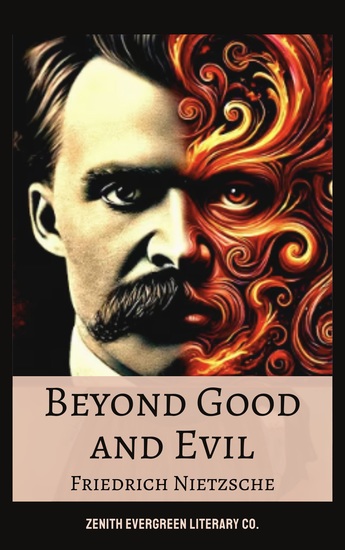
Beyond Good and Evil - Nietzsche's Provocative Philosophy - cover

Beyond Good and Evil - Nietzsche's Provocative Philosophy

Friedrich Nietzsche, Zenith Evergreen Literary Co.

Publisher: Zenith Evergreen Literary Co.

  • 0
  • 0
  • 0

Summary

📚 Immerse yourself in the groundbreaking philosophical work Beyond Good and Evil by Friedrich Nietzsche, a masterpiece that challenges conventional morality and explores the complexities of human nature. This thought-provoking text redefines traditional values and invites readers to embrace a bold, critical perspective on truth, society, and existence.

✨ Nietzsche delves into topics such as morality, religion, power, and human instincts, unraveling the intricacies of how individuals and civilizations define "good" and "evil." With incisive arguments and poetic prose, this seminal work encourages readers to break free from dogmatic thinking and engage in self-reflection. Beyond Good and Evil is a call to intellectual courage and philosophical exploration.

🏆 Recognized as one of the most influential texts in modern philosophy, Nietzsche's work continues to inspire and challenge thinkers around the world. Perfect for readers passionate about philosophy, ethics, or the study of human behavior, this book is a timeless classic.

👉 Embrace the journey of critical thinking—Click "Buy Now" to explore Friedrich Nietzsche's Beyond Good and Evil today! 📖🛒
Available since: 04/10/2025.
Print length: 200 pages.
Other books that might interest you

  • On Bigotry - Twenty Lessons on How Bigotry Works and What to Do About It - cover

    On Bigotry - Twenty Lessons on...

    Nicholas Ensley Mitchell

    • 0
    • 0
    • 0
    We like to believe that bigotry is a product of ignorance and that if we educate people enough, they will become immune to bigotry. But what if bigotry isn't a lack of education, but rather a moral code that people live by? What if bigotry is a common code of hate to which no community is immune? 
      
    On Bigotry is a field guide for understanding how bigots think and teach others to think, how bigotry disguises itself, how bigotry teaches people to act politically, and, most importantly, what individuals and communities can do about it. This is an essential read for anyone interested in challenging the spread of bigotry in society, regardless of who engages in it and why.
    Show book
  • Rhodes And His Banker - Empire Wealth And The Coming Of Union - cover

    Rhodes And His Banker - Empire...

    Richard Steyn

    • 0
    • 0
    • 0
    Rhodes and his Banker is an account of the remarkable friendship between a larger-than-life historical figure and a modest, unassuming banker, both of whom were personally involved in all the major political and financial developments in Southern Africa during the closing decades of the 19th century.
    The financial institution that brought diamond and gold magnate Cecil John Rhodes and Sir Lewis Michell together – the Standard Bank – was at the heart of the country's rapid transformation from an agricultural backwater to an industrial powerhouse thanks to the discovery of diamonds and gold. The book chronicles the activities and growth of the bank under the remarkable stewardship of Michell and recounts his role as the trusted confidant of Rhodes.
    Michell published the first biography of Rhodes to be written after his death and offers many intriguing insights into the character and motives of one of the most controversial and self-driven of British imperialists. He also did everything he could to fulfil Rhodes's ambition for a united South Africa and played a key role in setting up the world-famous Rhodes Scholarship programme.
    Intertwining dual narratives of Rhodes as rapacious entrepreneur with the Standard Bank under Michell tiptoeing in his wake to become the biggest bank in Africa, Steyn recounts how colonialism and capitalism took root in South Africa and Rhodesia.
    Show book
  • Wizards - David Duke America's Wildest Election and the Rise of the Far Right - cover

    Wizards - David Duke America's...

    Brian Fairbanks

    • 0
    • 0
    • 0
    The '91 Louisiana Governor's race was supposed to be forgettable. But when former KKK Grand Wizard David Duke shocked the nation by ousting incumbent Republican Governor Buddy Roemer in the primary, the world took notice. Democrat Edwin Edwards, a former three-term governor and two-time corruption defendant, was left alone to face Duke in the general election—and he was going to lose. 


    Then a little-known state committeewoman stepped in with evidence of Duke's nefarious past. Could her evidence be enough to sway the minds of fired-up voters, or would Louisiana welcome a far-right radical into the highest office in the state? 


    Journalist Brian Fairbanks explores how the final showdown between Duke and Edwards in November 1991 led to a major shift in our national politics, as well as the rise of the radical right and white supremacist groups, and how history repeated itself in the 2016 presidential election. The story of these political "wizards," almost forgotten by history, remains eerily prescient and disturbingly relevant.
    Show book
  • Exurbia Now - The Battleground of American Democracy - cover

    Exurbia Now - The Battleground...

    David Masciotra

    • 0
    • 0
    • 0
    The suburbs have become too liberal and diverse for many white American conservatives, so "exurbia"—areas outside the cities and their suburbs—are becoming the staging ground for the radical right extremist insurgency . . . 


    Beyond a fanatical devotion to former president Donald Trump, one of the curious things that united the rank and file of the January 6 insurrectionist mob was that many of them were residents of one of America's fastest growing residential areas: Exurbia. In this brilliant work of political and cultural inquiry, veteran political journalist David Masciotra provides a definitive account of what exurbia is, how it came to be, and how it's transforming American life. Zooming in outside the greater metropolitan area of Chicago—where Masciotra grew up—he shows how exurbia has become a safe space to fly the MAGA flag and romanticize the mores of the pre-civil rights, pre-feminist, pre-gay rights 1950s. 


    But, as Masciotra also shows, reactionary white flight is not the whole story of small-town America. The story often lost is the power and persistence of small-town liberals—people who believe in equality, celebrate diversity, and enroll in movements for justice. Exurbia, as it turns out, is ground zero for the fight over a democracy mightily beleaguered, yet still full of promise, and still worth fighting for.
    Show book
  • Fascism: What It Is And How To Fight It - cover

    Fascism: What It Is And How To...

    Leon Trotsky

    • 0
    • 0
    • 0
    Leon Trotsky (1879-1940) was a Bolshevik revolutionary and Marxist theorist. He was one of the leaders of the Russian October Revolution, second only to Vladimir Lenin. During the early days of the Soviet Union, he served first as People's Commissar for Foreign Affairs and later as the founder and commander of the Red Army and People's Commissar of War. He was also among the first members of the Politburo. 
    Why fascism was able to conquer only in those countries where social democratic or Stalinist parties blocked the workers and their allies from utilizing a revolutionary situation to remove the capitalists from power. There is a scientific analysis of fascism. It was made by the exiled Bolshevik revolutionary Leon Trotsky not as a postmortem, but during the rise of fascism. This was — along with his analysis of the nature of Stalinism — Trotsky's greatest contribution to Marxist theory. He began the task after Mussolini's victory in Italy in 1922 and brought itto ahigh pointin the years preceding Hitler'striumphin Germany in 1933.
    Show book
  • The Corpsewood Manor Murders in North Georgia - cover

    The Corpsewood Manor Murders in...

    Amy Petulla

    • 0
    • 0
    • 0
    Author Amy Petulla uncovers the curious case that left two men dead and the incredible story still surrounded by controversy, speculation, and myth. 


    In 1982, Tony West and Avery Brock made a visit to notorious Corpsewood Manor under the pretense of a celebration. They brutally murdered their hosts. Dr. Charles Scudder and companion Joey Odom built the "castle in the woods" in the Trion forest after Scudder left his position as professor at Loyola. He brought with him twelve thousand doses of LSD. Rumors of drug use and Satanism swirled around the two men. Scudder even claimed to have summoned a demon to protect the estate. The murders set the stage for a trial vibrant with local lore.
    Show book