Join us on a literary world trip!
Add this book to bookshelf
Grey
Write a new comment Default profile 50px
Grey
Subscribe to read the full book or read the first pages for free!
All characters reduced
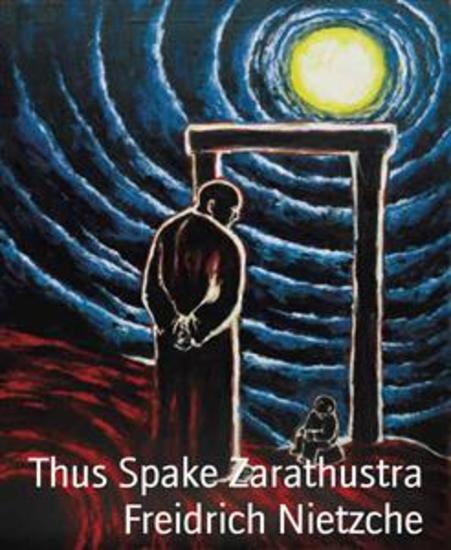
Thus Spake Zarathustra - cover

Thus Spake Zarathustra

Freidrich Nietzche

Publisher: BookRix

  • 0
  • 0
  • 0

Summary

Thus Spake Zarathustra) is a philosophical novel by German philosopher Friedrich Nietzsche. The book chronicles the fictitious travels and speeches of Zarathustra. Zarathustra's namesake was the Persian founder of Zoroastrianism, usually known in English as Zoroaster. Nietzsche is clearly portraying a "new" or "different" Zarathustra, one who turns traditional morality on its head. He goes on to characterize "what the name of Zarathustra means in my mouth, the mouth of the first immoralist:"

The book embodies a number of innovative poetical and rhetorical methods of expression. It serves as a parallel and supplement to the various philosophical ideas present in Nietzsche's body of work. He has, however, said that "among my writings my Zarathustra stands to my mind by itself." Emphasizing its centrality and its status as his magnum opus.
Since many of the book's ideas are also present in his other works, Zarathustra is seen to have served as a precursor to his later philosophical thought. With the book, Nietzsche embraced a distinct aesthetic assiduity. He later reformulated many of his ideas, in Beyond Good and Evil and various other writings that he composed thereafter. He continued to emphasize his philosophical concerns; generally, his intention was to show an alternative to repressive moral codes and to avert "nihilism" in all of its varied forms.

While Nietzsche injects myriad ideas into the book, a few recurring themes stand out. The overman (Übermensch), a self-mastered individual who has achieved his full power, is an almost omnipresent idea in Thus Spoke Zarathustra. Man as a race is merely a bridge between animals and the overman. Nietzsche also makes a point that the overman is not an end result for a person, but more the journey toward self-mastery.

The eternal recurrence, found elsewhere in Nietzsche's writing, is also mentioned. "Eternal recurrence" is the possibility that all events in one's life will happen again and again, infinitely. The embrace of all of life's horrors and pleasures alike shows a deference and acceptance of fate, or Amor Fati. The love and acceptance of one's path in life is a defining characteristic of the overman. Faced with the knowledge that he would repeat every action that he has taken, an overman would be elated as he has no regrets and loves life. Opting to change any decision or event in one's life would indicate the presence of resentment or fear; contradistinctly the overman is characterized by courage and a Dionysian spirit.

The will to power is the fundamental component of human nature. Everything we do is an expression of the will to power. The will to power is a psychological analysis of all human action and is accentuated by self-overcoming and self-enhancement. Contrasted with living for procreation, pleasure, or happiness, the will to power is the summary of all man's struggle against his surrounding environment as well as his reason for living in it.
Available since: 12/19/2023.
Print length: 365 pages.

Other books that might interest you

  • The Pearl On The String - cover

    The Pearl On The String

    Jenny Richter

    • 0
    • 0
    • 0
    Embark on a karmic odyssey with ”The Pearl on the String,” delving into the cosmic saga of Sekhmet, a member of a galactic pioneer group instrumental in initiating the human race through DNA creation. In ancient Egypt, the alien gods utilized giants and an inherent understanding of frequency as instruments to structure energy into settlements with unparalleled vibrancy. Yet, as Rah`s prophesy of a cataclysmic era looms, Sekhmet`s steadfast belief in humanity`s potential to pull itself out of the darkness becomes her exile sentence, propelling her into a cycle of karmic entanglement. 
    Across five incarnations spanning epochs and civilizations, Sekhmet grapples with her karmic wound amidst the rise and fall of empires. From Persia`s alchemical marvels to North America`s collision with fate, her journey echoes through time, guided by her intrinsic soul connection, yet lost within the era of forgetting and separation consciousness. 
    As the shadows of World War II engulf the world, Sekhmet`s voice transcends temporal confines, offering guidance in a turbulent era.  
    Rooted in the numerological wisdom of change, symbolized by the number 5, the narrative weaves a tapestry of personal destiny and human spirituality, inviting readers to uncover their own voices through the ages. 
    Amidst the ebb and flow of history, a revelation emerges—the cyclical flow of energy unveils a profound truth: abundance originates from within. Shedding the chains of savior thinking, a new epoch emerges—one where humanity seeks its own illumination, forging a cosmic path and awakening to its limitless potential within. ”The Pearl on the String” is an enthralling exploration of humanity`s evolution—from the cradle of guided cosmic infancy to the transformative embrace of self-empowerment—inviting readers on a journey of healing, discovery, and cosmic enlightenment.
    Show book
  • The Just-World Hypothesis - Believing That People Get What They Deserve - cover

    The Just-World Hypothesis -...

    William Rands

    • 0
    • 0
    • 0
    The Just-World Hypothesis is a psychological concept that suggests people have a deep-seated belief that the world is inherently fair, where individuals get what they deserve. This belief leads people to assume that good things happen to good people, and bad things happen to bad people. It is a cognitive bias that serves as a mechanism for reducing feelings of anxiety or uncertainty about the randomness and chaos of the world. This belief in a just world helps individuals to feel more in control of their lives and less vulnerable to the uncertainties of the world around them. 
    The hypothesis was first proposed by psychologist Melvin Lerner in the 1960s, and it has since been widely studied in the fields of psychology and sociology. Lerner’s research showed that people often justify the suffering of others by believing that those who experience hardship or injustice must have somehow deserved it. For example, when people see others suffering, they may reason that the victims must have done something to bring the suffering upon themselves, whether through their actions, choices, or inherent characteristics. This allows people to maintain their belief in a just world, as it provides a sense of order and predictability in what might otherwise seem to be a random and unfair world. 
    One of the primary psychological functions of the Just-World Hypothesis is to reduce feelings of powerlessness. When individuals can attribute suffering to a victim's behavior or actions, they can distance themselves from the fear of experiencing similar fates. This belief offers a form of psychological protection, assuring people that they can avoid misfortune by adhering to social norms, behaving morally, and making the right choices. As a result, individuals may experience less anxiety about the unpredictability of life, as they can convince themselves that misfortune is not random, but rather a consequence of personal shortcomings or wrongdoings.
    Show book
  • The Codependency Recovery - A Complete Guide to Fix Your Codependency Create Healthy Relationships Overcome the Fear of Abandonment Stop Being a People Pleaser and Start Loving Yourself - cover

    The Codependency Recovery - A...

    Jasmine W. Smith

    • 0
    • 0
    • 0
    Are you a people pleaser and always feel the need to help others?  
    Do you continue hanging on to relationships that cause you anxiety, depression, and sadness even though you know you should let go? 
    Do you have trouble setting boundaries? 
    Trying to control and alter people without being noticed is hard and does not result in the happy and healthy life you deserve. This tiredness can lead to a desire to numb uncomfortable sensations via harmful behaviors such as drinking, emotional eating, or failing to take care of oneself physically and psychologically, all of which only serve to exacerbate the problem. 
    The good news is... You can break your Codependency habits and break the cycle of unhappiness. 
    This program is aimed to uncover the underlying causes of your over-giving and overdoing so you may focus your efforts on living your best life. 
    here is just a fraction of what you will discover:The tools and strategies you need to move towards codependence recoveryWhat exactly codependency is, and where it comes fromHow to develop effective communication strategies and solve codependency conflictsHow to stop saying yes to everything when, in fact, your heart and mind say noPractical exercises to help you assess your relationships and take steps to transform your lifeThe ICAR procedure to combat depression, anxiety, anger, and other problems you may be facing from being codependentHow to redefine your mindset with confidence and get back the freedom you deserveHow to stop denying your own needs and feeling ashamed when you dare to think about them 
    And much more. 
    Start building a better relationship with yourself and the people around you using The Codependency Recovery.
    Show book
  • Eye for Genius An: James Brand Pinker and Henry James - cover

    Eye for Genius An: James Brand...

    Kerry Sutherland

    • 0
    • 0
    • 0
    A middle aged author declining in popularity. An up and coming literary agent with an eye for genius. A partnership that would forge a prodigious legacy in American literature.  
    Henry James was a middle-aged author who had established himself on a transatlantic scale when he employed James Brand Pinker as his literary agent in 1898. The changing preferences of a growing audience of readers along with James’s self-defeating practice of shifting from publisher to publisher, rather than adhering to the trade courtesy of remaining loyal to one house, were making the author’s efforts to keep his work in print increasingly difficult; bringing Pinker, who managed the literary business of over 100 authors including Stephen Crane, H.G. Wells, Joseph Conrad, and Jack London, into the picture made it possible for James to maintain a presence before the reading public to an extent that would have been impossible without the agent’s assistance. 
    Pinker’s involvement was vital to the continuance of James’s career, as his later works and the New York Edition proved difficult material to place. The agent’s role as the mediator of conflict between the commercial writer and literary artist, positions that James had difficulty reconciling, had considerable influence on the shape of James’s later career and thus the way in which the author is remembered; James’s legacy is therefore clearly tied to Pinker’s efforts. 
    Using correspondence between Pinker, James, and the primary publishers of James’s material from 1898 until Pinker’s death in 1922, along with secondary works addressing the agent’s endeavors during this period, this volume demonstrates the link between Pinker’s work and James’s continued presence in print, both during the author’s lifetime and after his death.
    Show book
  • NAZI MOVIES AS PROPAGANDA MACHINE - How Goebbels Changed the German Film Industry Into an Ideological Weapon - cover

    NAZI MOVIES AS PROPAGANDA...

    Davis Truman

    • 0
    • 0
    • 0
    The German film industry transformed from a collection of independent studios into a division of the Nazi Party between 1933 and 1945. German film became a crucial component of the Nazi campaign to ideologically indoctrinate the German populace as part of the Ministry for Popular Enlightenment and Propaganda, led by Joseph Goebbels. However, the business kept up its prior commercial practices and made movies aimed at paying German consumers. Even though Goebbels worked hard to turn German cinema into an ideological weapon, the theater served as a popular consumer marketplace, and the various film tastes of German moviegoers continued to affect the kinds of films made. Therefore, filmmaking in Nazi Germany was influenced by popular taste and Goebbels' ideological objectives. 
    This book will look at several movies that demonstrate Goebbel's evolving propaganda objectives and the changing preferences of the German audience for movies during the Nazi era. Box office statistics from the years before and after the start of World War II offer unique insight into German film consumption and serve to highlight the extent to which the general public supported the war in Germany.
    Show book
  • The Mother Artist - Portraits of Ambition Limitation and Creativity - cover

    The Mother Artist - Portraits of...

    Catherine Ricketts

    • 0
    • 0
    • 0
    Few women artists feature prominently in the history of art, and even fewer who are mothers. What can we learn about ambition, limitation, and creativity from women who persist in doing both? 


    Forged in the stress of early motherhood, The Mother Artist explores the fraught yet generative ties between caregiving and creative practice. As a young mother working at a museum, essayist Catherine Ricketts began asking questions about the making of motherhood and the making of art. Now, with incantatory prose and an intuitive gaze, she twines intimate meditations on parenthood with studies of the work and lives of painters, writers, dancers, musicians, and other creatives. Ricketts takes listeners through the studios of mother artists, placing us in the company of women from the past and the present who persevere in both art and caregiving. We encounter Senga Nengudi's sculptures, which celebrate the pregnant body, and Toni Morrison's powerful writing on childbirth. We behold Joan Didion's meditations on maternal grief and Alice Neel's portraits of mothers and babies. And we observe the ambition of sculptor Ruth Asawa, the activism of printmaker Elizabeth Catlett, and the constancy of writer Madeleine L'Engle. This book is for mothers who aspire to make art, anyone eager to discover the stories of visionary women, and all who long for a revolution of tenderness.
    Show book