Join us on a literary world trip!
Add this book to bookshelf
Grey
Write a new comment Default profile 50px
Grey
Subscribe to read the full book or read the first pages for free!
All characters reduced
Hadrian The Seventh - cover

Hadrian The Seventh

Frederick Rolfe

Publisher: Caelwick Press

  • 0
  • 0
  • 0

Summary

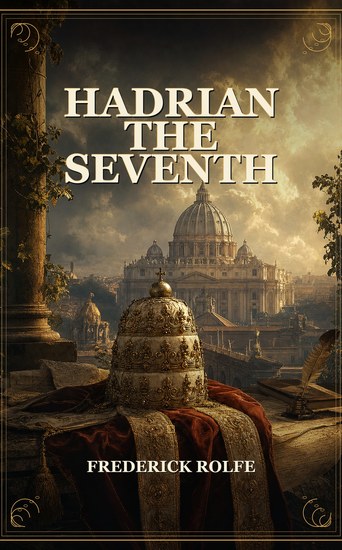
George Arthur Rose aspired to the priesthood, but after being much abused and taken advantage of for many years by his Catholic brothers, he finds himself disillusioned with humanity. But just as the secret conclave in Rome is deadlocked in the election of the next Pope, he finds himself rediscovered. A compromise in the election results in Rose being chosen for the office, and he styles himself as Hadrian the Seventh. With his new authority, he implements church reforms and a program to bring Christian order to the nations of the world. Frederick Rolfe was considered an eccentric, as evidenced by his often-idiosyncratic spelling ("Xystine Chapel") and made-up words like "contortuplications" and "occession." Hadrian the Seventh , written under the pen name of "Baron Corvo," is a novel of wish-fulfillment, reflecting Rolfe's vision of how he wants to order the world given unlimited power. Written before the world wars and amid the increasing secularization of twentieth century society, it was perhaps almost-plausible to think that a religious figure could get everyone on the same program merely by moral persuasion. Frederick Rolfe (died 1913) was a prominent voice of the late 19th and early 20th century. Their work has endured across generations and continues to be read and studied worldwide. As a work of classic literary fiction, Hadrian The Seventh exemplifies the narrative craft and social insight that defined great storytelling of its era. Literary fiction of this period was characterized by careful attention to character psychology, social milieu, and the moral questions that animated public discourse.
Available since: 05/19/2026.
Print length: 446 pages.

Other books that might interest you

  • Moby-Dick - or The Whale - cover

    Moby-Dick - or The Whale

    Herman Melville

    • 0
    • 0
    • 0
    A schoolmaster ships out of Nantucket on a whaler whose captain is hunting one particular white whale, and the voyage turns into an account of everything: how a whale is cut up, what the ropes are called, what the colour white means, and what a man owes the thing that maimed him. Melville had served on a whaler himself and jumped ship in the Marquesas. It sold badly, went out of print, and was rediscovered seventy years later. Ninety-nine plates of sea painting from 1760 to 1880, including Turner and Joseph Vernet, run through the book like the water the Pequod sails.
    Show book
  • The King in Yellow - cover

    The King in Yellow

    Robert W. Chambers

    • 0
    • 0
    • 0
    There are books that haunt. The King in Yellow is one of them.
    First published in 1895, this cycle of four interlinked stories—The Repairer of Reputations, The Mask, In the Court of the Dragon, and The Yellow Sign—offers a view into a world just a shade off from our own. Beneath the surface of elegant prose and civil order lies something broken, something touched by madness, art, power—and something unspeakably strange.
    A book within the book, a play that should never be read, threads through each tale, leaving behind not answers, but echoes. With quiet menace and disquieting beauty, Chambers sketches a fictional universe that lingers like a fevered dream.
    Not quite horror, not quite science fiction, not quite fantasy—The King in Yellow is a singular work. A whisper from the shadows. An invitation to look too long at the thing you cannot name. 
    Contents
    • The Repairer of Reputations
    • The Mask
    • In the Court of the Dragon
    • The Yellow Sign
    Show book
  • The Ward of King Canute - A Romance of the Danish Conquest - cover

    The Ward of King Canute - A...

    Ottilie A. Liljencrantz

    • 0
    • 0
    • 0
    England under Danish rule, a Saxon girl made the ward of the conqueror, and a court where the two peoples have to learn to live together. Liljencrantz wrote a run of Viking novels from the sagas and was among the first Americans to take that material seriously. This edition is bound with a gallery of 56 plates after Daniel Maclise, Thomas Gainsborough and Richard Wilson, among others.
    Show book
  • Caves of Terror - A Woman Nine Hundred Years Old - cover

    Caves of Terror - A Woman Nine...

    Talbot Mundy

    • 0
    • 0
    • 0
    An American agent in India follows a Russian conspiracy into caves under the hills, where a woman who claims to be nine hundred years old keeps a treasure and an army. Mundy had worked in India and East Africa before he wrote, and his intrigue novels are unusually honest about who the empire's servants actually were. The caves are a pulp invention; the politics around them are not. Fifty plates by painters including Vereshchagin and David Roberts follow the caravan roads, hill temples and desert cities of the East that give this tale its ground.
    Show book
  • The Knight in the Panther's Skin - cover

    The Knight in the Panther's Skin

    Shot'ha Rust'haveli

    • 0
    • 0
    • 0
    Georgia is a central Asian region which is situated in the mountains between the Black and Caspian seas. This, the 'Man in the Panther Skin' (also known as 'the Knight in the Panther Skin') is a 12th century medieval epic poem. It is considered one of the masterpieces of Georgian literature, and has been called the Georgian national epic. The author, Prince Shota Rustaveli, was a noble in the court of Queen Tamar, and served as her treasurer. He was also a painter who created frescoes in the Georgian monastery of the Holy Cross in Jerusalem. We do not know specific birth and death dates for Rustaveli. The poem was first printed in 1712 in Tblisi. This translation is, thankfully, into clearly written prose, unlike some of the awful 19th century attempts to versify translated poetry. Wardrop's translation, which she modestly called an attempt, makes enjoyable reading.The poem, strangely enough, is not set in Georgia, but in fictionalized versions of Arabia, Persia, India and fairy-tale lands set in the environs of the Indian Ocean. (However the characters are at one point described as speaking fluent Georgian!) There are two chief male protagonists, Avt'handil and Tariel. Tariel, the eponymous 'Knight in the Panther's Skin' is made heir to all India, but tragically falls in love with his adoptive sister, Nestan. Driven mad by this love, he ends up killing the man she is to marry and fleeing India. Nestan is also spirited away to parts unknown. The search for Nestan, described as radiant as the sun, so beautiful that everyone she meets falls in love with her, is the central thread of the story. Avt'handil, the suitor of the Queen of Arabia T'hinat'hin, sees Tariel wandering disconsolate one day and goes in quest of this mysterious knight. Eventually they meet up and after a long quest end up finding Nestan. Nestan and Tariel marry, and Avt'handil marries T'hinat'hin. I have appended a short synopis of the story to this etext, based on my reading notes.
    Show book
  • A Very Short Romance - From their pens to your ears genius in every story - cover

    A Very Short Romance - From...

    Vsevolod Garshin

    • 0
    • 0
    • 0
    Vsevolod Mikhailovich Garshin was born on 14th February 1855 in what is now Dnipro in the Ukraine, but then part of the Russian Empire. 
    After attending secondary school he studied at the Saint Petersburg Mining Institute.  
    Wars between and on behalf of Empires were a regular feature of the decades then.  Garshin volunteered to serve in the Russian army at the beginning of the Russo-Turkish War in 1877.  
    He began as a private in the Balkans campaign and was wounded in action.  By the end of the war, in 1878, he had been promoted to officer rank.  
    By now Garshin, having previously published some articles and reviews in newspapers, wished to devote himself to a literary career.  The decision made he resigned his army commission. 
    His time as a soldier provided rich experiences for his early stories. His first ‘Four Days’ was related as the interior monologue of a wounded soldier left for dead on the battlefield for four days, face to face with the corpse of a Turkish soldier he had killed, gained him early admiration as an author of note.  
    He wrote perhaps only 20 stories, but their influence was immense, although in these more modern times he is barely remembered and lives in the more prolific shadows of others.  His characters are superbly worked into stories that come alive in the intensity and reality of his prose.   
    Garshin’s most well-known story is ‘The Red Flower’, also known as ‘Scarlet Blossom’ and is easily amongst the first rank of stories dealing with mental health issues.  
    Despite early literary success, he himself experienced periodical bouts of mental illness.   
    In one such bout Garshin attempted to commit suicide by throwing himself down the stone stairs leading into his apartment building.  Although not immediately fatal, Vsevolod Garshin died as a result of his injuries in a St Petersburg hospital on 5th April 1888.  He was 33.
    Show book