Join us on a literary world trip!
Add this book to bookshelf
Grey
Write a new comment Default profile 50px
Grey
Subscribe to read the full book or read the first pages for free!
All characters reduced
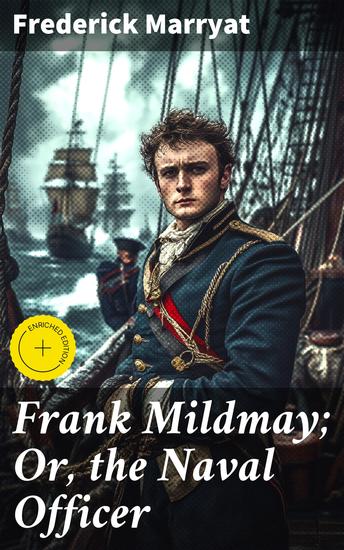
Frank Mildmay; Or the Naval Officer - Enriched edition A Young Man's Journey Through the Dangers and Challenges of Naval Life in the Napoleonic Wars - cover

Frank Mildmay; Or the Naval Officer - Enriched edition A Young Man's Journey Through the Dangers and Challenges of Naval Life in the Napoleonic Wars

Frederick Marryat

Publisher: Good Press

  • 0
  • 0
  • 0

Summary

In "Frank Mildmay; Or, the Naval Officer," Frederick Marryat crafts a vivid narrative that intricately explores the life of a young man embarking on a naval career in the early 19th century. This semi-autobiographical novel employs a rich literary style characterized by detailed characterizations and a blend of adventure and realism. Marryat's experiences as a naval officer provide a compelling backdrop, allowing him to depict maritime culture and the rigors of naval life authentically. The work not only serves as a thrilling maritime adventure but also reflects the social and political nuances of the time, such as the British Empire's influence and the heroism associated with naval service. Frederick Marryat, a British naval officer turned novelist, was influenced by his personal experiences at sea and his keen observations of naval life. His firsthand knowledge of maritime practices and naval engagements lends credibility to the narrative. Marryat wrote this novel during a period of significant naval conflict, and he sought to combine entertainment with memoir-like elements, aiming to inspire a sense of adventure and patriotism. "Frank Mildmay" is an essential read for enthusiasts of naval history and literature alike. It offers an authentic glimpse into the 19th-century naval world, combining thrilling escapades with deep character studies. Readers will find Marryat's storytelling engaging, making this novel not only an adventure but also a thoughtful reflection on duty, honor, and the complexities of naval life.

In this enriched edition, we have carefully created added value for your reading experience:
- A succinct Introduction situates the work's timeless appeal and themes.
- The Synopsis outlines the central plot, highlighting key developments without spoiling critical twists.
- A detailed Historical Context immerses you in the era's events and influences that shaped the writing.
- An Author Biography reveals milestones in the author's life, illuminating the personal insights behind the text.
- A thorough Analysis dissects symbols, motifs, and character arcs to unearth underlying meanings.
- Reflection questions prompt you to engage personally with the work's messages, connecting them to modern life.
- Hand‐picked Memorable Quotes shine a spotlight on moments of literary brilliance.
- Interactive footnotes clarify unusual references, historical allusions, and archaic phrases for an effortless, more informed read.
Available since: 08/12/2023.
Print length: 355 pages.

Other books that might interest you

  • A Madman's Diary - cover

    A Madman's Diary

    Lu Xun

    • 0
    • 0
    • 0
    “A Madman’s Diary” is a short story by Lu Xun first published in 1918. Written in vernacular Chinese, it is considered “China’s first modern short story” and the most influential modern work in the republican era. Lu was inspired by “Diary of a Madman" by Nicolai Gogol, both in the use of the diary form and in the idea that the madman sees things more clearly than others. The story comes about when the narrator decides to visit two friends with whom he has lost touch when he learns that one of them has fallen ill. When he arrives, he is met by the brother, who informs him that his brother is no longer ill and hands him a copy of his brother’s diary. It is immediately apparent that the diarist is indeed mad. He believes he is surrounded by cannibals and that everyone has cannibalistic designs on him. His paranoia grows and he begins to see threats everywhere. He even sees  the words “Eat People” between the lines of classic Confucian texts. He eventually suspects that his late sister had been eaten by his brother, and that he himself may have unknowingly done so. He ardently hopes that everyone will have a change of heart and change their ways. The story ends with a plea to “save the children”.The story is not readily comprehensible, and it took several years for it to be recognized as important. Gradually the madman is seen as a revolutionary contemptuous of Chinese tradition and its feudal society that “eats people”, people who themselves are corrupted by traditions they cannot escape.
    Show book
  • After Twenty years - From their pens to your ears genius in every story - cover

    After Twenty years - From their...

    O Henry

    • 0
    • 0
    • 0
    William Sydney Porter was born on 11th September 1862 in Greensboro, North Carolina. At age 3 his mother died from tuberculosis. From an early age it was clear Porter had a large appetite for reading as he absorbed the world around him. 
    He first attended at a school run by his aunt before enrolling at the Lindsey Street High School and then worked at his uncle’s drugstore and gained a pharmacists’ license in 1881.  
    A persistent cough took him to Texas in the hope that a change of climate would help his symptoms. He took on various types of work, initially from ranch hand and cook and then as varied as pharmacist, draftsman, bank teller and journalist. He also began to write, though for now, purely as a hobby. 
    He was a member of several singing and dramatic groups when he met 17 year old Athol Estes, daughter of a wealthy Austin family. Despite her mother’s objection owing to Athol’s tuberculosis, they began courting and in July 1887, they eloped and soon married. 
    Athol, impressed by his writing, encouraged him to get them published. A job as a draftsman at the Texas General Land Office paid a healthy $100 dollars per month and life was good. 
    But then life turned cruel. His son died a few hours after birth although a daughter, Margaret, came the following year.  His job had to be vacated but another was found at the First National Bank of Austin. The bank operated informally and Porter was careless in keeping the books. He lost that job but began writing for the humourous weekly The Rolling Stone and the Houston Post. Some time later the federal Bank auditors went through his former accounts and he was arrested on charges of embezzlement. 
    Porter fled the day before his trial to Honduras. Holed up for several months he began to write.  Athol had become too ill to travel to meet him and learning that her health was deteriorating he surrendered to the court in February 1897.  Bail was obtained so that he could stay with Athol during her final days.  
    Porter was sentenced to five years at the Ohio Penitentiary in Columbus. His pharmacy qualifications got him the job of night druggist.  His sentence also gave him time to write and publish fourteen short stories. In December 1899 in McClure’s Magazine he published a short story as O Henry.  
    He was released two years early in July 1901, and reunited with Margaret, now 11, in Pittsburgh.  He now began his most prolific period of writing; a short story per week for the New York World, while also publishing works in other magazines.  Eventually over 600 of his short stories were published. 
    Porter was a heavy drinker and in 1908 his health, which had deteriorated for several years, took a dramatic turn for the worse, as did his writing. 
    O Henry died of cirrhosis of the liver complicated by diabetes and an enlarged heart on 5th June 1910.<
    Show book
  • Strychinne for Dogs - Gask was an English dentist that emigrated to Australia he would write crime fiction whilst waiting for patients here is an excellent example of his work - cover

    Strychinne for Dogs - Gask was...

    Arthur Gask

    • 0
    • 0
    • 0
    Arthur Cecil Gask was born on 10th July 1869 in Marylebone, London. 
     
    He began his career as an author late in life.  It was only in 1920 when he and his second wife and family emigrated to Adelaide, South Australia to set up a dental practice that writing took its hold. 
     
    Gask paid for the publication of his first work, ‘The Secret of the Sandhills’, which was an immediate success, both commercially and critically.  
     
    Over the next 3 decades Gask wrote over thirty books, usually featuring his detective invention Gilbert Larose, as well as short stories.  Many of his works were translated, serialised and even broadcast on the radio.  HG Wells and Bertrand Russell were avid fans. 
     
    In the last years of his life he was still writing, usually two novels a year. 
     
    Arthur Gask died on 25th June 1951, in Adelaide, Australia.  He was 81 
     
    In this story we meet his most popular character, Detective Gilbert Larose, who, whilst on holiday, is drawn into a case of dogs being poisoned.  But why would anyone do that?
    Show book
  • Medusa's Coil - cover

    Medusa's Coil

    H.P. Lovecraft

    • 0
    • 0
    • 0
    Venture into the dark and mysterious world of H. P. Lovecraft’s Medusa's Coil, a tale that combines supernatural horror with a chilling sense of foreboding. When a man arrives at an isolated mansion, he uncovers the terrifying secrets hidden within, secrets that reveal an ancient evil lurking beneath the surface. As the story unfolds, he becomes entangled in a web of dread, deception, and doom, leading to an unforgettable climax that will haunt the listener long after the tale ends. 
    Narrated by Ken Kowalik, this audiobook captures Lovecraft’s unique blend of atmospheric suspense and cosmic horror. Kowalik’s performance brings a rich, ominous depth to the story, enhancing the eerie ambience and drawing listeners into the gripping tension of Lovecraft’s writing. 
    Perfect for fans of Lovecraftian horror, Medusa's Coil delivers a compelling journey into the uncanny and the unknown. Prepare for an audio experience filled with suspense, terror, and the dark allure of Lovecraft’s most haunting themes.
    Show book
  • Nikolai Gogol - A Short Story Collection - The absurdist Masters most compelling tale Ukranian born short story great that influenced the likes of Tolstoy and Dostoyevsky - cover

    Nikolai Gogol - A Short Story...

    Nikolai Gogol

    • 0
    • 0
    • 0
    Nikolai Vasilievich Gogol was born on 1st April 1809 to a father, descended from Ukrainian Cossacks and a mother with a military background in the Ukrainian town of Sorochyntsi, then part of the Russian Empire and rich in Cossack traditions and folklore.   
     
    His father wrote poetry and plays which the young Gogol helped stage at his uncle’s home theatre.  This helped ignite in him a love of literature and blossomed when he attended, what is now, the Nizhyn Gogol State University at the age of 12.  Here he participated in school theatre productions and refined his mastery of his native Ukrainian and also the Russian of his Imperial masters. 
     
    In 1828 he went to St Petersburg and unsuccessfully tried to begin a career as an actor after finding that with no money and no connections the civil service was barred to him. 
     
    Embezzling money from his mother he embarked on a trip to Germany. When the money ran out, he returned to St Petersburg but the experiences were used in a series of stories he contributed to periodicals.  These tales were steeped in his childhood memories of the Ukrainian landscape and peasantry enlivened with the supernatural of its folklore woven with realistic events of the day.  He wrote in Russian in a whimsical, colloquial style with a smattering of Ukrainian words and phrases that provided an authenticity.  Eight stories were published as ‘Evenings on a Farm near Dikanka’.  Seemingly all at once fame and fortune arrived. Gogol was hailed by his contemporaries, including Pushkin, as a pre-eminent writer of Russian literature.   
     
    His success continued with his brilliant plays ‘The Inspector General’ and the comedy ‘The Marriage for the Theatre’, both being highly acclaimed.   
     
    In 1834 he became Professor of Medieval History at the University of St. Petersburg but with little academic or teacher training, failed to adequately fulfil many of his duties and soon resigned this post.  With no obligations and using his earnings from his writing, which now included the impressionistic and immortal ‘Dead Souls’, Gogol travelled around Europe, spending the most time in Rome where he studied art, read Italian literature and developed a passion for opera.  
     
    In the 1840s Gogol became preoccupied with a need to purify his soul and embarked on a pilgrimage to Jerusalem. In tandem he fell under the influence of a strict and austere spiritual ascetic who persuaded him to observe strict fasts that, allied with his depression and deteriorating health, contributed to his death on 21st April 1852 at the age of only 43. 
     
    1 - Nikolai Gogol - A Short Story Collection - An Introduction 
    2 - The Nose by Nikolai Gogol 
    3 - The Cloak by Nikolai Gogol also known as 'The Overcoat' 
    4 - Old Fashioned Landowners by Nikolai Gogol 
    5 - St Johns Eve by Nikolai Gogol 
    6 - Diary of a Madman by Nikolai Gogol
    Show book
  • Top 10 Short Stories The - The 1860s - The top ten Short Stories of all time written in the 1860s - cover

    Top 10 Short Stories The - The...

    Charles Dickens, Wilkie Collins,...

    • 0
    • 0
    • 0
    Short stories have always been a sort of instant access into an author’s brain, their soul and heart.  A few pages can lift our lives into locations, people and experiences with a sweep of landscape, narration, feelings and emotions that is difficult to achieve elsewhere. 
     
    In this series we try to offer up tried and trusted ‘Top Tens’ across many different themes and authors. But any anthology will immediately throw up the questions – Why that story? Why that author?  
     
    The theme itself will form the boundaries for our stories which range from well-known classics, newly told, to stories that modern times have overlooked but perfectly exemplify the theme.  Throughout the volume our authors whether of instant recognition or new to you are all leviathans of literature. 
     
    Some you may disagree with but they will get you thinking; about our choices and about those you would have made.  If this volume takes you on a path to discover more of these miniature masterpieces then we have all gained something. 
     
    This mid-century decade reveals a journey traversing continents and genres as authors explore and revel in the tumultuous times of social upheaval as nations are divided by Civil War or expand with the brute force of Imperial Dreams.  Our writers also explore other genres including the absurd and ghostly with consummate ease. 
     
    01 - Top Ten - The 1860's - An Introduction 
    02 - The Signalman by Charles Dickens 
    03 - The Crocodile. An Extraordinary Incident - Part 1 by Fyodor Dostoyevsky 
    04 - The Crocodile. An Extraordinary Incident - Part 2 by Fyodor Dostoyevsky 
    05 - The Romance of Certain Old Clothes by Henry James 
    06 - Malachi's Cove by Anthony Trollope 
    07 - The Luck of Roaring Camp by Bret Harte 
    08 - The Brothers by Louisa May Alcott 
    09 - The Father by Bjornstjerne Bjornson 
    10 - The Celebrated Jumping Frog of Calveras Country by Mark Twain 
    11 - The Phantom Coach by Amelia Edwards 
    12 - The Dream Woman by Wilkie Collins
    Show book