Join us on a literary world trip!
Add this book to bookshelf
Grey
Write a new comment Default profile 50px
Grey
Subscribe to read the full book or read the first pages for free!
All characters reduced
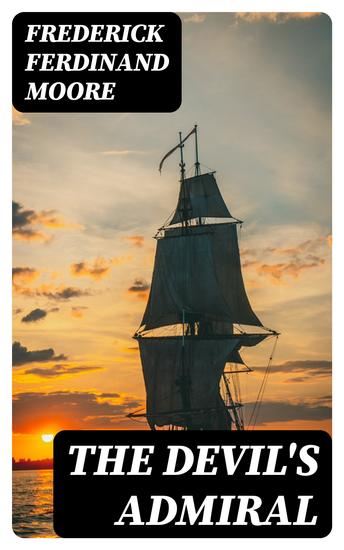
The Devil's Admiral - cover

The Devil's Admiral

Frederick Ferdinand Moore

Publisher: DigiCat

  • 0
  • 0
  • 0

Summary

In "The Devil's Admiral," Frederick Ferdinand Moore presents a gripping narrative that explores the complexities of naval warfare and human ambition with a lyrical, yet stark prose style. Set against the backdrop of early 20th-century maritime conflict, the novel delves into the psychological depths of its characters, particularly focusing on a conflicted admiral whose moral compass is tested by his relentless pursuit of victory. The rich detail and vivid descriptions reflect Moore's keen understanding of the intricacies of life at sea, while also commenting on broader themes such as loyalty, betrayal, and the cost of ambition, situating the work within the literary context of war literature that interrogates the intersection of personal and national identity. Frederick Ferdinand Moore, an accomplished author and veteran, drew heavily from his life experiences at sea, as well as his historical knowledge of naval strategy, to craft this potent narrative. His unique perspective on the ambitions and ethical dilemmas faced by military officers informs the authenticity of the characters and their motivations, making the story resonate on both an emotional and intellectual level. Moore's background and personal reflections enrich the text, offering readers an authentic glimpse into the life of those who navigate both the waters and the turbulent currents of duty and desire. "The Devil's Admiral" is a must-read for those intrigued by historical fiction and naval warfare, as well as anyone seeking a profound exploration of the human condition amid the trials of leadership. With its potent themes and eloquent prose, this novel invites readers to reflect on the moral ambiguities of ambition and the often-chaotic dance between personal ethics and professional demands, making it a compelling addition to any literary collection.
Available since: 10/11/2022.
Print length: 170 pages.
Other books that might interest you

  • The Signal - From their pens to your ears genius in every story - cover

    The Signal - From their pens to...

    Vsevolod Garshin

    • 0
    • 0
    • 0
    Vsevolod Mikhailovich Garshin was born on 14th February 1855 in what is now Dnipro in the Ukraine, but then part of the Russian Empire. 
    After attending secondary school he studied at the Saint Petersburg Mining Institute.  
    Wars between and on behalf of Empires were a regular feature of the decades then.  Garshin volunteered to serve in the Russian army at the beginning of the Russo-Turkish War in 1877.  
    He began as a private in the Balkans campaign and was wounded in action.  By the end of the war, in 1878, he had been promoted to officer rank.  
    By now Garshin, having previously published some articles and reviews in newspapers, wished to devote himself to a literary career.  The decision made he resigned his army commission. 
    His time as a soldier provided rich experiences for his early stories. His first ‘Four Days’ was related as the interior monologue of a wounded soldier left for dead on the battlefield for four days, face to face with the corpse of a Turkish soldier he had killed, gained him early admiration as an author of note.  
    He wrote perhaps only 20 stories, but their influence was immense, although in these more modern times he is barely remembered and lives in the more prolific shadows of others.  His characters are superbly worked into stories that come alive in the intensity and reality of his prose.   
    Garshin’s most well-known story is ‘The Red Flower’, also known as ‘Scarlet Blossom’ and is easily amongst the first rank of stories dealing with mental health issues.  
    Despite early literary success, he himself experienced periodical bouts of mental illness.   
    In one such bout Garshin attempted to commit suicide by throwing himself down the stone stairs leading into his apartment building.  Although not immediately fatal, Vsevolod Garshin died as a result of his injuries in a St Petersburg hospital on 5th April 1888.  He was 33.
    Show book
  • Sentiment Inc - cover

    Sentiment Inc

    Poul Anderson

    • 0
    • 0
    • 0
    In Sentiment, Inc., Poul Anderson masterfully blends science fiction and psychological intrigue. The story follows a young physicist who stumbles upon a mysterious company claiming to control human emotions. As he investigates, he uncovers a web of manipulation, ethical dilemmas, and unforeseen consequences. What starts as a scientific curiosity soon becomes a fight for free will. Anderson's sharp storytelling and thought-provoking themes explore the boundaries of science and morality. This gripping tale challenges the reader to consider: if emotions could be controlled, who would truly be in charge? A must-listen for fans of classic sci-fi and speculative fiction.
    Show book
  • Code Red - Dark Tales in Tech Vol 1 - cover

    Code Red - Dark Tales in Tech Vol 1

    Thomas Murosky

    • 0
    • 0
    • 0
    Henry David Thoreau warned us that our improved technology merely gives us an improved means to a deteriorating end. Our technology can be an excellent means to time saving and improving outcomes, but we must consider the downsides created by our own biases. In Code Red, Thomas examines several emerging technologies and policies driving technological advances. He peers into vehicular tracking technology, digital payments and currencies, and the proliferation of artificial intelligence in aspects of our life. How can such technologies be a harm to society? Code Red examines this question with a series of short stories warning us about blindly embracing technology.
    Show book
  • The Return - cover

    The Return

    Roberto Bolaño

    • 0
    • 0
    • 0
    “One of the most respected and influential writers of [his] generation.” —John Banville, The Nation“A genius . . . Bolaño had the courage to look at the world anew.” —Ilan Stavans, The Washington PostComposed of thirteen indelible stories, Roberto Bolaño’s The Return is preoccupied with ghosts: troubled souls haunting society’s margins, lovers lost to the ages, young men who no longer recognize themselves in the mirror, fresh corpses afforded no peace, departed poets who visit us in dreams. These tales capture the extremes of human experience—sex, violence, death—and the mundane acts that linger in between, with Bolaño’s inimitable mordant humor and trenchant insight into what drives us. A master of the short form, Bolaño is as interested in the act of storytelling as he is in the stories themselves: how they nestle within one another; how they shift, spread, and scatter; and how they return to us again and again.A Macmillan Audio production from Farrar, Straus and Giroux.
    Show book
  • Another Freak - From their pens to your ears genius in every story - cover

    Another Freak - From their pens...

    Mary Angela Dickens

    • 0
    • 0
    • 0
    The bookshelves of British literature are incredible collections that have gathered together centuries of very talented authors.  From these Isles their fame spread and whilst among their number many are now forgotten or neglected their talents endure.  Among them is Mary Angela Dickens.
    Show book
  • Vanka - From their pens to your ears genius in every story - cover

    Vanka - From their pens to your...

    Anton Chekhov

    • 0
    • 0
    • 0
    Anton Pavlovich Chekhov was born on 29th January 1860 in Taganrog, on the south coast of Russia.  
    His family life was difficult; his father was strict and over-bearing but his mother was a passionate story-teller, a subject Chekhov warmed to. As he later said; ‘our talents we got from our father, but our soul from our mother’.  
    At school Chekhov was distinctly average. At 16 his father mis-managed his finances and was declared bankrupt. His family fled to Moscow. Chekhov remained and eked out a living by various means, including writing and selling short sketches to newspapers, to finish his schooling. That completed and with a scholarship to Moscow University obtained he rejoined his family. 
    He was able to help support them by selling satirical sketches and vignettes of Russian lifestyles and gradually obtained further commissions. In 1884, he qualified as a physician and, although it earned him little, he often treated the poor for free, he was fond of saying ‘Medicine is my lawful wife, and literature is my mistress.’ 
    His own health was now an issue as he began to cough up blood, a symptom of tuberculosis.  Despite this his writing success enabled him to move the family into more comfortable accommodation.  
    Chekhov wrote over 500 short stories which included many, many classics including ‘The Kiss’ and ‘The Lady with a Dog’.  His collection ‘At Dusk’ won him the coveted Pushkin Prize when was only 26.  
    He was also a major playwright beginning with the huge success of ‘Ivanov’ in 1887.   
    In 1892 Chekhov bought a country estate north of Moscow. Here his medical skills and money helped the peasants tackle outbreaks of cholera and bouts of famine. He also built three schools, a fire station and a clinic.  It left him with less time for writing but the interactions with real people gained him detailed knowledge about the peasantry and their living conditions for his stories.  
    His most famous work, ‘The Seagull’ was received disastrously at its premiere in St Petersburg. It was later restaged in Moscow to highlight its psychological aspects and was a huge success. It led to ‘Uncle Vanya’, ‘The Three Sisters’ and ‘The Cherry Orchard’.  
    Chekhov suffered a major lung hemorrhage in 1897 while visiting Moscow. A formal diagnosis confirmed tuberculosis and the doctors ordered changes to his lifestyle.  
    Despite a dread of weddings the elusive literary bachelor quietly married the actress Olga Knipper, whom he had met at rehearsals for ‘The Seagull’, on 25th May 1901. 
    By May 1904 with his tuberculosis worsening and death imminent he set off for the German town of Badenweiler writing cheerful, witty letters to his family and assuring them his health was improving.  
    On 15th July 1904 Anton Chekhov died at Badenweiler.  He was 44.
    Show book