

Join us on a literary world trip!
Add this book to bookshelf
Grey
Write a new comment Default profile 50px
Grey
Subscribe to read the full book or read the first pages for free!
All characters reduced
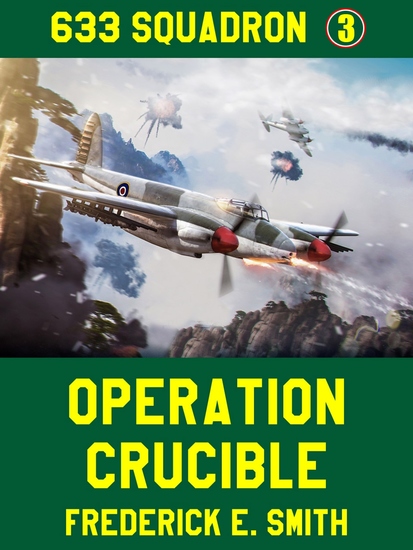
Operation Crucible - cover

Operation Crucible

Frederick E. Smith

Publisher: Thunderchild Publishing

  • 0
  • 0
  • 0

Summary

Autumn 1943: An angry American press has blamed the RAF for heavy U.S. B-17 losses over Europe. To restore confidence, joint Allied operations are planned by RAF and 8th Air Force top brass. 633 Squadron, whose Rhine Maiden mission success has won them a glorious reputation, is called in to launch Operation Crucible. It is to be a Dieppe-style landing by the Americans, supported by the aces of 633 Squadron. Their hazardous role: to give ground support to troops against overwhelming firepower and totally unforeseen odds...
 
Frederick E. Smith (1919-2012) joined the R.A.F. in 1939 as a wireless operator/air gunner and commenced service in early 1940, serving in Britain, Africa and finally the Far East. At the end of the war, he married and worked for several years in South Africa before returning to England to fulfill his lifelong ambition to write. Two years later, his first play was produced and his first novel published. Since then, he wrote over forty novels, about eighty short stories and two plays. Two novels, 633 Squadron and The Devil Doll, were made into films and one, A Killing for the Hawks, won the Mark Twain Literary Award.
Available since: 07/09/2024.
Print length: 202 pages.


Other books that might interest you

  • Sulla and Gaius Marius: The Lives and Legacies of the Leaders Who Fought Rome’s First Civil War - cover

    Sulla and Gaius Marius: The...

    Editors Charles River

    • 0
    • 0
    • 0
    Caesar is still remembered for winning a civil war and helping bring about the end of the Roman Republic, leaving a line of emperors in its place, but it’s quite possible that none of what Caesar did would’ve happened without the template for such actions being set 40 years earlier. At the time, when Caesar was in his teens, war was being waged both on the Italian peninsula and abroad, with domestic politics pitting the conservative, aristocratic optimates against the populist, reformist populares, and this tension ultimately escalated into an all-out war. One of the leading populares was Caesar’s uncle, Gaius Marius, a military visionary who had restructured the legions and extended the privileges of land ownership and citizenship to legionaries on condition of successful completion of a fixed term of service. In the late 2nd century BCE, Marius had waged a successful campaign against several Germanic tribes, and after earning eternal fame in the Eternal City, Marius was appointed a consul several times. In 88 BCE, he entered into conflict with his erstwhile protégé, the optimate Sulla, over command of the army to be dispatched against Mithridates VI of Pontus, a long-time enemy of Rome and its Greek allies.   
    	Ironically, Marius’s reforms had made the legions fiercely loyal to their individual generals rather than the state, which allowed Sulla to march his army against Rome and force Marius into exile. With that, Rome’s first civil war was officially underway, but Sulla’s triumph proved short-lived. Just as Sulla departed for a campaign, Marius returned at the head of a scratch army of veterans and mercenaries, taking over the city and purging it of Sulla’s optimate supporters, and though Marius died in 86 BCE, his party remained in power. 
    Show book
  • Writing Your Dissertation in Fifteen Minutes a Day - A Guide to Starting Revising and Finishing Your Doctoral Thesis - cover

    Writing Your Dissertation in...

    EdD Joan Bolker

    • 0
    • 0
    • 0
    Expert writing advice from the editor of the Boston Globe bestseller, The Writer's Home Companion 


    Dissertation writers need strong, practical advice, as well as someone to assure them that their struggles aren't unique. Joan Bolker, midwife to more than one hundred dissertations and cofounder of the Harvard Writing Center, offers invaluable suggestions for the graduate-student writer. Using positive reinforcement, she begins by reminding thesis writers that being able to devote themselves to a project that truly interests them can be a pleasurable adventure. She encourages them to pay close attention to their writing method in order to discover their individual work strategies that promote productivity; to stop feeling fearful that they may disappoint their advisors or family members; and to tailor their theses to their own writing style and personality needs. Using field-tested strategies she assists the student through the entire thesis-writing process, offering advice on choosing a topic and an advisor, on disciplining one's self to work at least fifteen minutes each day; setting short-term deadlines, on revising and defing the thesis, and on life and publication after the dissertation. Bolker makes writing the dissertation an enjoyable challenge.
    Show book
  • Letters from a Father to His Daughter - cover

    Letters from a Father to His...

    jawaharlal Nehru

    • 0
    • 0
    • 0
    Letters from a Father to His Daughter is a collection of letters written by the former Prime Minister of Inidia, Jawaharlal Nehru, to his daughter, Indira Gandhi, during the period when he was imprisoned. Heartfelt and moving, Nehru imparts knowledge on various subjects to young Indira, who was around 10 years old at the time.
    The letters cover everything from history and science to philosophy and the natural world. Nehru introduces Indira to the great figures of history, including ancient civilizations and leaders from various cultures, and explains the concepts of freedom, justice, and democracy. He also shares his love for nature, describing the beauty of the world around him, and encourages Indira to think critically, ask questions, and embrace learning.
    Show book
  • Writing an Identity Not Your Own - A Guide for Creative Writers - cover

    Writing an Identity Not Your Own...

    Alex Temblador

    • 0
    • 0
    • 0
    A practical guide to help authors authentically write and edit a character whose identity is different than their own. Do you have the tools to authentically write and edit a character whose identity is different than your own? It’s not a subject that’s generally taught in creative writing programs, and there are so few craft books and online resources on the subject. Even if you can take a seminar, class, or workshop, there’s nothing like having an easy-to-understand book on hand to provide guidance and insight every time you craft characters with historically marginalized identities. In Writing an Identity Not Your Own, award-winning author Alex Temblador discusses one of the most contentious topics in creative writing: crafting a character whose identity is historically marginalized. What is “identity,” and how do unconscious biases and bias blocks impact and influence what we write? What is intersectionality? You’ll learn about identity terms, stereotypes, and tropes, and receive genre-specific advice related to various identities to consider when writing different races and ethnicities, sexual and romantic orientations, gender identities, disabilities, nationalities, and more. Through writing strategies, exercises, and literary excerpts, writers will gain a clearer understanding on how misrepresentations and harmful portrayals can appear in storylines, dialogue, and characterization. Alex will guide writers from the brainstorming phase through the editing process so they can gain a full understanding of the complexities of writing other identities and why it’s important to get them right.
    Show book
  • Tuskegee Airmen and Montford Point Marines The: The History of the Men Who Broke the Color Barrier in the US Army Air Forces and Marine Corps - cover

    Tuskegee Airmen and Montford...

    Charles River Editors

    • 0
    • 0
    • 0
    The United States has no shortage of famous military units, from the Civil War’s Iron Brigade to the 101st Airborne, but one would be hard pressed to find one that had to go through as many hardships off the field as the Tuskegee Airmen, a group of African American fighter pilots who overcame Jim Crow at home and official segregation in the military to serve their country in the final years of World War II. In fact, it required a concerted effort by groups such as the National Association for the Advancement of Colored People (NAACP) and the extreme circumstances brought about by World War II that the military eventually decided to establish the “Tuskegee Experiment.” 
    The black crews trained at Tuskegee before being sent overseas, and even then, they faced discrimination from those who didn’t trust them to do more than escort bombers flown by white pilots. However, as the men proved their worth in the heat of battle, some of the squadrons’ red markings helped them earn the nickname “Red Tails,” and their track record was so good that eventually the white pilots of American bombers wanted to fly with them. As Tuskegee airman Roscoe Brown eloquently put it, “They have a saying that excellence is the antidote to prejudice; so, once you show you can do it, some of the barriers will come down.” 
    In the summer of 1942, the first group of African American recruits stepped off a bus into the pine woods of North Carolina, bound for an experiment the Marine Corps had long vowed never to attempt. Their destination - Montford Point, a hastily constructed satellite to the new Camp Lejeune - was more than a training ground. It was a compromise with democracy, a segregated doorway into an institution that had defined itself for generations by who could not enter. The Corps’ exclusivity had a racial edge, as the Marines had barred black men outright from 1798 all the way up the start of the Second World War. 
    Show book
  • Restoring Eden - Unearthing the Agribusiness Secret That Poisoned My Farming Community - cover

    Restoring Eden - Unearthing the...

    Elizabeth D. Hilborn

    • 0
    • 0
    • 0
    All spring, Dr. Elizabeth Hilborn watched as her family fruit farm of many years became increasingly diminished, suffering from a lack of bees. 


    The plentiful wildlife, so abundant just weeks before, was gone. Everything was still, silent. 


    As an environmental scientist trained to investigate disease outbreaks, she rose to the challenge. Despite facing headwinds from skeptical neighbors, environmental experts, and agricultural consultants, she'd assembled information. 


    The chemicals found in her water samples showed beyond any doubt that not only her farm, but her greater farming community, was at risk from toxic chemicals that traveled with rain water over the land and deep within the soil. 


    Even as a scientist, she'd been unaware of the risks to life from some common agricultural chemicals. Her goal was to protect her farm and the animals who lived there. 


    But first she had to convince her rural neighbors of the risk to their way of life, too. 


    A lyrical celebration of nature by a passionate citizen scientist who felt called to advocate for the land, earth, and creatures who don't have a voice, Restoring Eden ultimately offers hope that citizens can create change, that reform is possible.
    Show book
