Join us on a literary world trip!
Add this book to bookshelf
Grey
Write a new comment Default profile 50px
Grey
Subscribe to read the full book or read the first pages for free!
All characters reduced
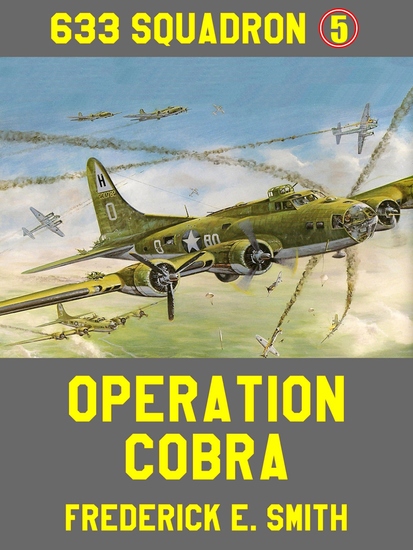
Operation Cobra - cover

Operation Cobra

Frederick E. Smith

Publisher: Thunderchild Publishing

  • 0
  • 0
  • 0

Summary

Spring 1944: In a fortified chateau hidden deep in the valleys of France, the Nazis are in the final stages of developing a terrifyingly deadly new weapon. Success would mean sure destruction for much of England and would dash all Allied hopes for a Normandy invasion. It’s up to the daring fighter pilots and crack navigators of the 633 Squadron to penetrate German defenses and, in the black of night, blast the doomsday project into extinction. Against incredible odds, this is the 633’s Operation Cobra...failure could forever alter the future of the free world.
 
Frederick E. Smith (1919-2012) joined the R.A.F. in 1939 as a wireless operator/air gunner and commenced service in early 1940, serving in Britain, Africa and finally the Far East. At the end of the war, he married and worked for several years in South Africa before returning to England to fulfill his lifelong ambition to write. Two years later, his first play was produced and his first novel published. Since then, he wrote over forty novels, about eighty short stories and two plays. Two novels, 633 Squadron and The Devil Doll, were made into films and one, A Killing for the Hawks, won the Mark Twain Literary Award.
Available since: 07/09/2024.
Print length: 262 pages.

Other books that might interest you

  • The Great Liquor War - cover

    The Great Liquor War

    David M. McGowan

    • 0
    • 0
    • 0
    Ex-Gold Miner Caught in Power Struggle in Exciting Western 
      
    In the 1880s, gold miners flooded the West trying to make their fortune. A few actually made a living. Realizing that the life of a miner isn’t as rewarding or romantic as he expected, Hank James is ready to quit panning for gold in British Columbia and look for other opportunities. 
      
    When he hears a prizefight will be fought in town, he attends, and with the help of the fight referee, wins big betting on the bout. At the urging of that same referee who is also a British Columbia Provincial Police constable, Hank takes his winnings and heads for a new job, hauling freight with pack horses for contractors building the transcontinental railroad. 
    Having entered BC, those supplying security for railroad construction, the North West Mounted Police are now at odds with the local authority, the BC Provincial Police As two opposing factions of the police fight for control of the project, including sales of liquor, Hank tries to steer clear of their turf war. 
      
    While the police are fighting their own battles, no one is looking for the real crooks, particularly those stealing Hank’s horses. Does he need to take the law into his own hands? This action-packed Western really delivers. 
      
    “I’ve never had so much fun reading history” ….. T. Morden 
    “The Great Liquor War is a wake-up call for the senses. Forget trying to live in the moment … you’’ be there.” ….. G. Wandling
    Show book
  • Deployment - cover

    Deployment

    Wilfred Zinavage

    • 0
    • 0
    • 0
    The Navy would not allow this book to be printed unless certain changes were made and I had to call it a work of fiction. The time is 1960; the setting; the Mediterranean Sea, a hotbed of the so called Cold War. that was getting even worst in its intensity. It follows the adventures of a crew that flew on board the Navy's first nuclear bomber the P2V-7 Neptune Patrol Bomber. It gives you, the reader, a behind the scenes look at the anti-submarine intelligence gathering, surveillance, and exercises from the perspective of one crew. To this day some of the events never happened and some of the systems used were later banned by the United Nations. There was a 70 million candlepower searchlight as well as the Julie system which was mentioned. With its earthy humor, Deployment gives an idea of their cool bravery as well as revealing some of the events that did occur were mentioned. Times, dates and locations were purposely kept out.
    Show book
  • Anvil of God - Book One of the Carolingian Chronicles - cover

    Anvil of God - Book One of the...

    J. Boyce Gleason

    • 0
    • 0
    • 0
    It is 741. Only one thing stands between Charles Martel and the throne - he is dying. He cobbles together a plan to divide the kingdom among his three sons, betroth his daughter to a Lombard prince to secure his southern border, and keep the Church unified behind them through his friend Bishop Boniface. Despite his best efforts, the only thing to reign after Charles's death is chaos. Son battles son, Christianity battles paganism, and Charles's daughter flees his court for an enemy's love. Based on a true story, Anvil of God is a whirlwind of love, honor, sacrifice, and betrayal that follows a bereaved family's relentless quest for power and destiny.
    Show book
  • Love Partitioned - cover

    Love Partitioned

    Manjula Waldron

    • 0
    • 0
    • 0
    Set during India’s Independence struggles leading to the Partition of India and Pakistan, this compelling novel tells the inspiring story of Mangla, her interactions with her mother Ammaji, her best friend Basanthi, and her husband Anand as they navigate their own conflicts of religion, sexuality, social privilege. 
    Raised on Gandhi ideals of peace and unity, Mangla strives to become the social change in women's education, advancement, and social freedom she wishes to see, allowing her daughter Mina to dream of a better future for herself and other Indian children. 
    Mangla’s personal triumph over betrayal, loss, and incredible odds is sure to instill hope and compassion in readers both young and old. 
    Love Partitioned is informed by the author’s own historical journey as a refugee during this turbulent time in India.
    Show book
  • The Confusions of Young Master Törless - cover

    The Confusions of Young Master...

    Robert Musil

    • 0
    • 0
    • 0
    Robert Musil (1880-1942) is best known for his enduring masterpiece The Man Without Qualities, one of the great European works of the 20th century. It was with The Confusions of Young Master Törless first published in 1906, a challenging but very different work, that he signalled his extraordinary talent. As the nineteenth century draws to an end, young Torless is sent to a military boarding school for the sons of the nobility on the eastern outreaches of the Austro-Hungarian Empire. Far from his comfortable, free-thinking bourgeois home and left to his own devices, he experiences the joy, pain and self-doubt of adolescence. He is confronted with desire and love, but also his own cruelty, as he finds himself participating in his fellow pupils' bullying campaigns. A dark Bildungsroman which shocked its readership at the time, Robert Musil's first novel is a fresco of psychoanalysis, philosophy, eroticism, snobbery, sado-masochism and schoolboy humour, a hothouse of alternately repressed and unchained desires that prefigure the carnage of both World Wars.
    Show book
  • Forgotten Authors The - Men - Volume 4 - W G Kelly to William Mudford - cover

    Forgotten Authors The - Men -...

    William Hauff

    • 0
    • 0
    • 0
    Throughout the long centuries of human history is the want, and the need, to share information, to exchange ideas and for that knowledge and experience, for curiosity and learning, to be the basis of a civil society. 
    In literature the ambition is much narrower.  In order to be known, to be popular, you had to be published.  And for that people had to know you existed and your ideas worth reading.  Obviously for most of humanity’s time people couldn’t read and texts couldn’t be published in any great number. 
    In the 15th Century Gutenberg’s printing press began the revolution to address the second and by the 19th century had gathered pace with startling speed and mass distribution.  Education for the many was brought in to help people understand more of their world and, with new skills, how to have a better place within it.  Now, if the powers that owned the presses and means of distribution agreed an audience would now be able to avail themselves of your ideas, your printed words.  
    Sadly, in the thirst for the new, the recent and the past fell from sight, relegated to dark corners and dusty shelves.   
    But the printed word is rarely without someone, somewhere busying themselves through piles of papers and books rediscovering what a good story is, whatever its age. 
    In this volume we offer up a small selection of those talents whose time has now come again.
    Show book