Join us on a literary world trip!
Add this book to bookshelf
Grey
Write a new comment Default profile 50px
Grey
Subscribe to read the full book or read the first pages for free!
All characters reduced
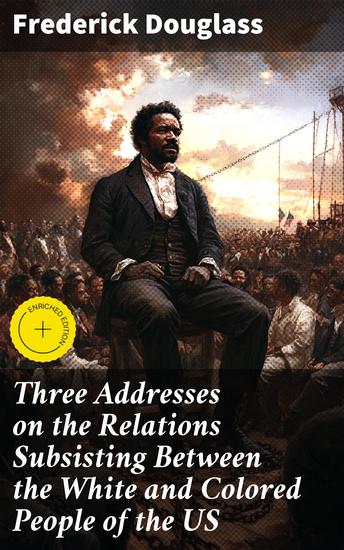
Three Addresses on the Relations Subsisting Between the White and Colored People of the US - Unveiling the Struggle for Equality: Insights on Race Relations in America - cover

Three Addresses on the Relations Subsisting Between the White and Colored People of the US - Unveiling the Struggle for Equality: Insights on Race Relations in America

Frederick Douglass

Publisher: Good Press

  • 0
  • 0
  • 0

Summary

In "Three Addresses on the Relations Subsisting Between the White and Colored People of the US," Frederick Douglass presents a profound exploration of race relations in 19th-century America. Through a series of eloquent and impassioned orations, Douglass employs a rhetorical style that is both incisive and accessible, adeptly blending logic with emotive appeals to engage with diverse audiences. This critical work situates itself in the broader context of antebellum abolitionist discourse, challenging both white complicity in systemic racism and the social structures that perpetuate inequality. Frederick Douglass, a former enslaved person who became a leading intellectual and activist, draws from his life experiences to advocate for justice and equality. His remarkable journey from bondage to becoming one of the most prominent voices against slavery informs his examination of social injustices. Douglass'Äôs multifaceted identity as an orator, writer, and statesman provides a rich backdrop to his arguments, highlighting his commitment to the principles of freedom and human dignity. This book is essential reading for those who seek to understand the historical foundations of race relations in the United States. Douglass's addresses resonate with contemporary discussions on race and social justice, making this work not only a vital historical document but also a timeless call to action for equality and understanding.
Available since: 08/21/2022.
Print length: 71 pages.

Other books that might interest you

  • How to Teach a Baby to Fall Asleep Alone - Baby Sleep Training - cover

    How to Teach a Baby to Fall...

    Susan Urban

    • 0
    • 0
    • 0
    This book is the answer to any infant sleep problems. If you want your baby to nap longer, or don’t know how to stop rocking, or you’re looking for full sleep training program - Hold With Love from „How to teach a baby to fall asleep alone” is the only method you need! It is smooth and fast approach showing how to teach your baby to fall sleep alone. Remarkably gentle for the baby and easy to follow for the parent. Thanks to the step-by-step narration, this method for teaching baby self-soothing is so easy, you will undoubtedly succeed. 
    WHY DO YOU NEED THIS BOOK? 
    Whether you are expecting a baby or already have a baby unable to self-sooth - this sleep training will help you. 
    Are you looking for help? Would you like to find a cheap alternative for a sleep consultant? Here it is! 
    WHAT WILL YOU LEARN? 
    With HWL method you can resolve most of the baby sleeping issues, like: 
    - Inability to self-soothe 
    - Early morning wake ups 
    - Waking during the night 
    - Taking too short naps 
    - Refusing to nap 
    After reading just over a dozen pages, you will finally know how to: 
    - Establish or extend before-bedtime routine 
    - Teach a baby to self-soothe 
    - Prevent middle-night waking 
    - Extend the nap time 
    - Transition your baby to a crib 
    WHAT AGE IS THIS FOR? 
    Tips you get in the guide are useful from week 1 to sleep training a toddler. 
    There are two parts of the book: solutions suitable form age 0 to 3 months and the main training program that you can apply at any age, starting from month 4. 
    Get your copy now, make your child a sleep champion in few days and enjoy slept-through nights again.
    Show book
  • Summary: Forgiving What You Can't Forget - Discover How to Move On Make Peace with Painful Memories and Create a Life That's Beautiful Again by Lysa TerKeurst: Key Takeaways Summary & Analysis Included - cover

    Summary: Forgiving What You...

    Brooks Bryant

    • 0
    • 0
    • 0
    Disclaimer: This is not the official book, but a summary & it does not accompany the official. 
    Struggling with the shackles of unforgiveness? Discover healing with our incisive summary of Lysa TerKeurst's 'Forgiving What You Can't Forget.' Dive into a transformative guide that explores the intricate pathway toward forgiveness, even when it seems unfathomable. 
    TerKeurst provides you with practical tools and spiritual wisdom, but our summary distills her groundbreaking methods into digestible insights that you can apply today. Find out how to liberate yourself from the torment of resentment and let go of the grudges that hold you back. 
    Is it possible to forgive when your heart screams 'never'? Is there a way to move on without giving up your right to justice? Our summary answers these questions and more, setting you on a journey toward peace and emotional freedom. 
    If you're ready to step out of the past and into a future defined by joy and freedom, this is your go-to guide. Unlock the strength of forgiveness and reclaim your well-being now
    Show book
  • Environmental Justice - A Very Short Introduction - cover

    Environmental Justice - A Very...

    Pamela Hill

    • 0
    • 0
    • 0
    Environmental justice recognizes that environmental benefits and burdens should be distributed fairly, and that the people making policy decisions should incorporate the views of those most often harmed: people of color, Indigenous populations, low-income communities, and those who are underserved and disenfranchised for other reasons such as age, gender, or disability. It encompasses not only traditional environmental issues like clean air and clean water, but also social issues such as employment, nutrition, and access to health care. Although environmental justice is a relatively recent concept, it has become a focus of governmental environmental policy, UN actions, and the activities of many nongovernmental environmental organizations. Its development tracks our growing understanding of racism and wealth disparity in the United States and elsewhere, and of our understanding of inequality between the Global North and the Global South. In the era of climate change, climate justice is a particular focus.Environmental Justice: A Very Short Introduction defines the concept, identifies specific environmental justice populations, examines root causes, including racism, capitalism, and colonialism, and traces the history of the environmental justice movement and governmental responses to it. It concludes with suggestions for achieving this elusive goal.
    Show book
  • Communist Manifesto The: 1888 Translated Edition (The Political Classic of Karl Marx And Friedrich Engels) - cover

    Communist Manifesto The: 1888...

    Karl Marx, Friedrich Engels,...

    • 0
    • 0
    • 0
    The Communist Manifesto, written by Karl Marx and Friedrich Engels and translated into English by Samuel Moore in 1888 under Engels’ supervision, is one of the most influential political texts in modern history. Originally published in 1848, this concise manifesto lays out the principles of communism, the theory of historical materialism, and the role of class struggle as the driving force of history. Marx and Engels call for the working class to unite against capitalist oppression and envision a future society free from class divisions. Samuel Moore’s translation, authorized and edited by Engels himself, has become the standard English version, preserving the clarity and force of the original German text.
    Show book
  • Communism VS Capitalism - A Comparative Analysis of Two Economic Systems - cover

    Communism VS Capitalism - A...

    Arlo Holders

    • 0
    • 0
    • 0
    An economic system refers to the structure and methods a society uses to produce, distribute, and consume goods and services. It defines how resources are allocated, how wealth is distributed, and how economic decisions are made. Different societies have developed various economic systems over time, influenced by their unique historical, cultural, and political contexts. Among these systems, capitalism and communism are two of the most prominent and contrasting economic ideologies that have shaped the global landscape. 
    Capitalism is an economic system that operates on the principles of private ownership and free markets. In capitalism, individuals or businesses own the means of production and are free to make decisions regarding what to produce, how to produce it, and at what price to sell it. The market is driven by competition, and prices are determined by supply and demand. Profit motives incentivize innovation and efficiency, leading to economic growth and technological advancements. However, capitalism can also lead to inequality, as wealth tends to be concentrated among those who own the most resources, while others may struggle to access basic necessities. While the role of government in capitalism is typically limited, debates about regulation, social welfare, and economic justice persist. 
    In contrast, communism is an economic system grounded in collective ownership and centralized control. In a communist society, the means of production are owned by the state or collectively by the people, and wealth is distributed based on need rather than profit. Communism seeks to eliminate class distinctions, advocating for equality and fairness in wealth and resource distribution. The government plays a central role in planning and directing economic activities, including determining production levels and distribution of goods.
    Show book
  • The Talking Draft Method - Hollywood’s Secret for a Fast First Draft - cover

    The Talking Draft Method -...

    Frederick Gooltz

    • 0
    • 0
    • 0
    The Talking Draft Method is the fastest way for playwrights and screenwriters to create scenes. A writer records audio of themselves improvising the dialogue and the action lines, the audio is transcribed, then the text is reformatted into a script. This is not new, as the book reveals, it is actually one of old Hollywood's best-kept secrets. 
    Today it can be done instantly and for free. This practical guide shows exactly how to use The Talking Draft Method for a fast first draft of your script. This book also contains many of Hollywood's most popular outlining structures, plus great revision tricks of the trade to ensure that your next drafts are as great as they can be. 
    The Talking Draft Method is also the best way to achieve a creative flow state while writing. This book contains some of the latest findings about flow state neuroscience and provides helpful steps to harness the peak performance of the flow state as a writer while using the Talking Draft Method. 
    Inside This Practical Guide to The Talking Draft Method:how to achieve a creative flow stateovercome common first draft trapspopular screenplay structurescommon beat sheet examplesproven techniques for revisionsthe screenwriter's "notes" decodernever fear a blank page againthe history of the methodtips for aspiring writers
    Show book