Join us on a literary world trip!
Add this book to bookshelf
Grey
Write a new comment Default profile 50px
Grey
Subscribe to read the full book or read the first pages for free!
All characters reduced
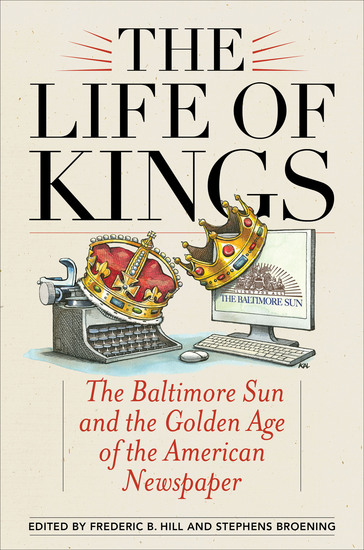
The Life of Kings - The Baltimore Sun and the Golden Age of the American Newspaper - cover

The Life of Kings - The Baltimore Sun and the Golden Age of the American Newspaper

Frederic B Hill, Stephens Broening

Publisher: Stackpole Books

  • 0
  • 0
  • 0

Summary

In an age when local daily papers with formerly robust reporting are cutting sections and even closing their doors, the contributors to The Life of Kings celebrate the heyday of one such paper, the Baltimore Sun, when it set the agenda for Baltimore, was a force in Washington, and extended its reach around the globe. Contributors like David Simon, creator of HBO’s The Wire, and renowned political cartoonist Kevin Kallaugher (better known as KAL), tell what it was like to work in what may have been the last golden age of American newspapers -- when journalism still seemed like “the life of kings” that H.L. Mencken so cheerfully remembered. The writers in this volume recall the standards that made the Sun and other fine independent newspapers a bulwark of civic life for so long. Their contributions affirm that the core principles they followed are no less imperative for the new forms of journalism: a strong sense of the public interest in whose name they were acting, a reverence for accuracy, and an obligation
Available since: 06/14/2023.
Print length: 322 pages.
Other books that might interest you

  • The Upstairs Delicatessen - On Eating Reading Reading About Eating and Eating While Reading - cover

    The Upstairs Delicatessen - On...

    Dwight Garner

    • 0
    • 0
    • 0
    Reading and eating, like Krazy and Ignatz, Sturm und Drang, prosciutto and melon, Simon and Schuster, and radishes and butter, have always, for me, simply gone together. The book is a product of these combined gluttonies. 


    Dwight Garner, the beloved New York Times critic and the author of Garner's Quotations, serves up the intertwined pleasures of books and food. The product of a lifetime of obsessively reading, eating, and every combination therein, The Upstairs Delicatessen: On Eating, Reading, Reading About Eating, and Eating While Reading is a charming, emotional memoir that only Garner could write. In it, he records the voices of great writers and the stories from his life that fill his mind as he moves through the sections of the day and of this book: breakfast, lunch, shopping, the occasional nap, drinking, and dinner. 


    Through his lifelong infatuation with these twin joys, we meet the man behind the pages and the plates, and a portrait of Garner, eager and insatiable, emerges. He writes with tenderness and humor about his mayonnaise-laden childhood in West Virginia and Naples, Florida (and his father's famous peanut butter and pickle sandwich), his mind-opening marriage to a chef from a foodie family, and the words and dishes closest to his heart. This is a book to be savored, though it may just whet your appetite for more.
    Show book
  • Hope Made A Way - cover

    Hope Made A Way

    Lucy Wanjiku Njenga

    • 0
    • 0
    • 0
    She walks the streets of New York and other countries like she walked the slums of Nairobi growing up. She knows the depths of poverty, the scars of abuse inflicted at a tender age, the trials of teenage motherhood, the unbearable loss of a child, and the agony of living with an abusive partner. As if it wasn't enough, she got diagnosed with a chronic condition all before she was 21 years old.  But now, she stands tall as a beacon of resilience and triumph. Leading a successful community-based organization, serving on influential boards, and speaking alongside renowned figures in global health. Her  dedication being to empower girls and women across Africa.This inspiring memoir offers solace, comfort and a path forward. It reminds us all that no matter where we come from or how dire our circumstances may be, hope has the power to guide us through the darkest of times. Brace yourself for a remarkable story that will captivate your heart, uplift your spirit, and leave you yearning for more
    Show book
  • Poor Folk - A Heartfelt Story of Love Poverty and Human Struggle - cover

    Poor Folk - A Heartfelt Story of...

    Fyodor Dostoevsky, Tim Zengerink

    • 0
    • 0
    • 0
    What if love and dignity could survive even the harshest poverty? 
    In this emotionally charged epistolary novel, Poor Folk introduces us to two souls struggling with loneliness, hardship, and the quiet hope for human connection.  
    Makar Devushkin and Varvara Dobroselova—two distant relatives living in squalid conditions—exchange heartfelt letters that reveal their pain, their unspoken love, and their attempts to preserve dignity in the face of overwhelming poverty. 
    This modern translation brings new life to Dostoevsky’s first published novel, making its characters and themes resonate as powerfully today as they did in 1846. 
    What you'll discover inside: 
    - A Tender Story of Emotional Bonding – A touching portrayal of letter-bound love and friendship 
    - Early Dostoevsky at His Most Vulnerable – A glimpse into the emotional roots of his future genius 
    - Modern, Clear Narration – Accessible language that preserves the soul of Dostoevsky’s debut 
    - A Lens on Class and Compassion – A heartbreaking look at how the poor survive with grace and feeling 
    Dive into a story that speaks softly but pierces deeply—an unforgettable journey through the human heart.
    Show book
  • About Love - From their pens to your ears genius in every story - cover

    About Love - From their pens to...

    Anton Chekhov

    • 0
    • 0
    • 0
    Anton Pavlovich Chekhov was born on 29th January 1860 in Taganrog, on the south coast of Russia.  
    His family life was difficult; his father was strict and over-bearing but his mother was a passionate story-teller, a subject Chekhov warmed to. As he later said; ‘our talents we got from our father, but our soul from our mother’.  
    At school Chekhov was distinctly average. At 16 his father mis-managed his finances and was declared bankrupt. His family fled to Moscow. Chekhov remained and eked out a living by various means, including writing and selling short sketches to newspapers, to finish his schooling. That completed and with a scholarship to Moscow University obtained he rejoined his family. 
    He was able to help support them by selling satirical sketches and vignettes of Russian lifestyles and gradually obtained further commissions. In 1884, he qualified as a physician and, although it earned him little, he often treated the poor for free, he was fond of saying ‘Medicine is my lawful wife, and literature is my mistress.’ 
    His own health was now an issue as he began to cough up blood, a symptom of tuberculosis.  Despite this his writing success enabled him to move the family into more comfortable accommodation.  
    Chekhov wrote over 500 short stories which included many, many classics including ‘The Kiss’ and ‘The Lady with a Dog’.  His collection ‘At Dusk’ won him the coveted Pushkin Prize when was only 26.  
    He was also a major playwright beginning with the huge success of ‘Ivanov’ in 1887.   
    In 1892 Chekhov bought a country estate north of Moscow. Here his medical skills and money helped the peasants tackle outbreaks of cholera and bouts of famine. He also built three schools, a fire station and a clinic.  It left him with less time for writing but the interactions with real people gained him detailed knowledge about the peasantry and their living conditions for his stories.  
    His most famous work, ‘The Seagull’ was received disastrously at its premiere in St Petersburg. It was later restaged in Moscow to highlight its psychological aspects and was a huge success. It led to ‘Uncle Vanya’, ‘The Three Sisters’ and ‘The Cherry Orchard’.  
    Chekhov suffered a major lung hemorrhage in 1897 while visiting Moscow. A formal diagnosis confirmed tuberculosis and the doctors ordered changes to his lifestyle.  
    Despite a dread of weddings the elusive literary bachelor quietly married the actress Olga Knipper, whom he had met at rehearsals for ‘The Seagull’, on 25th May 1901. 
    By May 1904 with his tuberculosis worsening and death imminent he set off for the German town of Badenweiler writing cheerful, witty letters to his family and assuring them his health was improving.  
    On 15th July 1904 Anton Chekhov died at Badenweiler.  He was 44.
    Show book
  • Hank Williams Jr - A Country Music Legend - cover

    Hank Williams Jr - A Country...

    Newbury Publishing

    • 0
    • 0
    • 0
    Living in the shadow of a famous parent is never easy. But having to endure the legacy of a legend whose music and life transformed a nation is even harder. As if the unwanted attention from fans, reporters, and endless onlookers isn't enough, there is intense pressure of expectation to keep up the public image of the parent. Fortunately, there are a few examples of children of celebrities who dare to forge their own identities. While it is never easy and often takes a great deal of struggle and independent thinking, there are examples of success stories. One of the best examples is the life of Hank Williams, Jr. 
    The story of Hank Williams, Sr. is the tale of a tragic battle between drugs, alcohol, and infidelity. Unable to control his insecurities, Williams drank constantly, and his drunkenness impacted every relationship he had. Yet, the son's story is not the story of the father. While the life of Hank Williams, Jr. is a complex drama of struggle, resurrection, heartbreak, and success; it is a far cry from the self-destructive spiral of the legacy left to him by his father. Today, Hank Williams, Jr. is one of the most famous and admired entertainers of the century, far exceeding the sales and attention bestowed on his father. He has become a legend in his own right who continues to influence the landscape of country music in ways his famous father never could.
    Show book
  • The Greatest Band That Ever Wasn't - The Story Of The Roughest Toughest Most Hell-Raising Band To Ever Come Out Of The Pacific Northwest The Screaming Trees - cover

    The Greatest Band That Ever...

    Barrett Martin

    • 0
    • 0
    • 0
    In 1992, the Screaming Trees were expected to become the next big band to come out of the Seattle music scene during the heyday of grunge. Except it never happened. It wasn't because the band didn't have great songs-indeed, the Trees were revered for their ability to write a great song that was both artistically original and commercially viable, which is no easy task. Other Seattle bands like Nirvana, Pearl Jam, and Soundgarden were fans of the Screaming Trees, playing shows with them and collaborating on albums, long before their own bands broke through into the mainstream. That kind of success eluded the Screaming Trees, and it seemed as if there were more demons than angels in the band's corner when it came time for the Trees to make their mark. Their songwriting skills, however, remain as their greatest legacy.Written by Screaming Trees long-serving drummer, Barrett Martin, The Greatest Band That Ever Wasn't reads like a Greek comedy or tragedy, depending on your viewpoint. Each of the three acts contained in this book features 11 short stories, for a combined total of 33 stories. These tales will make you laugh and perhaps even cry, which is why the saga of the Screaming Trees reads more like a great myth-one that is incredible, at times unbelievable, yet still contains volumes of humor and wisdom.
    Show book