Join us on a literary world trip!
Add this book to bookshelf
Grey
Write a new comment Default profile 50px
Grey
Subscribe to read the full book or read the first pages for free!
All characters reduced
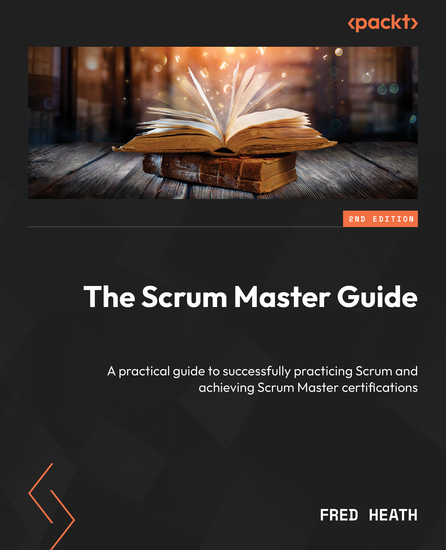
The Scrum Master Guide - A practical guide to successfully practicing Scrum and achieving Scrum Master certifications - cover

The Scrum Master Guide - A practical guide to successfully practicing Scrum and achieving Scrum Master certifications

Fred Heath

Publisher: Packt Publishing

  • 0
  • 0
  • 0

Summary

Curious why so many rely on Scrum and what makes Agile so effective? Learn from seasoned software engineer and Scrum expert Fred Heath, everything you need to become a certified Scrum Master. With over two decades of experience across the software development lifecycle, Fred brings invaluable insights from his extensive work in Scrum, both as a Scrum Master and developer. In this updated guide, he not only takes you from Scrum basics to mastery but also offers practical, real-world knowledge to help you become an effective Scrum Master.The first part of the book introduces the Scrum fundamentals and prepares you for Level I certification, covering the importance of Scrum team structure, the benefits of well-planned sprints, and how to create and manage sprint and product backlogs.The second part elevates your skills to the Level II certification standard, exploring advanced topics such as Scrum anti-patterns, scaling Scrum, and how to support developers and product owners. Each chapter concludes with quizzes to reinforce the concepts you've learned. The book wraps up with exam preparation tips and myth-busting strategies to give you a competitive edge in passing your Scrum Master exams.By the end of this book, you'll be proficient as a Scrum Master ensuring you won’t fall behind in an ever-increasingly agile world.
Available since: 12/06/2024.
Print length: 206 pages.

Other books that might interest you

  • Progressive Planet - Modern Techniques for Recycling and Reclaiming Earth - cover

    Progressive Planet - Modern...

    Alexander Hodzic

    • 0
    • 0
    • 0
    "Progressive Planet: Modern Techniques for Recycling and Reclaiming Earth" is a groundbreaking guide to modern, sustainable living, offering insights into our environmental challenges and empowering readers to shape a sustainable future. Starting with an overview of the planet's state, the book addresses climate change and biodiversity loss, emphasizing the importance of acknowledging and understanding these issues. 
     
    Chapter 2 delves into the complexities of our waste problem, exploring both obvious and hidden culprits like food waste. The book advocates a shift to a circular economy to combat environmental degradation caused by waste overload. Chapter 4 explores advanced recycling techniques, from plastic recycling to industrial composting and e-waste recycling, making readers informed eco-conscious consumers. 
     
    Chapter 6 emphasizes individual responsibility, providing practical tips for small changes that collectively make a big difference. The book extends beyond recycling, introducing concepts like upcycling, repurposing, urban mining, habitat restoration, and support for renewable energy and regenerative agriculture. 
     
    "Progressive Planet" concludes with actionable steps, including reviewing government policies, corporate responsibility, and activism. The book ends on a hopeful note, empowering readers to contribute to a sustainable and resilient Earth. 
     
    With a call to action, "Progressive Planet: Modern Techniques for Recycling and Reclaiming Earth" is not just a book but a guide for responding to the planet's needs with knowledge, consciousness, and care.
    Show book
  • Changing Our System Of Land Ownership - cover

    Changing Our System Of Land...

    Martin Adams

    • 0
    • 0
    • 0
    Most people aspire to become property owners and view real estate investments as an important way to build wealth and security. Mortgages are the norm. But does this system truly serve the well-being of either the economy or the individual? Martin Adams shares a view that profiting from land ownership causes social and cultural decline as well as environmental devastation. He introduces a radically new economic model that points to a more fair and abundant reality for everyone. He says this about mortgages, “As long as it remains an ongoing reality for the majority of human beings to have to pay other human beings for the land that they’re standing on, the economic system will forever cause wealth inequality at a core level.” Tune into this dynamic dialogue in order to fully understand his vision of a more equitable economic system that takes banks out of the picture and puts community in the center of economic of wealth and prosperity. (hosted by Molly Rowan Leach)
    Show book
  • Ultimate Snowflake Architecture for Cloud Data Warehousing - Architect Manage Secure and Optimize Your Data Infrastructure Using Snowflake for Actionable Insights and Informed Decisions - cover

    Ultimate Snowflake Architecture...

    Ganesh Bharathan

    • 0
    • 0
    • 0
    "Unlocking the Power of Snowflake: Unveiling the Architectural Wonders of Modern Data Management"
     
    Book Description
    Unlock the revolutionary world of Snowflake with this comprehensive book which offers invaluable insights into every aspect of Snowflake architecture and management.
     
    Beginning with an introduction to Snowflake's architecture and key concepts, you will learn about cloud data warehousing principles like Star and Snowflake schemas to master efficient data organization. Advancing to topics such as distributed systems and data loading techniques, you will discover how Snowflake manages data storage and processing for scalability and optimized performance.
     
    Covering security features like encryption and access control, the book will equip you with the tools to ensure data confidentiality and compliance. The book also covers expert insights into performance optimization and schema design, equipping you with techniques to unleash Snowflake's full potential.
     
    By the end, you will have a comprehensive understanding of Snowflake's architecture and be empowered to leverage its features for valuable insights from massive datasets.
     
    Table of Contents
    1. Getting Started with Snowflake Architecture
    2. Managing Organizations and Accounts
    3. Virtual Warehouse Compute
    4. Role-Based Access Control
    5. Snowflake Data Governance
    6. Snowflake Security Framework
    7. Deployment Considerations
    8. Data Storage in Snowflake
    9. Snowflake Marketplace:
    10. Snowpark
    Index
    Show book
  • Innovation Outlook: Renewable Ammonia - cover

    Innovation Outlook: Renewable...

    Irena International Renewable...

    • 0
    • 0
    • 0
    This IRENA-AEA joint report provides a detailed overview of renewable ammonia in contrast to conventional and fossil-based ammonia with carbon mitigation.
    Show book
  • Java Web Development - Java Unleashed: Crafting Enterprise-Level Solutions - cover

    Java Web Development - Java...

    Christopher Wright

    • 0
    • 0
    • 0
    "Java Web Development: Java Unleashed: Crafting Enterprise-Level Solutions," is one comprehensive book that will give the developers the education for building solid, high performance Java web applications that are good enough to stand in an enterprise level. 
    Comprehensive covering of the book has essential and advanced information with regards to Java web development, from fundamental concepts into advanced frameworks Spring Boot, Hibernate. Bibliophile will learn how to build applications that are functional, scalable, secure, and maintainable-like that produced by industry standards. 
    With each chapter, the hard subject matter proves to be feasible pieces a reader can understand, making it with Java Servlets, JavaServer Pages (JSP), or in the creation of a RESTful API, concurrency, and databases all found within code. 
    Beyond this, the text is advancing on a study in the context of MVC architecture and session management of multiple web technologies applied after layer of another enterprise application development. 
    The book "Java Web Development" is designed to be armed with tools to approach common modern problems of web applications in improvement of performance, security improvement, and implementation best practices with real examples and case studies taken from reality. 
    This book is for medium-to-aces Java developers that would serve as a great learning tool and lasting reference for building and deploying their Java applications with confidence on scalability in the future of growth and technological advances. The guide would help develop improved skills and be even more actively working on a constantly changing enterprise solution in Java.
    Show book
  • The History of Urbanization - From Ancient Cities to Modern Metropolises - cover

    The History of Urbanization -...

    Lyric Vale

    • 0
    • 0
    • 0
    Urbanization refers to the process through which cities and towns grow as a result of the migration of people from rural areas and the expansion of urban areas. It is a phenomenon that has shaped human history for thousands of years, influencing every aspect of society from economics to culture and beyond. As populations increase, the desire for better living conditions, access to employment, and social interaction has led individuals to seek opportunities in urban centers. Over time, these cities evolve to accommodate larger populations, evolving into complex hubs of commerce, culture, and technology. 
    The roots of urbanization trace back to the early agricultural revolution, which enabled humans to produce food more efficiently and settle in one place. This change allowed small villages to grow into the first cities, creating more permanent centers of human life. As civilizations advanced, cities became focal points for trade, governance, religion, and culture. Each of these elements played a crucial role in promoting further urban development, as settlements began to specialize in various industries, services, and functions that drew people from surrounding rural regions. 
    Historically, urbanization was most prominent in ancient civilizations such as Mesopotamia, Egypt, and later, Greece and Rome. These early cities, though primitive by modern standards, laid the foundations for the urban environments we know today. Greek and Roman cities were carefully planned, with infrastructures like roads, aqueducts, and public spaces that contributed to their growth and sustainability. In more recent centuries, urbanization expanded rapidly during the Industrial Revolution, driven by advances in technology, industry, and transportation. Factories, railroads, and new employment opportunities in cities attracted millions of people, transforming landscapes and social structures in profound ways.
    Show book