¡Acompáñanos a viajar por el mundo de los libros!
Añadir este libro a la estantería
Grey
Escribe un nuevo comentario Default profile 50px
Grey
Suscríbete para leer el libro completo o lee las primeras páginas gratis.
All characters reduced
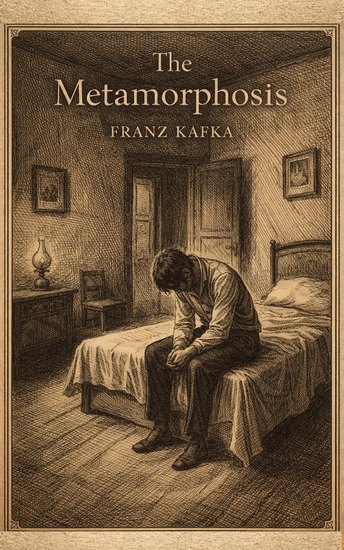
The Metamorphosis - cover

The Metamorphosis

Franz Kafka

Editorial: CLXBX

  • 0
  • 0
  • 0

Sinopsis

A haunting exploration of identity, isolation, and the fragile boundaries of humanity, The Metamorphosis by Franz Kafka stands as one of the most influential works of twentieth-century literature. First published in 1915, this unforgettable novella delves into the psychological and emotional consequences of alienation in a world governed by duty, expectation, and silent despair.

The story begins with one of the most startling openings in literary history: Gregor Samsa, a traveling salesman and devoted son, awakens one morning to find himself transformed into a monstrous insect. Trapped within his altered body and confined to his bedroom, Gregor struggles to comprehend his new existence while worrying more about missing work than about his inexplicable condition. As he attempts to adapt, his family—once financially dependent on him—must confront the burden of his transformation.

Kafka masterfully shifts the focus from the surreal event itself to the quiet unraveling of family bonds. Gregor's metamorphosis exposes underlying tensions, resentments, and unspoken frustrations within the household. His parents and sister, initially shocked and sympathetic, gradually grow fearful, ashamed, and impatient. The room that once offered him refuge becomes a symbol of his increasing isolation, and the apartment that housed a family unit transforms into a space of emotional distance and moral ambiguity.

Through sparse yet powerful prose, Kafka examines themes of alienation, guilt, responsibility, and the search for meaning in a modern, impersonal world. Gregor's condition can be read as a metaphor for social exclusion, mental anguish, or the dehumanizing pressures of work and conformity. The story's surreal premise heightens its emotional realism, inviting readers to confront uncomfortable questions about compassion, identity, and the value of an individual when usefulness fades.

Both unsettling and deeply moving, The Metamorphosis continues to resonate with readers for its profound insight into the human condition. Kafka's distinctive blend of absurdity and psychological depth creates a narrative that is as thought-provoking today as it was over a century ago. This timeless classic remains a powerful meditation on transformation—not only of the body, but of relationships, perception, and self-worth.
Disponible desde: 14/02/2026.
Longitud de impresión: 75 páginas.
Otros libros que te pueden interesar

  • Alice's Adventures In Wonderland - Sleepless Edition - cover

    Alice's Adventures In Wonderland...

    Lewis Carroll

    • 0
    • 0
    • 0
    Experience Lewis Carroll's classic masterpiece, Alice's Adventures In Wonderland, brought to life through this full unabridged Audiobook narrated by Sleepless Night Tales. 
    Rest assured that this is not AI, it is voiced entirely by a real person (me, Sleepless). This Alice in Wonderland audiobook is complete with immersive soundscapes, music, and the original John Tenniel artwork. 
    Originally told verbally and later manuscripted as a gift to Alice Liddell. The first book was then officially released in November of 1865. The classic tale follows a young girl who stumbles into a dreamlike world known simply as Wonderland, where she must traverse a nonsensical land filled with absurd curiosities. 
    The story has become a cultural phenomenon with several Alice in Wonderland films, plays, games, spin-offs, and other adaptations released over the years. Now join me and get lost down the Rabbit Hole as I read to you the source material that inspired it all. 
    …and remember, we're ALL mad here.
    Ver libro
  • Facing the Flag - cover

    Facing the Flag

    Jules Verne

    • 0
    • 0
    • 0
    Facing the Flag is a gripping techno-thriller and political adventure by Jules Verne that explores the dangerous intersection of scientific genius, nationalism, and unchecked ambition. At the heart of the novel is Thomas Roch, a brilliant but unstable inventor who has created a devastating new weapon—an explosive force so powerful it could alter the balance of world power. When Roch's invention is dismissed and ridiculed, his wounded pride becomes a vulnerability that sinister forces are eager to exploit.
    
    Abducted by pirates and taken to a secret stronghold hidden deep within the Caribbean, Roch finds himself surrounded by criminals who seek to use his invention for global domination. As nations unknowingly edge closer to catastrophe, a lone French engineer, Simon Hart, works from within the pirates' lair to thwart their plans and save the world from destruction.
    
    Blending cutting-edge science with political intrigue, Facing the Flag is both a thrilling adventure and a cautionary tale about the ethical responsibilities of scientists and the perils of blind patriotism. Often regarded as Jules Verne's prophetic response to the rise of modern warfare and weapons of mass destruction, the novel remains strikingly relevant today. With its fast-paced narrative, imaginative technology, and moral depth, Facing the Flag stands as a powerful example of Verne's ability to anticipate the future while delivering timeless storytelling.
    Ver libro
  • The Prize - From their pens to your ears genius in every story - cover

    The Prize - From their pens to...

    Mary Webb

    • 0
    • 0
    • 0
    Mary Gladys Meredith was born on 25th March 1881 at Leighton Lodge in the village of Leighton, near Shrewsbury in Shropshire.  
    Mary was home-schooled by her father before being sent to a finishing school in Southport in 1895. Her longs walks in the countryside helped her develop a heightened sense of observation and description, of both people and places, which later infused both her poetry and prose. 
    When she was 20 she developed symptoms of Graves' disease, a thyroid disorder that caused bulging protuberant eyes and throat goitre. This caused life-long ill health and was a possible contributor to her early death.  
    Mary was first published as a teenager when her brother sent to a local newspaper her poem on a recent rail accident.  Mary, who was in the habit of destroying her work was appalled though placated when she discovered that it had received some positive appreciation in readers letters. 
    1912 brought marriage to Henry Bertram Law Webb, a teacher. He supported her literary work which, in 1917, resulted in the publication of her novel ‘The Golden Arrow.’ 
    A few years later they acquired a property in London where, it was hoped, recognition of her literary talents would be more easily recognised.   
    Her 1924 novel, ‘Precious Bane’, won the Prix Femina Vie Heureuse, the prestigious French literary prize awarded by an all-female jury. 
    Most of her poetry and various other works were only published after her death. 
    By 1927 her health was deteriorating and her marriage failing.   
    Mary Webb died on 8th October 1927 at St Leonards-on-Sea, East Sussex.  She was 46.
    Ver libro
  • Selected Short Stories - by F Scott Fitzgerald - cover

    Selected Short Stories - by F...

    F. Scott Fitzgerald

    • 0
    • 0
    • 0
    Selected Short Stories is a collection of some of F. Scott Fitzgerald's most memorable and thought-provoking works. Published in 1931, the collection includes several of his best-known stories, such as "The Diamond as Big as the Ritz," "Bernice Bobs Her Hair," and "The Curious Case of Benjamin Button." These stories explore themes of social class, love, loss, and the search for meaning in a rapidly changing world. Fitzgerald's writing style is characterized by its elegance, wit, and poetic language, making his stories both engaging and thought-provoking. 
     
    One of the recurring themes in Fitzgerald's stories is the tension between the individual and society. In many of his stories, the characters are struggling to find their place in a society that values wealth, status, and conformity. This is particularly evident in "Bernice Bobs Her Hair," in which the protagonist, Bernice, must decide whether to conform to the expectations of her wealthy cousin or to follow her own desires. Similarly, in "The Curious Case of Benjamin Button," the protagonist must come to terms with his unusual condition, which sets him apart from the rest of society. 
     
    Another important theme in Fitzgerald's stories is the fleeting nature of happiness and the inevitability of change. Many of his characters are searching for love, success, or fulfillment, but find that these things are elusive and ultimately fleeting. This is particularly evident in "The Diamond as Big as the Ritz," in which the protagonist discovers a hidden mountain of diamonds, only to realize that his wealth is meaningless in the face of the vastness of the universe. Fitzgerald's stories remind us that life is both beautiful and fragile and that the pursuit of happiness can be both exhilarating and heartbreaking. 
    Overall, Selected Short Stories is a testament to Fitzgerald's talent as a writer and his ability to capture the spirit of his time.
    Ver libro
  • Huntingtower - The First Dickson McCunn Thriller of Romance Urchins and International Intrigue - cover

    Huntingtower - The First Dickson...

    John Buchan

    • 0
    • 0
    • 0
    Departing from his usual military heroes, John Buchan crafts a delightful and suspenseful thriller in 'Huntingtower.' The story follows Dickson McCunn, a newly retired Glasgow grocer who sets out on a walking holiday in the Scottish borders. Instead of peace, he finds himself spearheading the defense of a captive Russian noblewoman against a ruthless band of Bolshevik agents. Aided by a romantic poet and the 'Gorgie Die-Hards'—a fiercely loyal gang of slum children—this heartwarming, gripping adventure is narrated with superb wit and spirit by John.
    Ver libro
  • Son - From their pens to your ears genius in every story - cover

    Son - From their pens to your...

    Ivan Bunin

    • 0
    • 0
    • 0
    Ivan Alekseyevich Bunin was born on 22nd October 1870 in Voronezh province, in the South-West of the Russian Empire. 
    His early life was plagued by his Father’s gambling habits which caused his education to be erratic and the family to lose most of their wealth. 
    Bunin published his first poem in 1887 in St Petersburg and later in Oryol he worked for the local paper and became its editor, handily allowing him to publish his own poems and short stories.  There he met and married Varvara Pashchenko.  Ivan Bunin's debut book of poetry ‘Poems (1887–1891)’ was published in 1891. 
    This poetry and his translation of Longfellow garnered him his first Pushkin Prize.  Now he switched to writing prose and his novella ‘Antonov Apples’ is regarded as his first masterpiece.  Many more would follow. 
    The October Revolution of 1905 found Bunin in the Crimea.  Scenes of ‘class struggle’ he saw more as the oppressed people's craving for anarchy and destruction. 
    In November 1906 he began a passionate affair with Vera Muromtseva, within a few months they were touring through Egypt and Palestine.  ‘The Bird's Shadow’ collection was the result.   
    His second Pushkin Prize came in 1909 for Poems (1903–1906) and further translations.  He was now elected to the prestigious Russian Academy. 
    More widespread fame came in 1910 with ‘The Village’, a controversial and bleak portrayal of Russian country life.  Travel too beckoned them back to the Middle East, Ceylon (now Sri Lanka) and for winters in Capri with their friend Maxim Gorky.  
    That friendship suddenly ended in April 1917 as the revolution began to ferment in war-ravaged Russia.  After the Bolsheviks took power and the upheavals continued, he decided to leave Russia, finally achieving that in early 1920.  
    It would take some time to heal the wounds and stress he had been under and for his writing to begin again.  Settled in France, Bunin published many of his previous works and collections of novellas.  He also made regular contributions to the Russian emigre press.  
    Although reluctant to become involved in politics, Bunin was now feted as both a writer and the figurehead of non-Bolshevik Russian values and traditions.  In 1933 he became the first Russian to be awarded the Nobel Prize for Literature ‘for following through and developing with chastity and artfulness the traditions of Russian classic prose.’  
    In 1938 Bunin began working on the celebrated cycle of nostalgic, and erotically themed stories known Dark Avenues (or Dark Alleys).  
    As World War II broke out he chose to remain in Grasse spending the war at his remote Villa Jeanette, high in the mountains.  
    Ivan Bunin was a staunch anti-Nazi, and often, under difficult conditions, sheltered fugitives after Vichy was occupied by the Germans.  He wrote but did not publish during these years until on August 23rd the Nazi’s fled Grasse without a fight.  The next day the Americans came.  
    In May 1945 he returned to Paris and, apart from convalescing at times in Juan-les-Pins, he stayed for the rest of his life. 
    After 1948, with his health deteriorating, Bunin concentrated upon writing his memoirs and a book on Chekhov.  His last years were overshadowed by bitterness and despair at the situation in Russia and the treatment of its peoples.  He was suffering now from asthma, bronchitis and chronic pneumonia. 
    Ivan Alekseyevich Bunin died in a Paris attic flat on 8th November 1953.  Heart failure, cardiac asthma and pulmonary sclerosis were given as the causes of death.  He was 83.
    Ver libro