Join us on a literary world trip!
Add this book to bookshelf
Grey
Write a new comment Default profile 50px
Grey
Subscribe to read the full book or read the first pages for free!
All characters reduced
The Metamorphosis - cover

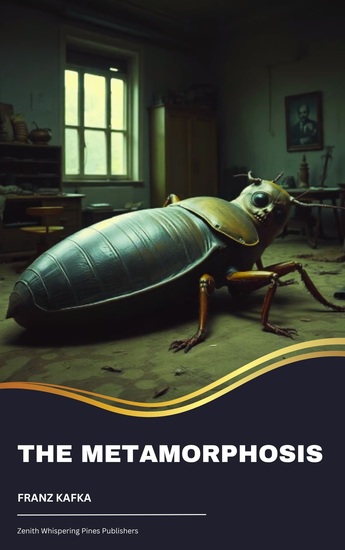
The Metamorphosis

Franz Kafka

Translator Ian Johnston

Publisher: Zenith Whispering Pines Publishers

  • 0
  • 0
  • 0

Summary

One morning, he wakes—and he is no longer himself.
When traveling salesman Gregor Samsa opens his eyes to find he has transformed into a monstrous insect, his world collapses into fear, shame, and silence. As his family recoils and his life shrinks behind a bedroom door, Gregor confronts the cruelty of alienation and the fragile threads that tie us to one another.

Praised as "one of the most influential works of modern literature," Kafka's unsettling masterpiece blends dark humor, emotional poignancy, and existential horror into a story that lingers long after the final page. Readers are drawn to its raw portrayal of identity, family, and the quiet tragedies hidden within ordinary lives.

If you seek thought-provoking fiction that challenges, unsettles, and stays with you, this timeless novella is essential reading.

Open the book—and step into a transformation you'll never forget.
Available since: 12/08/2025.
Print length: 63 pages.

Other books that might interest you

  • By Virtue Fall - cover

    By Virtue Fall

    Barbara Anne Machin

    • 0
    • 0
    • 0
    A trio of stories depicting true life struggles for people in all walks of life. How individuals can spoil what is good in life through the very stubbornness in their own nature. Jealously. Harsh words and anger. Misunderstanding that would be easier to face talk about instead of walking away. No problem is insurmountable if faced instead of ignored.
    Show book
  • A Lickpenny Lover - From their pens to your ears genius in every story - cover

    A Lickpenny Lover - From their...

    O Henry

    • 0
    • 0
    • 0
    William Sydney Porter was born on 11th September 1862 in Greensboro, North Carolina. At age 3 his mother died from tuberculosis. From an early age it was clear Porter had a large appetite for reading as he absorbed the world around him. 
    He first attended at a school run by his aunt before enrolling at the Lindsey Street High School and then worked at his uncle’s drugstore and gained a pharmacists’ license in 1881.  
    A persistent cough took him to Texas in the hope that a change of climate would help his symptoms. He took on various types of work, initially from ranch hand and cook and then as varied as pharmacist, draftsman, bank teller and journalist. He also began to write, though for now, purely as a hobby. 
    He was a member of several singing and dramatic groups when he met 17 year old Athol Estes, daughter of a wealthy Austin family. Despite her mother’s objection owing to Athol’s tuberculosis, they began courting and in July 1887, they eloped and soon married. 
    Athol, impressed by his writing, encouraged him to get them published. A job as a draftsman at the Texas General Land Office paid a healthy $100 dollars per month and life was good. 
    But then life turned cruel. His son died a few hours after birth although a daughter, Margaret, came the following year.  His job had to be vacated but another was found at the First National Bank of Austin. The bank operated informally and Porter was careless in keeping the books. He lost that job but began writing for the humourous weekly The Rolling Stone and the Houston Post. Some time later the federal Bank auditors went through his former accounts and he was arrested on charges of embezzlement. 
    Porter fled the day before his trial to Honduras. Holed up for several months he began to write.  Athol had become too ill to travel to meet him and learning that her health was deteriorating he surrendered to the court in February 1897.  Bail was obtained so that he could stay with Athol during her final days.  
    Porter was sentenced to five years at the Ohio Penitentiary in Columbus. His pharmacy qualifications got him the job of night druggist.  His sentence also gave him time to write and publish fourteen short stories. In December 1899 in McClure’s Magazine he published a short story as O Henry.  
    He was released two years early in July 1901, and reunited with Margaret, now 11, in Pittsburgh.  He now began his most prolific period of writing; a short story per week for the New York World, while also publishing works in other magazines.  Eventually over 600 of his short stories were published. 
    Porter was a heavy drinker and in 1908 his health, which had deteriorated for several years, took a dramatic turn for the worse, as did his writing.  
    O Henry died of cirrhosis of the liver complicated by diabetes and an enlarged heart on 5th June 1910.
    Show book
  • A Little Holiday - From their pens to your ears genius in every story - cover

    A Little Holiday - From their...

    Oswald Sickert

    • 0
    • 0
    • 0
    The bookshelves of British literature are incredible collections that have gathered together centuries of very talented authors.  From these Isles their fame spread and whilst among their number many are now forgotten or neglected their talents endure.  Among them is Oswald Sickert.
    Show book
  • Cain - From their pens to your ears genius in every story - cover

    Cain - From their pens to your...

    Alexander Kuprin

    • 0
    • 0
    • 0
    Alexander Kuprin was born in Narovchat, Penza in Russia on 7th September 1870. 
    At 3 his Father died and he and mother moved to Moscow. By 10 he was enrolled at the Second Moscow Military High School and there his interest in literature began. The Alexander Military Academy followed and two years later he was a sub-lieutenant and posted to an Infantry Regiment for a further four years. 
    Despite his duties he was a now a keen writer and published his first short story at this time. His military duties also garnered him experiences for his breakthrough work ‘The Duel’.  Leaving the military he left for Kiev to work for local newspapers.  He continued to publish both stories and novels and by 1901 he was in St Petersburg becoming part of a group that included Chekhov, Ivan Bunin, Maxim Gorky and Leonid Andreyev.  
    In the years that followed further controversial works and acclaim followed.  His comments on the regime meant he was also put under secret police surveillance.   
    As World War I erupted, Kuprin opened a military hospital but was then given command of an infantry company in Finland. He was soon discharged on grounds of ill health.  
    The October Revolution saw him praise Lenin, but he warned that the Bolsheviks threatened Russian culture and might cause further widespread suffering to the peasants.  As Civil War raged he took his family to Helsinki and then on to Paris. 
    Exile saw his talents decline further and his succumbing to alcoholism. He became lonely and withdrawn. The family's poverty increased his malaise.   
    In May 1937, the Kuprin’s returned to Moscow.  He now saw his work published but wrote almost nothing new.  In 1938 his health rapidly deteriorated.  Already suffering from a kidney problems and sclerosis, he had now developed cancer of the oesophagus.  
    Alexander Kuprin died on 25th August 1938.
    Show book
  • New Arabian Nights - cover

    New Arabian Nights

    Robert Louis Stevenson

    • 0
    • 0
    • 0
    "New Arabian Nights" is a collection of short stories written by Robert Louis Stevenson, first published in 1882. The book is a series of interconnected tales that explore themes of adventure, romance, and the supernatural. Drawing inspiration from the Arabian Nights, Stevenson weaves a tapestry of exotic and imaginative stories set in various locations, each with its own unique characters and plots.
    Show book
  • The Blind Accordionist - cover

    The Blind Accordionist

    C.D. Rose

    • 0
    • 0
    • 0
    In the novel Who's Who When Everyone Is Someone Else, the character "C. D. Rose" (not to be confused with the author C. D. Rose) searches an unnamed middle-European city for the long-lost manuscript of a little-known writer named Maxim Guyavitch. That search was fruitless, but in The Blind Accordionist, "C. D. Rose" has found the manuscript—nine sparkling, fable-like short stories—and he presents them here with an (hilarious) introduction explaining the discovery, and an afterword providing (hilarious) critical commentary on the stories, and what they might reveal about the mysterious Guyavitch. 


    The Blind Accordionist is another masterful book of world-making by the real C. D. Rose, absorbing in its mix of intelligence and light-heartedness, and its ultimate celebration of literature itself. It is the third novel in the series about "C. D. Rose," although the reader does not need to have read the previous two books. (The first in the series was The Biographical Dictionary of Literary Failure; the second was Who's Who When Everyone Is Someone Else.) 


    Like those books, The Blind Accordionist can be read both as a simple but wonderful collection of quirky stories, and as comedy—or as a beautiful and moving elegy on the nobility of writers wanting to be read.
    Show book