Join us on a literary world trip!
Add this book to bookshelf
Grey
Write a new comment Default profile 50px
Grey
Subscribe to read the full book or read the first pages for free!
All characters reduced
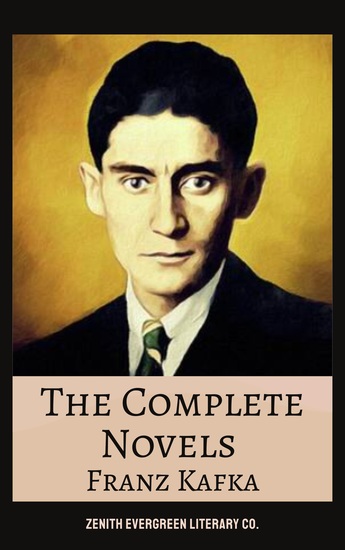
The Complete Novels of Franz Kafka - The Trial The Castle Amerika and The Metamorphosis - cover

The Complete Novels of Franz Kafka - The Trial The Castle Amerika and The Metamorphosis

Franz Kafka, Zenith Evergreen Literary Co.

Publisher: Zenith Evergreen Literary Co.

  • 0
  • 0
  • 0

Summary

The absurdity of existence, the labyrinth of power, and the frailty of human will—Kafka captures them all.

The Complete Novels of Franz Kafka brings together the major works of one of literature's most haunting voices. Featuring The Trial, The Castle, Amerika, and the unforgettable The Metamorphosis, Kafka's novels delve into the alienation, bureaucratic madness, and existential dread that define the modern human experience.

Perfect for readers fascinated by surreal worlds, philosophical depth, and profound psychological insight, Kafka's writing challenges, unsettles, and illuminates the human condition like no other.

💬 "Kafka reminds us: in the heart of reason lies a maze; in every step, a silent terror."

🕷️ Why Readers Must Explore Kafka:
Includes all major novels and famous short pieces like The Metamorphosis

Perfect for fans of Albert Camus, George Orwell, Haruki Murakami, and Jean-Paul Sartre

Essential for students of existentialism, surrealism, and 20th-century modernist fiction

📣 Enter the Maze. Confront the Absurd. Question Everything.
Buy The Complete Novels of Franz Kafka today and journey into stories where reality slips away and meaning trembles.
Available since: 04/29/2025.
Print length: 855 pages.

Other books that might interest you

  • Top 10 Short Stories The - Sadness - The ten best short stories of all time about sadness - cover

    Top 10 Short Stories The -...

    D H Lawrence, Nikolai Gogol,...

    • 0
    • 0
    • 0
    Short stories have always been a sort of instant access into an author’s brain, their soul and heart.  A few pages can lift our lives into locations, people and experiences with a sweep of landscape, narration, feelings and emotions that is difficult to achieve elsewhere. 
     
    In this series we try to offer up tried and trusted ‘Top Tens’ across many different themes and authors. But any anthology will immediately throw up the questions – Why that story? Why that author?  
     
    The theme itself will form the boundaries for our stories which range from well-known classics, newly told, to stories that modern times have overlooked but perfectly exemplify the theme.  Throughout the volume our authors whether of instant recognition or new to you are all leviathans of literature. 
     
    Some you may disagree with but they will get you thinking; about our choices and about those you would have made.  If this volume takes you on a path to discover more of these miniature masterpieces then we have all gained something. 
     
    In this volume our author’s pens turn to tales of sadness.  This distressing feeling can arrive at a moment’s notice or gradually build and overwhelm.  Within these stories Anton Chekhov, Sherwood Anderson, Alice Dunbar Nelson, Katherine Mansfield and many others explore and reveal the consequences.  
     
    1 - The Top 10 Short Stories - Sadness - An Introduction 
    2 - Odour of Chrysanthemums by D H Lawrence 
    3 - The Cloak by Nikolai Gogol also known as 'The Overcoat' 
    4 - Life of Ma Parker by Katherine Mansfield 
    5 - Paul's Case by Willa Cather 
    6 - Silence by Leonid Andreyev 
    7 - The Stones of the Village by Alice Dunbar Nelson 
    8 - Hide And Seek or Pliatki by Fyodor Sologub 
    9 - Hands by Sherwood Anderson 
    10 - Vanka by Anton Chekhov 
    11 - A Dark Brown Dog by Stephen Crane
    Show book
  • The Legend of Sleepy Hollow - cover

    The Legend of Sleepy Hollow

    Washington Irving

    • 0
    • 0
    • 0
    In a quiet valley where time moves a little slower and shadows fall a little longer, a tale has been whispered for generations. Washington Irving's The Legend of Sleepy Hollow captures the strange charm of a world perched between dream and folklore—where superstition lingers, and the night rides on a restless horse.
    This classic story blends gentle satire, eerie beauty, and a touch of the uncanny. It doesn't just haunt—it hums like a memory just out of reach.
    Show book
  • Mansfield Park - cover

    Mansfield Park

    Jane Austen

    • 0
    • 0
    • 0
    "Mansfield Park" is a novel by Jane Austen, published in 1814. It centers on Fanny Price, a young woman from a poor family who is sent to live with her wealthy relatives at Mansfield Park. Unlike other Austen heroines, Fanny is shy and reserved, and she struggles with the ethical and social dilemmas presented to her. As she navigates love, betrayal, and moral complexity within the confines of upper-class society, Fanny grows into her own person. The novel delves into themes of social class, morality, and the complexities of human relationships.
    Show book
  • Betty Brown the St Giles Orange Girl - From their pens to your ears genius in every story - cover

    Betty Brown the St Giles Orange...

    Hannah More

    • 0
    • 0
    • 0
    Hannah More was born on February 2nd, 1745 at Fishponds in the parish of Stapleton, near Bristol. She was the fourth of five daughters. 
    The City of Bristol, at that time, was a centre for slave-trading and Hannah would, over time, become one of its staunchest critics.  
    She was keen to learn, possessed a sharp intellect and was assiduous in studying.  Hannah first wrote in 1762 with The Search after Happiness (by the mid-1780s some 10,000 copies had been sold). 
    In 1767 Hannah became engaged to William Turner.  After six years, with no wedding in sight, the engagement was broken off.  Turner then bestowed upon her an annual annuity of £200.  This was enough to meet her needs and set her free to pursue a literary career.   
    Her first play, The Inflexible Captive, was staged at Bath in 1775. The famous David Garrick himself produced her next play, Percy, in 1777 as well as writing both the Prologue and Epilogue for it.  It was a great success when performed at Covent Garden in December of that year.  
    Hannah turned to religious writing with Sacred Dramas in 1782; it rapidly ran through nineteen editions. These and the poems Bas-Bleu and Florio (1786) mark her gradual transition to a more serious and considered view of life. 
    Hannah contributed much to the newly-founded Abolition Society including, in February 1788, her publication of Slavery, a Poem recognised as one of the most important of the abolition period.   
    Her work now became more evangelical.  In the 1790s she wrote several Cheap Repository Tracts which covered moral, religious and political topics and were both for sale or distributed to literate poor people.  The most famous is, perhaps, The Shepherd of Salisbury Plain, describing a family of incredible frugality and contentment. Two million copies of these were circulated, in one year. 
    In 1789, she purchased a small house at Cowslip Green in Somerset. She was instrumental in setting up twelve schools in the area by 1800. 
    She continued to oppose slavery throughout her life, but at the time of the Abolition Bill of 1807, her health did not permit her to take as active a role in the movement as she had done in the late 1780s, although she maintained a correspondence with Wilberforce and others.  
    In July 1833, the Bill to abolish slavery throughout the British Empire passed in the House of Commons, followed by the House of Lords on August 1st. 
    Hannah More died on September 7th, 1833.
    Show book
  • Doctors (Unabridged) - cover

    Doctors (Unabridged)

    H. G. Wells

    • 0
    • 0
    • 0
    Herbert George Wells (21 September 1866 - 13 August 1946) was an English writer. Prolific in many genres, he wrote dozens of novels, short stories, and works of social commentary, history, satire, biography and autobiography. His work also included two books on recreational war games. Wells is now best remembered for his science fiction novels and is often called the "father of science fiction", along with Jules Verne and the publisher Hugo Gernsback.
    DOCTORS: In that extravagant world of which I dream, in which people will live in delightful cottages and ground rents will serve instead of rates, and everyone will have a chance of being happy-in that impossible world all doctors will be members of one great organisation for the public health, with all or most of their income guaranteed to them: I doubt if there will be any private doctors at all.
    Show book
  • The Story of B24 - From their pens to your ears genius in every story - cover

    The Story of B24 - From their...

    Arthur Conan Doyle

    • 0
    • 0
    • 0
    Arthur Conan Doyle was born in Edinburgh, Scotland on 22nd May 1859.  His childhood was blighted by his father’s heavy drinking which for some years broke up the family. Fortunately, wealthy uncles were willing to support them by paying for education and clothing.  
    He was accepted at the University of Edinburgh to study medicine and also began to write short stories the first, ‘The Haunted Grange of Goresthorpe’, was published in Blackwood’s Magazine.  Despite several other stories and some articles in the British Medical Journal his medical studies took priority. 
    When these finished he was appointed as Doctor on the Greenland whaler ‘Hope of Peterhead’ in 1880 and then, after graduation, as ship’s surgeon on the SS Mayumba on its voyage to West Africa. 
    1882 saw a move to Plymouth and his own independent practice. With few patients he resumed writing and completed his first novel, ‘The Mystery of Cloomber’, although most of his output was short stories based on his experiences at sea.  
    He married Louisa Hawkins in 1885. However, two years later he met and fell in love with Jean Elizabeth Leckie, though they remained platonic out of respect for, and loyalty to, his wife. 
    His literary career suddenly burst into life in November 1886 with ‘A Study In Scarlet’, the first of the fabulously successful Sherlock Holmes stories.  
    With two children to support he now revisited his haphazard commercial arrangements and curtailed everything save for commissions from the Strand Magazine.  
    As a sportsman he was remarkably proficient. He was goalkeeper for Portsmouth Association Football Club and played ten first-class cricket matches for the Marylebone Cricket Club as well as captain of the Crowborough Beacon Golf Club in East Sussex.  
    In 1891 tired of writing Holmes stories, he began a series of historical novels and even went so far as to apparently kill off Holmes in a lethal brawl with his arch-nemesis Moriarty. 
    Despite heavy and sustained criticism he continued to write in support of the Boer War, a fact he thought contributed to his knighthood in 1902.  The following year to great relief and acclaim he brought Sherlock Holmes back from the dead in his first outing for a decade. 
    Sadly, his wife Louisa died from TB in 1906 and, a year later, he at last married Jean.  
    During the War and for several years after family deaths had left him depressed. In a search for solace and answers he alighted upon spiritualism and, such was his interest, that he wrote several books on the subject. 
    On 7th July 1930 Conan Doyle was discovered in the hall of Windlesham Manor, his house in East Sussex, clutching his chest dying of a heart attack.  He was 71.
    Show book