Join us on a literary world trip!
Add this book to bookshelf
Grey
Write a new comment Default profile 50px
Grey
Subscribe to read the full book or read the first pages for free!
All characters reduced
Data Format Compare - cover

Data Format Compare

Frank Wellington

Translator A AI

Publisher: Publifye

  • 0
  • 0
  • 0

Summary

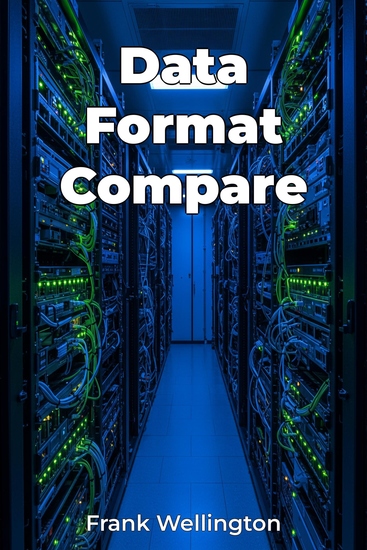
"Data Format Compare" addresses the critical decision of choosing the right data format in today's data-driven environment. It offers a comparative analysis of JSON, XML, and YAML, three prevalent formats used in software development and data architecture. The book uniquely empowers readers to make informed choices based on their specific project needs, rather than advocating for a one-size-fits-all solution. Did you know that XML's roots are in structured document markup, whereas JSON emerged for lightweight web data interchange? Or that YAML aims for enhanced readability compared to both?

 
The book progresses logically, first introducing data serialization principles and the core concepts behind each format. It then systematically compares JSON, XML, and YAML based on syntax, data types, schema validation, parsing efficiency, and human readability. Each format receives dedicated chapters exploring its unique features and capabilities. This approach ensures a comprehensive understanding of each format's strengths and weaknesses.

 
The culmination includes practical examples and case studies demonstrating real-world applications of these formats in web APIs and configuration files. By providing a balanced comparison, "Data Format Compare" helps readers avoid common pitfalls in data integration and system interoperability, ultimately leading to more efficient and robust data handling in their information technology projects.
Available since: 02/22/2025.
Print length: 252 pages.


Other books that might interest you

  • States and Nature - The Effects of Climate Change on Security - cover

    States and Nature - The Effects...

    Joshua William Busby

    • 0
    • 0
    • 0
    Under what circumstances might climate change lead to negative security outcomes? Over the past fifteen years, a rapidly growing applied field and research community on climate security has emerged. While much progress has been made, we still don't have a clear understanding of why climate change might lead to violent conflict or humanitarian emergencies in some places and not others. Busby develops a novel argument – based on the combination of state capacity, political exclusion, and international assistance – to explain why climate leads to especially bad security outcomes in some places but not others. This argument is then demonstrated through application to case studies from sub-Saharan Africa, the Middle East, and South Asia. This book will provide an informative resource for students and scholars of international relations and environmental studies, especially those working on security, conflict and climate change, on the emergent practice and study of this topic, and identifies where policy and research should be headed.
    Show book
  • The Invisible Clash - FBI Shin Bet and the IRA's Struggle against Domestic War on Terror - cover

    The Invisible Clash - FBI Shin...

    Davis Truman

    • 0
    • 0
    • 0
    Dive into the gripping world of intelligence agencies, covert operations, and the relentless fight against domestic terror. "The Invisible Clash" takes you on a heart-pounding journey as the FBI, Shin Bet, and the IRA unite in an extraordinary battle to preserve peace, protect lives, and expose the covert forces threatening our existence. 
    Within the pages of "The Invisible Clash," you'll encounter a cast of unforgettable characters, each propelled by their unshakable belief in the righteousness of their cause. Meet the seasoned FBI agent, hardened by years of service, who embarks on a dangerous undercover mission to infiltrate a web of extremist groups. Witness the relentless pursuit of the Shin Bet agent, whose unwavering dedication to homeland security leads him into the heart of the storm. And discover the untold stories of the IRA operatives, caught between their desire for independence and the pursuit of a more peaceful future. 
    Immerse yourself in a world where alliances are tested, secrets are unveiled, and the battle between good and evil unfolds in the shadows. Don't miss your chance to experience "The Invisible Clash" – a literary tour de force that will keep you on the edge of your seat until the very last page.
    Show book
  • Fatal Abstraction - Why the Managerial Class Loses Control of Software - cover

    Fatal Abstraction - Why the...

    Darryl Campbell

    • 0
    • 0
    • 0
    Software was supposed to radically improve society. Outdated mechanical systems would be easily replaced; social media platforms like Facebook would bring people together; and generative AI would solve the world’s greatest ills. Yet in practice, few of the systems we looked to with such high hopes have lived up to their fundamental mandate. In fact, in too many cases they've made things worse. How did we get to this point? 


    In Fatal Abstraction, Darryl Campbell explains that the problem is "managerial software": programs created and overseen not by engineers but by professional managers with only the most superficial knowledge of technology itself. 


    A former tech worker himself, Campbell shows how managerial software fails, and when it does what sorts of disastrous consequences ensue, from the Boeing 737 MAX crashes to a deadly self-driving car to PowerPoint propaganda, and beyond. Yet just because the tech industry is currently breaking its core promise does not mean the industry cannot change. Campbell argues that the solution is tech workers with actual expertise establishing industry-wide principles of ethics and safety that corporations would be forced to follow. Fatal Abstraction is a stirring rebuke of the tech industry's current managerial excesses, and also a hopeful glimpse of what a world shaped by good software can offer.
    Show book
  • Battlefields of The Future: The Evolution of the Technology of War 2025-2125 - cover

    Battlefields of The Future: The...

    Dr. Nick Coman, I. A.I.

    • 0
    • 0
    • 0
    A 36‑lecture audio course on how wars are actually fought in the machine age—from seabed cables and city power grids to low‑Earth orbit, cislunar space, and the neural loop between a human and a weapon. We break the kill chain open: sensing and space‑based cueing; edge compute and target fusion; communications that survive jamming; and the things that do damage—mines, missiles, loitering munitions, directed energy, electromagnetic pulse, and code. 
    We make the stack legible for operators and serious thinkers alike: synthetic aperture radar becomes SAR; high‑altitude long endurance becomes HALE; link budgets and laser crosslinks stop being magic and start being math you can reason about in words. You will see how orbital “stalkers” shadow satellites, why stratospheric platforms matter when air defenses make manned ISR bleed, how decoys and digital camouflage fracture an adversary’s picture, and where the automation boundary really sits when AI runs parts of the kill web with a human on the loop. 
    Engineering reality, not brochure fog, sets the pace. We trace power budgets, attrition math, and reconstitution timelines; map chokepoints in chips, propellants, optics, batteries, and shipyards; and follow sanctions, export controls, and standards as operational constraints, not afterthoughts. 
    The glidepath is explicit. 2025 to 2035: proliferated space, cheap autonomy, hard lessons from electronic warfare. 2035 to 2050: directed‑energy baselines, resilient meshes, smarter decoys. 2050 to 2075 and beyond: cislunar logistics with teeth, human performance management that is governed not ghoulish, brain–computer interfaces that shorten loops without erasing judgment. 
    Rigorous, unsentimental, and built for the intellectually ambitious, this course is an operator’s guide to modern combat systems—how they are built, how they break, and how they win.
    Show book
  • Statistical Analysis for Beginners - Comprehensive Introduction - cover

    Statistical Analysis for...

    Daniel Garfield

    • 0
    • 0
    • 0
    Dive into the fascinating realm of data with "Statistical Analysis for Beginners: A Hands-On Approach to Unraveling Data Mysteries and Transforming Numbers into Knowledge." This comprehensive guide is crafted for those seeking to demystify the world of statistics and harness the power of data in their hands.
    Show book
  • Not with a Bug But With a Sticker - Attacks on Machine Learning Systems and What to Do About Them - cover

    Not with a Bug But With a...

    Hyrum Anderson, Ram Shankar Siva...

    • 0
    • 0
    • 0
    A robust and engaging account of the single greatest threat faced by AI and ML systems. 


    In Not with a Bug, But with a Sticker: Attacks on Machine Learning Systems and What to Do About Them, a team of distinguished adversarial machine learning researchers deliver a riveting account of the most significant risk to currently deployed artificial intelligence systems: cybersecurity threats. The authors take you on a sweeping tour—from inside secretive government organizations to academic workshops at ski chalets to Google's cafeteria—recounting how major AI systems remain vulnerable to the exploits of bad actors of all stripes. 


    Based on hundreds of interviews of academic researchers, policy makers, business leaders and national security experts, the authors compile the complex science of attacking AI systems with color and flourish and provide a front row seat to those who championed this change. Grounded in real world examples of previous attacks, you will learn how adversaries can upend the reliability of otherwise robust AI systems with straightforward exploits.
    Show book