Join us on a literary world trip!
Add this book to bookshelf
Grey
Write a new comment Default profile 50px
Grey
Subscribe to read the full book or read the first pages for free!
All characters reduced
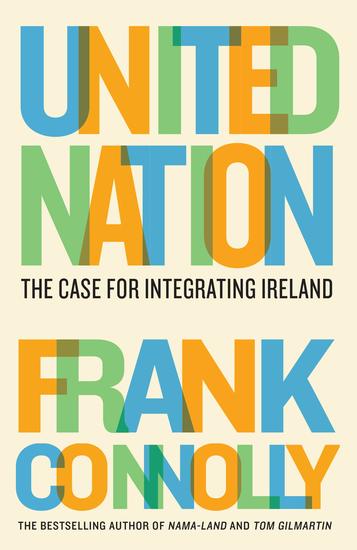
United Nation - The case for integrating Ireland - cover

United Nation - The case for integrating Ireland

Frank Connolly

Publisher: Gill Books

  • 0
  • 0
  • 0

Summary

One hundred years after the Anglo-Irish Treaty and partition, after thirty years of Troubles, the Good Friday Agreement and Brexit, the debate on Irish unity has intensified. But what could a united country look like and what would it mean for people north and south of the border?
Considering health, education, the economy, cultural identity and the arts, constitutional change and international relations, award-winning journalist Frank Connolly asks whether a united Ireland could create a viable, vibrant new country.
With contributions from President Michael D. Higgins, Paula Meehan, David McWilliams, Linda Ervine, Christy Moore, Mary Lou McDonald, Ian Marshall and Brian Keenan, United Nation is a timely look at the case for integrating Ireland.
Available since: 05/26/2022.
Print length: 432 pages.

Other books that might interest you

  • The Chile Project - The Story of the Chicago Boys and the Downfall of Neoliberalism - cover

    The Chile Project - The Story of...

    Sebastian Edwards

    • 0
    • 0
    • 0
    In The Chile Project, Sebastian Edwards tells the story of how the neoliberal economic model came to an end in 2021, when Gabriel Boric was elected president, vowing that "If Chile was the cradle of neoliberalism, it will also be its grave." More than a story about one Latin American country, The Chile Project is a behind-the-scenes history of the spread and consequences of the free-market thinking that dominated economic policymaking around the world in the second half of the twentieth century—but is now on the retreat. 


    In 1955, the United States State Department launched the "Chile Project" to train Chilean economists at the University of Chicago. After General Augusto Pinochet overthrew socialist president Salvador Allende in 1973, Chile's "Chicago Boys" implemented the purest neoliberal model for the next seventeen years, undertaking a package of privatization and deregulation, creating a modern capitalist economy, and sparking talk of a "Chilean miracle." But under the veneer of success, a profound dissatisfaction with the inequalities caused by neoliberalism was growing. In 2019, protests erupted throughout the country, and in 2022 Boric began his presidency with a clear mandate: to end neoliberalismo. 


    The Chile Project provides an important new perspective on the history of neoliberalism and its global decline today.
    Show book
  • Rare Earth Elements & Critical Minerals: Science Supply Chains & Statecraft - What They Do Why They Matter & What The Future Holds… - cover

    Rare Earth Elements & Critical...

    Dr. Nick Coman, I. A.I.

    • 0
    • 0
    • 0
    A 36‑lecture audio course on the materials that run the modern world—from ore bodies and brines to magnets, batteries, chips, and reactors. Each lecture focuses on one element or mineral, tracing its journey from deposit geology through beneficiation and refining to the devices it powers. 
    We make the flowsheet legible: comminution and flotation; roasting, high‑pressure acid leaching, solvent extraction, and ion exchange; separation to oxides and metals; alloying and specialty powders. See how neodymium‑iron‑boron magnets are born, why lithium hexafluorophosphate matters in electrolytes, where gallium nitride wins in power, how graphite anodes evolve with silicon, and how the uranium fuel cycle and vanadium flow batteries actually work. 
    Markets and politics are treated as engineering constraints. Learn to spot yield killers, read offtake agreements, and separate strategic scarcity from narrative. Test real substitutions—ferrites in small motors, sodium‑ion for short‑range storage, gallium nitride versus silicon carbide—and where performance cliffs block redesign. We map chokepoints beyond the mine: separation capacity, reagents, waste handling, water and energy intensity, and manufacturer qualification cycles. Then we follow the consequences—export controls and quotas, permitting and community consent, tariffs and friend‑shoring, standards and labeling rules. 
    Rigorous, narrative‑driven, and built for the intellectually ambitious, this course is an operator’s guide to the science, supply chains, and statecraft of a materials‑constrained century.
    Show book
  • What's Right With America - And How We Can Keep It That Way! - cover

    What's Right With America - And...

    Hon. Paul Johnson, Larry Aldrich

    • 0
    • 0
    • 0
    Is America's future as bright as its past? What's Right With America argues that not only is the answer "Yes," but the nation's most incredible days are yet to come. Despite the challenges and divisions we face, America's true strength lies in its core principles and the resilient spirit of its people. 


    From the vision of our Founding Fathers to the resilience and determination that have shaped our history, What's Right With America explores what makes the country uniquely capable of thriving in times of change. With inspiring stories and thought-provoking analysis, authors Paul Johnson and Larry Aldrich reveal how America's prosperity is rooted in more than just economic might—it's grounded in values like freedom, individual empowerment, and deep commitment to justice and liberty. 


    Johnson and Aldrich have identified five defining characteristics that have propelled the United States to greatness, showing how these ideals can guide us through current and future challenges. Whether you're concerned about politics, society, or the economy, What's Right With America offers a powerful reminder that America's strength is more than just its leadership—it's in every citizen who believes in the promise of a better future.
    Show book
  • The Prince - cover

    The Prince

    Niccolò Machiavelli

    • 0
    • 0
    • 0
    The Prince 
    By Niccolò Machiavelli 
    A timeless masterpiece on power, strategy, and statecraft, The Prince is one of the most influential political treatises ever written. First penned in 1513, Niccolò Machiavelli offers a bold and unapologetic guide on how rulers can acquire and maintain power, often advocating for pragmatism over morality. 
    With razor-sharp insights into human nature, deception, and governance, Machiavelli argues that a successful leader must be cunning, adaptable, and, when necessary, ruthless. From the necessity of fear over love to the art of war and manipulation, The Prince remains a vital read for politicians, strategists, and anyone seeking to understand the complex dynamics of power. 
    Whether admired as a manual for leadership or criticized as a blueprint for tyranny, The Prince continues to shape political thought centuries after its publication. This edition, translated by W.K. Marriott, preserves the clarity and brilliance of Machiavelli’s original work, making it accessible to modern readers."It is better to be feared than loved, if you cannot be both."
    Show book
  • Socialism: Book Summary & Analysis - cover

    Socialism: Book Summary & Analysis

    Briefly Summaries

    • 0
    • 0
    • 0
    This is a concise summary and analysis of Socialism, by Ludwig von Mises.
     
    It is not the original book and is not affiliated with or endorsed by Ludwig von Mises.
    Ideal those seeking a quick and insightful overview.
     
    "Socialism" delivers a profound critique of socialist economic systems, challenging the viability of central planning and collectivist ideologies. With a clear and methodical approach, the book explores the implications of socialism on human freedom, economic efficiency, and societal progress. It delves into the mechanics of market economies, the role of private property, and the intricate dynamics of supply and demand, presenting a compelling argument for the superiority of capitalism as a framework for prosperity and individual liberty. A foundational text in economic theory and political philosophy, this book is an essential read for anyone seeking to understand the ideological and practical challenges of socialism.
    Show book
  • The Communist Manifesto - cover

    The Communist Manifesto

    Karl Marx, Friedrich Engels

    • 0
    • 0
    • 0
    Embark on a revolutionary journey into the foundations of modern political thought with "The Communist Manifesto" by Karl Marx and Friedrich Engels, now available as a thought-provoking audiobook. In this seminal work, Marx and Engels articulate their vision for a classless society, where the proletariat rises against capitalist oppression to achieve equality and liberation. 
    Through incisive analysis and impassioned rhetoric, "The Communist Manifesto" critiques the inequalities inherent in the capitalist system and calls for collective action to overthrow the bourgeoisie and establish a society based on cooperation and solidarity. As listeners delve into the pages of this historic document, they'll confront timeless questions about power, justice, and the nature of social change. 
    Perfect for students of political science, history, and economics, this audiobook provides a compelling exploration of the forces that shape our world. Whether you're a staunch advocate of socialism or simply curious about its principles, "The Communist Manifesto" offers valuable insights into the complexities of modern society. 
    So, if you're ready to engage with one of the most influential political treatises ever written, start listening to "The Communist Manifesto" today and discover the enduring relevance of Marx and Engels' revolutionary ideas.
    Show book