Join us on a literary world trip!
Add this book to bookshelf
Grey
Write a new comment Default profile 50px
Grey
Subscribe to read the full book or read the first pages for free!
All characters reduced
The tenderfoots - cover

The tenderfoots

Francis Lynde

Publisher: Good Press

  • 0
  • 0
  • 0

Summary

Set against the rugged backdrop of the American West, Francis Lynde's "The Tenderfoots" delves into the lives of inexperienced cowboys navigating the challenges of life on the frontier. Through richly descriptive prose, Lynde captures the essence of the landscape, while simultaneously exploring themes of resilience and personal growth. The narrative unfolds with a blend of adventure and humor, echoing the literary currents of early 20th-century frontier literature, making it both an entertaining and enlightening read for fans of the genre. Francis Lynde, a seasoned journalist and writer, drew upon his own experiences with the American West to craft this novel. Having lived through the complexities and trials of frontier life, his insights into the social dynamics and struggles of his characters reveal an authentic understanding of the era. Lynde's commitment to portraying the realities of life on the frontier, coupled with his keen eye for captivating storytelling, positions him as a significant voice in American literature. I highly recommend "The Tenderfoots" for readers seeking an engaging tale that combines adventure with introspective character development. Lynde's work offers a profound glimpse into the human spirit's capacity to adapt and thrive in the face of adversity, making it a vital addition to the canon of American literature.
Available since: 03/02/2025.
Print length: 200 pages.
Other books that might interest you

  • A Scene from the Ghetto of Venice - From their pens to your ears genius in every story - cover

    A Scene from the Ghetto of...

    Rainer Maria Rilke

    • 0
    • 0
    • 0
    René Karl Wilhelm Johann Josef Maria Rilke was born into a troubled marriage on the 4th December 1875 in Prague, then part of the Austro-Hungarian Empire.  His mother, having previously lost a baby girl, would dress the young boy up in girl’s clothing.   
    Later his father dispatched him to a military academy at age 10 but after a miserable 5 years the young Rilke left due to illness and instead entered first Prague and then Munich and finally Berlin university to study art history, philosophy and literature. 
    His initial forays into literature was in poetry.  His intense, mystical and lyrical style was much admired and over time inspired many in succeeding generations.    
    His short prose collection ‘Stories of God’, written in an impassioned burst over several nights was published in 1900 and offers a beguiling view of much of Rilke’s influences and outlook.  
    The following year he married the pioneering sculptor and artist Clara Westhoff.  The union produced one child, a daughter Ruth.   
    He lived in Paris for most of the Century’s first decade where he mixed with many great minds of the time.  Although he continued to write he also worked as a secretary to the sculptor, Rodin.   
    It was only after they settled in Switzerland in 1919 that his writing output was in full flow.  Here he wrote profusely in both German and French, which included much on his previous travels, his left-wing sympathies, his religious and existential thoughts, all part of a unique and consummate style. 
    From 1923 on, Rilke increasingly struggled with his health which was now in constant decline and often spent time rehabilitating at a sanatorium.   
    Rainer Maria Rilke died of leukaemia on the 29th December 1926 in Montreux, Switzerland.  He was 51.
    Show book
  • The Saint - From their pens to your ears genius in every story - cover

    The Saint - From their pens to...

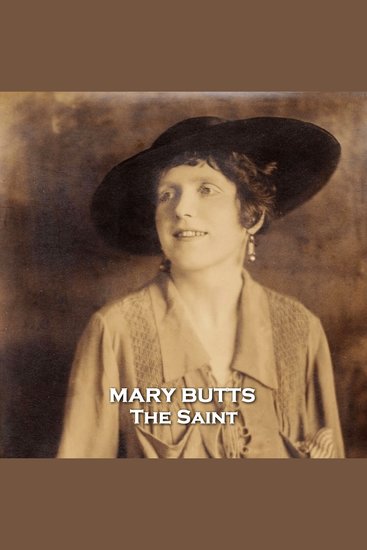
    Mary Butts

    • 0
    • 0
    • 0
    Mary Frances Butts was born on 13th December 1890 in Poole, Dorset. 
    Her early years were spent at Salterns, an 18th-century house overlooking Poole Harbour.  Sadly in 1905 her father died, and she was sent for boarding at St Leonard's school for girls in St Andrews. 
    Her mother remarried and, from 1909, Mary studied at Westfield College in London, and here, first became aware of her bisexual feelings.  She was sent down for organising a trip to Epsom races and only completed her degree in 1914 when she graduated from the London School of Economics.  By then Mary had become an admirer of the occultist Aleister Crowley and she was given a co-authorship credit on his ‘Magick (Book 4)’. 
    In 1916, she began the diary which would now detail her future life and be a constant reference point for her observations and her absorbing experiences. 
    During World War I, she was doing social work for the London County Council in Hackney Wick, and involved in a lesbian relationship.  Life changed after meeting the modernist poet, John Rodker and they married in 1918. 
    In 1921 she spent 3 months at Aleister Crowley's Abbey of Thelema in Sicily; she found the practices dreadful and also acquired a drug habit.  Mary now spent time writing in Dorset, including her celebrated book of short stories ‘Speed the Plough’ which saw fully develop her unique Modernist prose style. 
    Europe now beckoned and several years were spent in Paris befriending many artists and writing further extraordinary stories.   
    She was continually sought after by literary magazines and also published several short story collections as books. Although a Modernist writer she worked in other genres but is essentially only known for her short stories.  Mary was deeply committed to nature conservation and wrote several pamphlets attacking the growing pollution of the countryside. 
    In 1927, she divorced and the following year her novel ‘Armed with Madness’ was published.  A further marriage followed in 1930 and time was spent attempting to settle in London and Newcastle before setting up home on the western tip of Cornwall.  By 1934 the marriage had failed. 
    Mary Butts died on 5th March 1937, at the West Cornwall Hospital, Penzance, after an operation for a perforated gastric ulcer. She was 46.
    Show book
  • Call of the Wild The - Audiobook - cover

    Call of the Wild The - Audiobook

    Jack London, Classic Audiobooks,...

    • 0
    • 0
    • 0
    The Call of the Wild is a gripping adventure story about a domestic dog named Buck, who is stolen from his comfortable life in California and thrust into the brutal world of the Alaskan wilderness. As he is passed from one harsh master to another, Buck is forced to awaken his primal instincts in order to survive. Eventually, he embraces the wild entirely, answering the ancient call that echoes in his blood.This novel is both a thrilling survival story and a meditation on the forces of nature, the struggle between civilization and instinct, and the journey toward freedom and self-discovery. Jack London captures the raw power of the wilderness and the untamed spirit that lives within all creatures.
    Show book
  • The Domain of Arnheim - cover

    The Domain of Arnheim

    Sampi Books, Edgar Allan Poe

    • 0
    • 0
    • 0
    In "The Domain of Arnheim", Edgar Allan Poe explores the aesthetics and power of nature through Ellison, a wealthy man who creates an impressive landscaped garden. This tale discusses themes of beauty, art and idealism, as Ellison uses his fortune to shape a perfect earthly refuge.
    Show book
  • Lot No 249 - cover

    Lot No 249

    Arthur Conan Doyle

    • 0
    • 0
    • 0
    Unexplained events are happening at Oxford these days. Several students have been attacked at night by some strange form of wild animal. It can scale walls with cat-like agility. Its arms are as thin and as strong as steel bands. And there is one student who conducts midnight studies in his room with certain Egyptian artifacts. The most significant of which is a 6'7" tall mummy.
    Show book
  • A Reminiscence of Dr Samuel Johnson - cover

    A Reminiscence of Dr Samuel Johnson

    H.P. Lovecraft

    • 0
    • 0
    • 0
    This spoof is from the point of view of a colleague of Samuel Johnson, something that showcased Lovecraft’s passion for antiquities and classical writers. The narrator introduces himself as being 228 years old and goes on to document his interactions with Dr. Johnson. Being older and in a time when respect for elders was everything, the narrator expects Dr. Johnson to appreciate his writing, which the man does not. While the tale goes on to document other awkward meetings with Dr. Johnson, he ultimately dies younger than the narrator – who goes on to continue writing and living an unfulfilled life.  
    Show book