Join us on a literary world trip!
Add this book to bookshelf
Grey
Write a new comment Default profile 50px
Grey
Subscribe to read the full book or read the first pages for free!
All characters reduced
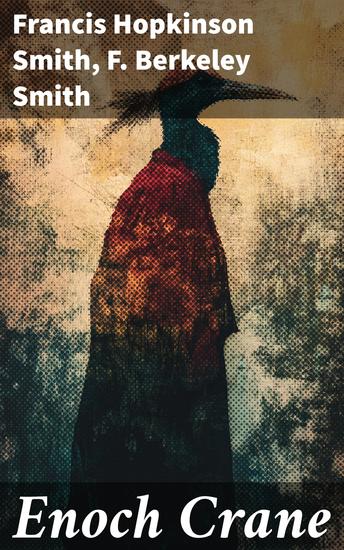
Enoch Crane - cover

Enoch Crane

Francis Hopkinson Smith, F. Berkeley Smith

Publisher: Good Press

  • 0
  • 0
  • 0

Summary

In 'Enoch Crane,' readers are invited to traverse an expansive literary landscape that deftly interweaves themes of identity, perseverance, and the inescapable pull of destiny. Spanning a range of styles from rich, atmospheric prose to insightful narrative voices, this collection captures the nuanced tapestry of human experience. The anthology's standout pieces craft narratives that echo with universal truths, exploring both the complexities and simplicities of life without attributing singularity to any one author. The literary context of the collection situates it as both a reflection and an innovator in its depiction of life's inevitable transformations. The combined efforts of Francis Hopkinson Smith and F. Berkeley Smith offer a mosaic of voices drawing from their diverse backgrounds and shared literary heritage. As contributors to the ongoing dialogue within literary and artistic movements of their time, they provide a vivid tapestry that traverses cultural and historical landscapes. This anthology embodies such an eclectic array of influences and talents, thereby enriching the thematic exploration of 'Enoch Crane.' Their collaborative contributions highlight the perennial human quest for meaning amidst life's uncertainties, bridging past narratives with present insights. 'Epoch Crane' serves as an invaluable literary conduit for those eager to explore the rich textures and varied perspectives contained within a single volume. This anthology provides an educational and emotionally resonant journey through its multiplicity of voices. Readers who immerse themselves in this collection are offered opportunities to engage with a kaleidoscope of interpretations and styles, deepening their understanding of both self and society. Ultimately, the collection offers not just stories, but a dialogue that invites readers to ponder the interplay of destiny and identity in their own lives.
Available since: 03/02/2025.
Print length: 200 pages.

Other books that might interest you

  • Guide to Health A - Audiobook - cover

    Guide to Health A - Audiobook

    Mahatma Gandhi, Classic...

    • 0
    • 0
    • 0
    In A Guide to Health, Mahatma Gandhi sets forth his philosophy of simple living, self-discipline, and the intimate connection between body and spirit. Written with clarity and conviction, the book emphasizes natural methods of maintaining health, advocating for moderation, vegetarianism, and a life of balance and restraint. Gandhi believed that true well-being comes not from indulgence, but from self-control and harmony with nature.The text is not a technical medical manual but rather a reflection on how one can live in alignment with both physical health and moral duty. Gandhi's advice ranges from diet and hygiene to the importance of personal responsibility in maintaining one's own vitality. His approach reveals the unity of physical, mental, and ethical health as essential to a fulfilling life.For modern readers and listeners, A Guide to Health remains a timeless call to simplicity. It invites us to consider how conscious choices in daily living—what we eat, how we care for ourselves, and how we view health—can shape a more meaningful existence.
    Show book
  • The Valley of Fear - cover

    The Valley of Fear

    Arthur Conan Doyle

    • 0
    • 0
    • 0
    "The valley of fear, the valley of death. The terror is in the hearts of the people from the morning to the night."
    
    A cipher message from a mole in Professor Moriarty's organization warns Sherlock Holmes of a looming danger to a country gentleman named John Douglas. Before Holmes can act, news arrives of a gruesome murder at Birlstone Manor—a moated house where the victim was killed with a bizarre American weapon. The room is locked, the drawbridge is up, and yet the killer has vanished.
    
    The Brotherhood of Terror: The investigation takes a sudden, cinematic turn across the Atlantic to the coal mines of Pennsylvania. Here, the "Valley of Fear" is ruled by a murderous secret society known as the Scowrers. Through the eyes of the daring Jack McMurdo, readers witness a world of infiltration, betrayal, and high-stakes espionage that predates the modern noir thriller.
    
    Holmes's Darkest Rivalry: Unlike other Holmes adventures, The Valley of Fear highlights the terrifying reach of Professor Moriarty. Even from the safety of London, the "Napoleon of Crime" pulls the strings of a global web of violence. This novel is a relentless, two-part epic that proves that even in the most isolated corners of the world, no one is truly safe from the consequences of their past.
    
    Two worlds. One secret. A trail of blood that spans an ocean. Purchase "The Valley of Fear" today and see if you can outguess the Master of Deduction.
    Show book
  • Gooseberries - From their pens to your ears genius in every story - cover

    Gooseberries - From their pens...

    Anton Chekhov

    • 0
    • 0
    • 0
    Anton Pavlovich Chekhov was born on 29th January 1860 in Taganrog, on the south coast of Russia.  
    His family life was difficult; his father was strict and over-bearing but his mother was a passionate story-teller, a subject Chekhov warmed to. As he later said; ‘our talents we got from our father, but our soul from our mother’.  
    At school Chekhov was distinctly average. At 16 his father mis-managed his finances and was declared bankrupt. His family fled to Moscow. Chekhov remained and eked out a living by various means, including writing and selling short sketches to newspapers, to finish his schooling. That completed and with a scholarship to Moscow University obtained he rejoined his family. 
    He was able to help support them by selling satirical sketches and vignettes of Russian lifestyles and gradually obtained further commissions. In 1884, he qualified as a physician and, although it earned him little, he often treated the poor for free, he was fond of saying ‘Medicine is my lawful wife, and literature is my mistress.’ 
    His own health was now an issue as he began to cough up blood, a symptom of tuberculosis.  Despite this his writing success enabled him to move the family into more comfortable accommodation.  
    Chekhov wrote over 500 short stories which included many, many classics including ‘The Kiss’ and ‘The Lady with a Dog’.  His collection ‘At Dusk’ won him the coveted Pushkin Prize when was only 26.  
    He was also a major playwright beginning with the huge success of ‘Ivanov’ in 1887.   
    In 1892 Chekhov bought a country estate north of Moscow. Here his medical skills and money helped the peasants tackle outbreaks of cholera and bouts of famine. He also built three schools, a fire station and a clinic.  It left him with less time for writing but the interactions with real people gained him detailed knowledge about the peasantry and their living conditions for his stories.  
    His most famous work, ‘The Seagull’ was received disastrously at its premiere in St Petersburg. It was later restaged in Moscow to highlight its psychological aspects and was a huge success. It led to ‘Uncle Vanya’, ‘The Three Sisters’ and ‘The Cherry Orchard’.  
    Chekhov suffered a major lung hemorrhage in 1897 while visiting Moscow. A formal diagnosis confirmed tuberculosis and the doctors ordered changes to his lifestyle.  
    Despite a dread of weddings the elusive literary bachelor quietly married the actress Olga Knipper, whom he had met at rehearsals for ‘The Seagull’, on 25th May 1901. 
    By May 1904 with his tuberculosis worsening and death imminent he set off for the German town of Badenweiler writing cheerful, witty letters to his family and assuring them his health was improving.  
    On 15th July 1904 Anton Chekhov died at Badenweiler.  He was 44.
    Show book
  • A Pair of Blue Eyes - cover

    A Pair of Blue Eyes

    Thomas Hardy

    • 0
    • 0
    • 0
    Immerse yourself in the evocative world of "A Pair of Blue Eyes" by Thomas Hardy, a tale of love, social class, and inner conflict. Follow the beautiful and naive Elfride Swancourt as she becomes entangled in a romantic triangle with the ambitious architect Stephen Smith and the intellectual but troubled Henry Knight. Set against the rugged Cornish landscape, this poignant novel explores the pressures of societal expectations and the complexities of human emotions. Hardy's rich narrative and vivid characters create an enduring story of passion, heartbreak, and self-discovery.
    Show book
  • The Kiss - From their pens to your ears genius in every story - cover

    The Kiss - From their pens to...

    Guy de Maupassant

    • 0
    • 0
    • 0
    Henri René Albert Guy de Maupassant was born on August 5th, 1850 near Dieppe in France.  
    Maupassant’s early life was badly torn when at age 11 (his younger brother Hervé was then five) his mother, Laure, a headstrong and independent-minded woman, risked social disgrace in order to obtain a legal separation from her husband. 
    After the separation, Laure kept custody of her two boys. With the father now forcibly absent, Laure became the most influential and important figure in the young boy's life.   
    Maupassant’s education was such that he rebelled against religion and other societal norms but a developing friendship with Gustave Flaubert began to turn his mind towards creativity and writing. 
    After graduation he volunteered for the Franco-Prussian war. With its end he moved to Paris to work as a clerk in the Navy Department.  Gustave Flaubert now took him under his wing.  Acting as a literary guardian to him, he guided the eager Maupassant to debuts in journalism and literature.  For Maupassant these were exciting times and the awakening of his creative talents and ambitions. 
    In 1880 he published what is considered his first great work, ‘Boule de Suif’, (translated as as ‘Dumpling’, ‘Butterball’, ‘Ball of Fat’, or ‘Ball of Lard’) which met with a success that was both instant and overwhelming.  Flaubert at once acknowledged that it was ‘a masterpiece that will endure.’ Maupassant had used his talents and experiences in the war to create something unique.  
    This decade from 1880 to 1891 was to be the most pivotal of his career.  With an audience now made available by the success of ‘Boule de Suif’ Maupassant organised himself to work methodically and relentlessly to produce between two and four volumes of work a year.  The melding of his talents and business sense and the continual hunger of sources for his works made him wealthy. 
    In his later years he developed a desire for solitude, an obsession for self-preservation, and a fear of death as well as a paranoia of persecution caused by the syphilis he had contracted in his youth.  
    On January 2nd, 1892, Maupassant tried to commit suicide by cutting his throat.  Unsuccessful he was committed to the private asylum of Esprit Blanche at Passy, in Paris.  It was here on July 6th, 1893 that Henri René Albert Guy de Maupassant died at the age of only 42.
    Show book
  • Little Boy Lost - cover

    Little Boy Lost

    Marghanita Laski

    • 0
    • 0
    • 0
    Marghanita Laski’s novel Little Boy Lost is as enthralling as it is heart-wrenching. A man grapples with questions of emotional responsibility, fatherhood, and memory. Laski describes a much-changed France, struggling to rebuild its morale after the ruin caused by wartime bombing and occupation.English writer Hilary Wainwright lost all trace of his young son when Lisa, his wife, was killed by the Gestapo in Paris. Several years later, an acquaintance travels to England with news that Hilary’s son may be alive in France. Doubting whether five-year-old Jean is indeed his, and determined not to feel vulnerable to love and tenderness again, Hilary travels to France to find the boy. Amidst a war-torn Northern French town, he gets to know young Jean, as well as the town’s inhabitants. In a matter of days Hilary must decide if this charming and intelligent child could be his own . . . and if he is prepared to take Jean home.Little Boy Lost is part of the Persephone Audiobook Collection, a series of forgotten classics including neglected fiction and non-fiction by women writers. First published in 1949, this edition includes a new afterword by Anne Sebba.
    Show book