Join us on a literary world trip!
Add this book to bookshelf
Grey
Write a new comment Default profile 50px
Grey
Subscribe to read the full book or read the first pages for free!
All characters reduced
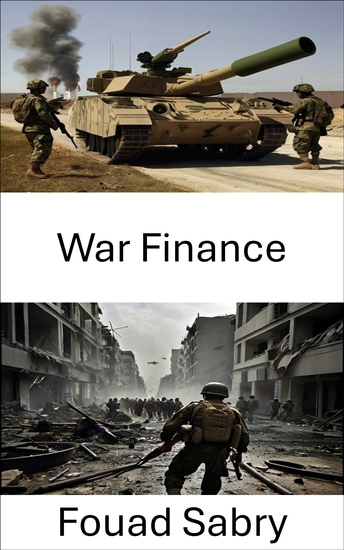
War Finance - Strategic Funding for Modern Combat Operations - cover

War Finance - Strategic Funding for Modern Combat Operations

Fouad Sabry

Publisher: One Billion Knowledgeable

  • 0
  • 0
  • 0

Summary

What is War Finance
 
There is a subfield of defense economics known as war finance. It is the economic base of a military that determines its might, and without this financial support, soldiers will not be paid, weapons and equipment will not be made, and food will not be purchased. In light of this, achieving victory in a war requires not only achieving success on the battlefield but also achieving economic dominance and maintaining economic stability within a state. The term "war finance" refers to a wide range of financial programs, including fiscal and monetary efforts, that are implemented in order to support the expensive expenditures that are associated with a war.
 
How you will benefit
 
(I) Insights, and validations about the following topics:
 
Chapter 1: War finance
 
Chapter 2: Tax
 
Chapter 3: Government bond
 
Chapter 4: Fiscal policy
 
Chapter 5: Fiscal multiplier
 
Chapter 6: Deficit spending
 
Chapter 7: Public finance
 
Chapter 8: Government budget balance
 
Chapter 9: Debt of developing countries
 
Chapter 10: Government debt
 
(II) Answering the public top questions about war finance.
 
Who this book is for
 
Professionals, undergraduate and graduate students, enthusiasts, hobbyists, and those who want to go beyond basic knowledge or information for any kind of War Finance.
Available since: 06/23/2024.
Print length: 136 pages.
Other books that might interest you

  • Nuremberg Trials - Bringing Nazi War Criminals to Justice after the War - cover

    Nuremberg Trials - Bringing Nazi...

    Sage Winters

    • 0
    • 0
    • 0
    The Nuremberg Trials were a series of military tribunals held after World War II to prosecute prominent leaders of Nazi Germany for crimes committed during the war. These trials were a defining moment in the history of international law and marked the first time that individuals were held accountable on an international stage for atrocities committed by a regime. The trials took place in the city of Nuremberg, Germany, from 1945 to 1949, and were conducted by the Allied powers—the United States, the Soviet Union, the United Kingdom, and France—who sought to bring justice to the victims of the Holocaust, forced labor, and widespread destruction caused by the Nazis. 
      
    The importance of the Nuremberg Trials lies not only in their role in punishing the architects of Nazi terror but also in establishing legal precedents that continue to influence the field of international criminal law today. The trials were based on the premise that individuals, including political and military leaders, could be held personally accountable for violations of international law, including war crimes, crimes against humanity, and crimes against peace. This principle challenged the notion that state leaders were immune from prosecution under the guise of sovereignty, a concept that had previously been accepted in international relations.
    Show book
  • The Communist Manifesto - cover

    The Communist Manifesto

    Karl Marx

    • 0
    • 0
    • 0
    A world divided. A system in crisis. A document that ignited a global movement.
    Written in 1848 at a moment of rising unrest, The Communist Manifesto lays out Marx and Engels's bold vision of class struggle, economic injustice, and the power of collective action. With clarity and urgency, it exposes the tensions between workers and capital, challenges the foundations of modern society, and calls on the oppressed to reshape the future.
    
    Celebrated as "one of the most influential political texts ever written," this manifesto continues to spark debate, inspire social movements, and shape discussions about power, inequality, and human rights. Its ideas remain as provocative and relevant today as they were more than a century ago.
    
    If you're drawn to political philosophy, social justice, or foundational works that changed world history, this essential classic offers a powerful lens on how societies rise, fall, and transform.
    
    Open the book—and explore the ideas that still challenge the world.
    Show book
  • Holy Roman Empire’s Conflicts with the Vatican The: The History of the Medieval Wars that Fractured Germany and Italy - cover

    Holy Roman Empire’s Conflicts...

    Charles River Editors

    • 0
    • 0
    • 0
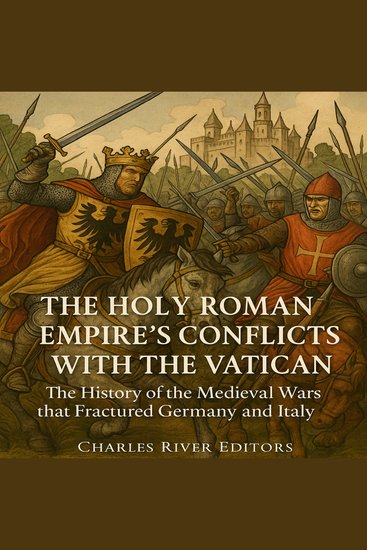
    It has been famously pointed out that the Holy Roman Empire was neither holy, nor Roman, but it was also not an empire in the sense people expect when hearing the term. In theory, the emperor was the highest prince in Christendom, and his dominion extended the length and breadth of Western Europe. The empire had been created by the papacy in 801 when Pope Leo the Third famously crowned the supposedly unwitting Charlemagne in Saint Peter’s Basilica, intending to recreate the Western Roman Empire. In truth, the imperial power did not extend beyond central Europe, which by the beginning of the 16th century included Germany, northern Italy, and the Netherlands. Even in these lands, however, the emperor struggled to command obedience. His dominion over northern Italy was theoretical only, the cities of the Netherlands were deeply conscious of their ancient rights and privileges, and Germany had long ceased to be compliant. The latter had become a collection of principalities, dukedoms and bishoprics which vied with each other and pursued their own agendas. They were, however, united in only one sense: denying the emperor power and resisting attempts to centralize the government.  
    	At the same time, the secular sovereigns frequently butted heads with religious authorities back in Rome, and arguably none of the conflicts were as crucial as the War of the Keys and the Investiture Controversy. The tensions between the Holy Roman Empire and Church over the power to invest bishops with authority led to decades of civil war in Germany on the way to establishing the relationship between Church and state, elevating the status of the papacy and weakening the Holy Roman Empire. What is crucial in understanding the conflicts is to not view them with the benefit of hindsight. Most importantly, no nation as people recognize it today yet existed, as England, France, Germany, and Italy were largely geographical expressions, not national identities.
    Show book
  • Against the Grain - How Farmers around the Globe Are Transforming Agriculture to Nourish the World and Heal the Planet - cover

    Against the Grain - How Farmers...

    Roger Thurow

    • 0
    • 0
    • 0
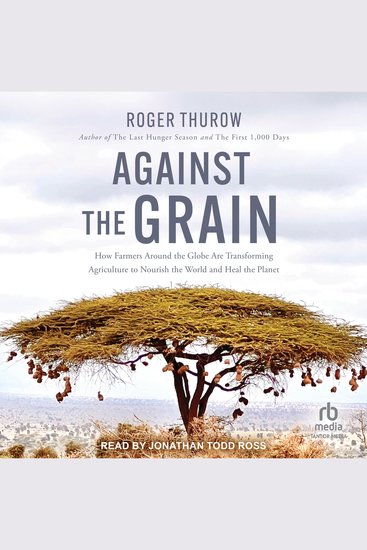
    Farmers in some of the world's oldest agricultural areas were toiling year after year, only to find that modern industrial agriculture was turning on itself. Industrial agriculture's effects on our climate and environment were multiplying and worsening, until the very families growing the world's food were starving. 


    They terraced the land to catch more rainwater and prevent soil runoff; they planted a diverse range of vegetables that would balance the nutrients in the soil; they replaced commercial fertilizers with organic matter from their own farms; they planted more trees and drought-resistant grains; and, perhaps most importantly, they taught their communities by example that these regenerative farming methods paid off—both in nourishing their families and in bringing their land back to life. 


    Award-winning author and journalist Roger Thurow has traveled to Ethiopia, Uganda, Kenya, India, Guatemala, Peru, and the United States to share their stories, highlighting the conflicts inherent in our most important human endeavor: feeding the world using the methods of industrial agriculture is stripping the land of its ability to feed future generations. But these farmers are starting a new kind of revolution, nourishing both humans and the land, and following their lead could help us solve one of the great crises of our time.
    Show book
  • Scientific Method and Critical Thinking - Master the Foundations of Science Through Analytical Reasoning and Evidence-Based Problem Solving - cover

    Scientific Method and Critical...

    Virversity Online Courses

    • 0
    • 0
    • 0
    Explore essential principles of scientific inquiry and develop strong critical thinking skills with this comprehensive course on the Scientific Method and Critical Thinking. Designed to enhance analytical abilities, it equips you to conduct reliable experiments, evaluate evidence effectively, and communicate results clearly.Master Scientific Methods and Enhance Critical Thinking Skills:- Formulate testable hypotheses from observations.- Design experiments controlling variables for accuracy.- Develop data collection and analysis skills for valid conclusions.- Identify logical fallacies and maintain objectivity.- Understand basic statistics, distinguishing correlation from causation.- Learn the importance of peer review and replication.- Improve scientific communication via writing and presentations.- Apply critical thinking in everyday decision-making.Starting with scientific inquiry foundations, you’ll learn how observation leads to reliable hypotheses. The course guides you in designing controlled experiments to minimize errors and ensure trustworthy findings, emphasizing accurate data collection and analysis.It also covers critical thinking essentials like spotting logical fallacies, evaluating evidence quality, and maintaining scientific integrity by recognizing bias. You’ll explore basic statistics and the crucial difference between correlation and causation.Beyond experiments, the course examines the scientific process, including peer review, replication, and clear result communication. Finally, these critical thinking skills extend to everyday situations, helping you reason effectively beyond science.By course completion, you’ll gain a solid grasp of the scientific method and advanced critical thinking, empowering you to solve problems systematically, evaluate information critically, and communicate confidently—enhancing both academic and real-world reasoning.
    Show book
  • AP Calculus AB Premium Prep : Effortless Strategies for Success - "Unlock success in AP Calculus AB with powerful audio strategies for effortless exam mastery!" - cover

    AP Calculus AB Premium Prep :...

    Cyrus Lockridge

    • 0
    • 0
    • 0
    AP Calculus AB Premium Prep: Effortless Strategies for Success  
    ⭐ ⭐ Simplified Guide & Explanations Included ⭐ ⭐ 
    Are you aiming to advance your academic journey and strengthen your understanding by successfully mastering AP Calculus AB? 
    In search of a comprehensive resource that encompasses everything you need to excel in AP Calculus AB? 
    Your quest ends here! 
    This guide is your ultimate companion for enhancing your comprehension, applying your skills, and engaging in practical exercises. With this tool, you're set for success. 
    Updated for the 2024-2025 AP Calculus AB Exam Format. 
    Key features of this enhanced guide: 
    - In-depth insights into the AP Calculus AB Certification 
    - Thorough explanation of calculus principles 
    - Effective strategies for exam preparation and problem-solving 
    Our guide stands out with its extensive coverage, vital for your exam triumph. Concepts aren't just glossed over; they are explored in detail. 
    Please note that this guide is an independent resource and is not affiliated with any official AP organization. 
    Crafted with a clear structure and accessible language, our AP Calculus AB Guide ensures seamless transitions between topics. Say goodbye to complex jargon and embrace clear, concise, and technically accurate content. 
    So, why hold back? Click the BUY NOW button, secure your guide, and begin your journey to AP Calculus AB success!
    Show book