Join us on a literary world trip!
Add this book to bookshelf
Grey
Write a new comment Default profile 50px
Grey
Subscribe to read the full book or read the first pages for free!
All characters reduced
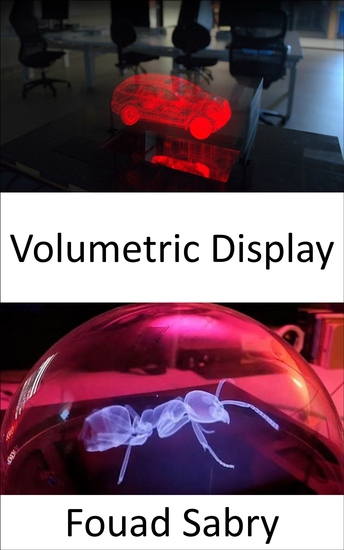
Volumetric Display - Star Wars-inspired Tech You Can Buy Right Now - cover

Volumetric Display - Star Wars-inspired Tech You Can Buy Right Now

Fouad Sabry

Publisher: One Billion Knowledgeable

  • 0
  • 0
  • 0

Summary

What Is Volumetric Display
 
A volumetric display device is a graphic display device that forms a visual representation of an object in three physical dimensions, as opposed to the planar image of traditional screens that simulate depth through a number of different visual effects. One definition offered by pioneers in the field is that volumetric displays create 3D imagery via the emission, scattering, or relaying of illumination from well-defined regions in (x,y,z) space.
 
How You Will Benefit
 
(I) Insights, and validations about the following topics:
 
Chapter 1: Volumetric display
 
Chapter 2: Photolithography
 
Chapter 3: Holography
 
Chapter 4: Stereoscopy
 
Chapter 5: Voxel
 
Chapter 6: Tomography
 
Chapter 7: Display device
 
Chapter 8: Scientific visualization
 
Chapter 9: Optical coherence tomography
 
Chapter 10: Volume rendering
 
Chapter 11: Light field
 
Chapter 12: Stereo display
 
Chapter 13: Autostereoscopy
 
Chapter 14: HoloVID
 
Chapter 15: Holographic display
 
Chapter 16: Structured-light 3D scanner
 
Chapter 17: Spinning mirror system
 
Chapter 18: Multiscopy
 
Chapter 19: Microscanner
 
Chapter 20: MotionParallax3D
 
Chapter 21: Scanning Fiber Endoscope (SFE)
 
(II) Answering the public top questions about volumetric display.
 
(III) Real world examples for the usage of volumetric display in many fields.
 
(IV) 17 appendices to explain, briefly, 266 emerging technologies in each industry to have 360-degree full understanding of volumetric display' technologies.
 
Who This Book Is For
 
Professionals, undergraduate and graduate students, enthusiasts, hobbyists, and those who want to go beyond basic knowledge or information for any kind of volumetric display.
Available since: 02/21/2022.
Print length: 296 pages.
Other books that might interest you

  • Connecting Care - Unlocking the Potential of Electronic Health Records to Unite Patients and Providers - cover

    Connecting Care - Unlocking the...

    Ken Hoffman, Gilbert Pant

    • 0
    • 0
    • 0
    Discover the missed opportunities and untapped potential of electronic health records (EHRs) with Connecting Care. Utilizing both technological and clinical perspectives, Ken Hoffman and Gilbert Pant delve into the evolution of EHRs, offering a candid look at their successes and shortcomings. This book presents a compelling case for how EHRs can enhance clinical decision-making, improve patient experiences, and streamline administrative processes.
    Show book
  • Know about "giordano bruno" - a friar philosopher mathematician astronomer & occultist - cover

    Know about "giordano bruno" - a...

    Saurabh Singh Chauhan

    • 0
    • 0
    • 0
    This is small copy of introduction of the book: Giordano Bruno was a 16th-century Italian friar, philosopher, mathematician, astronomer, and occultist. He is best known for his cosmological theories, which anticipated the Copernican model of the universe and held that the stars are distant suns surrounded by their own planets. Bruno's ideas were considered heretical by the Catholic Church, and he was burned at the stake in Rome in 1600. 
    Bruno was born in Nola, Italy, in 1548. He joined the Dominican Order at the age of 15, but he soon became disillusioned with the Church's teachings. He left the Order in 1572 and began to travel throughout Europe, teaching his ideas about cosmology and philosophy. 
    In 1576, Bruno published his book On the Shadows of the Ideas, in which he outlined his cosmological theories. He argued that the universe is infinite and that it contains many inhabited worlds. He also rejected the Aristotelian view of the universe as a finite sphere centered on the Earth.  
    Bruno's ideas were controversial from the start. He was accused of heresy by the Catholic Church and forced to flee Geneva in 1583. He then spent several years in France, where he was protected by King Henry III. However, after Henry's death in 1589, Bruno was forced to flee again. 
    In 1591, Bruno returned to Italy. He was arrested in Venice in 1592 and extradited to Rome. He was put on trial for heresy and found guilty. On February 17, 1600, Bruno was burned at the stake in Campo de' Fiori. 
    Despite his execution, Bruno's ideas had a profound influence on later thinkers. His work helped to pave the way for the scientific revolution of the 17th century.
    Show book
  • Pitch Sketch Launch - What Sketch Comedy Can Teach Us About Product Development - cover

    Pitch Sketch Launch - What...

    John Krewson

    • 0
    • 0
    • 0
    Software development is no laughing matter. But it should be. 
    Backward management practices have hobbled what was once the world’s most innovative industry. The result? Wasted time and resources. Sinking morale. Dissatisfied customers. 
    Regaining software development’s groundbreaking spirit requires the type of bold, madcap thinking that originally defined it—and in Pitch, Sketch, Launch John Krewson presents a remarkable, proven template for revival. 
    Pitch, Sketch, Launch extracts the techniques used to create today’s most beloved comedy shows and applies them to revitalizing software development. It shines a spotlight on the sketch comedy world’s ethos of feedback-driven product deliveries and its playful search for original solutions. Insightful interviews, best practices, and case studies demonstrate how creating comedy applies to designing top-tier software. 
    Rethink what makes your creative team effective. Transform meetings into electrifying idea incubators. Rediscover the exhilaration of software innovation. Let Pitch, Sketch, Launch help you set the stage for producing your most adventurous work yet.
    Show book
  • Axiology - The Study of Values Ethics and What we Believe in - cover

    Axiology - The Study of Values...

    Mike Crawford

    • 0
    • 0
    • 0
    Axiology, the branch of philosophy that studies the nature of values, plays a crucial role in understanding human beliefs, decisions, and behaviors. This chapter introduces the concept of axiology, emphasizing its importance in ethics and how it influences not just personal conduct but also societal norms and expectations. At its core, axiology is concerned with two primary components: value theory and the study of ethics. These two areas work in tandem, guiding individuals in understanding what is good, right, or desirable, and shaping their actions accordingly. 
    The term "axiology" comes from the Greek words "axios," meaning value, and "logos," meaning study or discourse. Axiology thus represents the study of values in the most comprehensive sense, ranging from personal preferences to the collective ethical standards that govern entire societies. The study of values is fundamental to various fields such as ethics, psychology, politics, and education, providing a framework for determining what is valuable in different contexts. Values themselves can take many forms, including moral values, aesthetic values, social values, and economic values, each influencing behavior in unique ways. 
    Understanding values is essential because they serve as the foundation upon which we build our beliefs, attitudes, and actions. From an individual perspective, values guide the decisions we make daily—whether in choosing a career, deciding what is right or wrong, or determining what we prioritize in life.
    Show book
  • RoboNexus - Bridging Realms: The Confluence of Mechanics Electronics and Programming - cover

    RoboNexus - Bridging Realms: The...

    Hannah Mitchell

    • 0
    • 0
    • 0
    Greetings from the cutting edge of "RoboNexus: Bridging Realms," where programming, electronics, and mechanics join together to open the door to a brand-new era of creativity and discovery. This book thoroughly explores the exciting field of robotics and is your pass to the dynamic junction of these three domains. 
    By inviting amateurs, students, and experts alike to explore the fascinating world where mechanics, electronics, and programming are flawlessly blended, "RoboNexus" encourages them to do so. This book will pique your curiosity and introduce you to a world in which the lines between the digital and the physical worlds are blurred, regardless of whether you are an aspiring engineer, an inquisitive tech enthusiast, or a seasoned professional. 
    When you immerse yourself in the desire to understand how mechanics, electronics, and programming combine to give life to robotic creations, you will undoubtedly experience a surge of interest. "RoboNexus" reveals the mysteries behind the synergy, offering a complete guide that stokes your excitement and intensifies your desire to become an expert in the complicated dance between gears, circuits, and code.
    Show book
  • Environmental Science - Challenges and Solutions for a Healthier Planet - cover

    Environmental Science -...

    Jeron Iris

    • 0
    • 0
    • 0
    Environmental Science is an interdisciplinary field that integrates various scientific disciplines to study the natural world and the impact of human activities on it. This branch of science explores the complex interactions between living organisms, their physical surroundings, and the broader ecosystems they form. The primary goal of environmental science is to understand how natural systems function, identify environmental problems, and develop strategies for addressing these issues. 
      
    At its core, environmental science seeks to answer fundamental questions about the earth's resources, how they are used, and how human actions influence the balance of ecosystems. It draws from biology, chemistry, physics, geology, and social sciences to provide a comprehensive understanding of the environment. For example, ecology, the study of living organisms and their relationships to each other and their surroundings, is a central component of environmental science. By examining the dynamics of ecosystems, scientists can assess the health of the environment and predict the effects of human activities such as urbanization, deforestation, and pollution. 
    One of the primary focuses of environmental science is resource management. As the global population continues to grow, the demand for natural resources such as water, energy, and food increases. Environmental scientists work to ensure that these resources are used sustainably, balancing the needs of current populations with the preservation of resources for future generations. This includes studying renewable resources, such as solar and wind energy, and nonrenewable resources, like fossil fuels, to understand their availability and impact on the environment.
    Show book