Join us on a literary world trip!
Add this book to bookshelf
Grey
Write a new comment Default profile 50px
Grey
Subscribe to read the full book or read the first pages for free!
All characters reduced
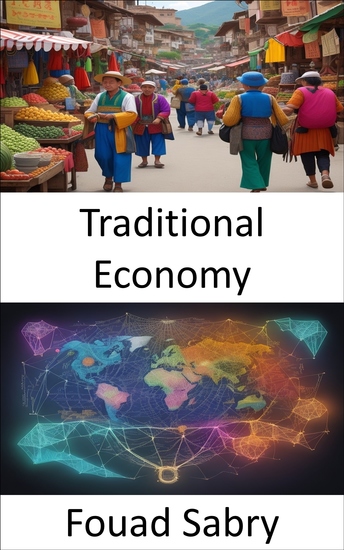
Traditional Economy - Traditional Economy Nurturing Sustainability and Cultural Resilience for a Modern World - cover

Traditional Economy - Traditional Economy Nurturing Sustainability and Cultural Resilience for a Modern World

Fouad Sabry

Publisher: One Billion Knowledgeable

  • 0
  • 0
  • 0

Summary

What is Traditional Economy
 
A traditional economic system is one that is founded on ancient practices, historical precedents, and long-held beliefs. A traditional economy is a type of economic system in which the commodities and services that are produced by the economy, as well as the rules and manners in which they are distributed, are influenced by the traditions, practices, and beliefs that are prevalent in the economy. There is a strong correlation between this type of economic structure and rural and agriculturally-based nations. Bartering and trading are the defining characteristics of a traditional economy, which is often referred to as a subsistence economy. When there is a small surplus of products produced, they are often distributed to a controlling authority or landowner. If there is any surplus of goods, they are also distributed.
 
How you will benefit
 
(I) Insights, and validations about the following topics:
 
Chapter 1: Traditional economy
 
Chapter 2: Economy of Haiti
 
Chapter 3: Subsistence agriculture
 
Chapter 4: Economic system
 
Chapter 5: Dependency theory
 
Chapter 6: Subsistence economy
 
Chapter 7: Mangyan
 
Chapter 8: Plantation economy
 
Chapter 9: Dual economy
 
Chapter 10: Moral economy
 
Chapter 11: Antebellum South
 
Chapter 12: Economy
 
Chapter 13: Nutritional anthropology
 
Chapter 14: Transition economy
 
Chapter 15: Spheres of exchange
 
Chapter 16: Agriculture in Costa Rica
 
Chapter 17: Peasant economics
 
Chapter 18: Political economy in anthropology
 
Chapter 19: Formalist-substantivist debate
 
Chapter 20: Archaeology of trade
 
Chapter 21: Work (human activity)
 
(II) Answering the public top questions about traditional economy.
 
(III) Real world examples for the usage of traditional economy in many fields.
 
Who this book is for
 
Professionals, undergraduate and graduate students, enthusiasts, hobbyists, and those who want to go beyond basic knowledge or information for any kind of traditional economy.
Available since: 01/08/2024.
Print length: 193 pages.
Other books that might interest you

  • Right Relationship - Building a Whole Earth Economy - cover

    Right Relationship - Building a...

    Anonymous

    • 0
    • 0
    • 0
    In this groundbreaking guide to building an ethical economy, Peter Brown and his colleagues at the Quaker Institute for the Future show readers how a system that embodies the core Quaker principle of "right relationship" can deliver a more equitable and sustainable future.
    Show book
  • Dividend Investing - Complete Beginner's Guide to Learn How to Make Passive Income by Trading Dividend Stocks Start Achieving Financial Freedom and Planning Your Early Retirement - cover

    Dividend Investing - Complete...

    Mark Warren Anderson

    • 0
    • 0
    • 0
    Are you making the most of your investment opportunities by trading dividends?  
    Or are you sitting back with underperforming stocks, building your wealth sideways rather than upwards? 
    Nobody can predict the future, but betting on stocks is a good way for people who know what they're doing to make money. If you don't, it's a great way to lose everything. 
    If used as part of a diversified portfolio and grown over time, investing in dividend stocks is one of the safest, most practical, and highest wealth-building strategies. So, why aren't more people putting money into dividend stocks? They honestly don't know. You can, however. 
    Mark Warren Anderson, a financial consulting expert, has outlined everything you need to know to start a portfolio that will bring you wealth for life.  
    Dividend Investing Beginner's Guide will teach you:Step-by-step instructions for trading dividend stocks to build your empireHow to make a fortune regardless of your incomeBeginner investment strategies that will last a lifetimeLearn about 'the dividend kings', a select group of dividend stocks that have consistently paid out dividends for decadesExplore the world of bond investing and understand how to make it work for youInvest in mutual funds to diversify your portfolio and reduce riskDiscover techniques to take advantage of special dividend investing opportunities 
    And much more! 
    Is there any better reason to spend a few dollars on a book than the assurance that you will amass a fortune that you will be able to live off of for the rest of your life?  


    Show book
  • Road to Freedom The: Book Summary & Analysis - cover

    Road to Freedom The: Book...

    Briefly Summaries

    • 0
    • 0
    • 0
    This is a concise summary and analysis of The Road to Freedom, by Arthur C. Brooks.
     
    It is not the original book and is not affiliated with or endorsed by Arthur C. Brooks.
    Ideal those seeking a quick and insightful overview.
     
    The Road to Freedom explores the moral case for free enterprise as the foundation for a prosperous and just society. With compelling arguments and engaging storytelling, the book examines how personal liberty, innovation, and entrepreneurship empower individuals to build a better future. It challenges readers to rethink the role of government and the importance of ethical capitalism in achieving widespread opportunity and happiness. Perfect for anyone passionate about economics, social justice, or the American Dream, this book offers a roadmap to preserving freedom while fostering human dignity.
    Show book
  • Grow Rich While You Sleep - cover

    Grow Rich While You Sleep

    Ben Sweetland

    • 0
    • 0
    • 0
    Ben Sweetland’s Grow Rich While You Sleep is a compelling guide to harnessing the power of the subconscious mind to achieve wealth and success. Based on the principle that the mind continues to work even while the body rests, Sweetland explores how nighttime conditioning can lead to daytime prosperity. 
    The book breaks down how negative beliefs, self-doubt, and limiting thoughts prevent financial and personal success. By applying positive affirmations and subconscious reprogramming, readers can reshape their mental outlook, build self-confidence, and attract wealth. Sweetland explains the psychology behind success and provides practical techniques such as visualization, auto-suggestion, and goal-setting to condition the subconscious for abundance. 
    With a focus on financial prosperity as well as happiness, Grow Rich While You Sleep remains a timeless classic in personal development and wealth-building. It is ideal for those seeking to improve their mindset, overcome obstacles, and unlock the hidden potential of their minds to create a life of abundance.
    Show book
  • Essential Austrian Economics The (Essential Scholars) - cover

    Essential Austrian Economics The...

    Christopher J. Coyne, Peter J....

    • 0
    • 0
    • 0
    The origin of the Austrian School of economics is the publication of Carl Menger’s Principles of Economics in 1871. Menger, William Stanley Jevons, and Léon Walras are considered the co-founders of the “marginal revolution” in economics, a shift to the marginal utility theory of value from the labour theory of value. The revolutionists argued that value is not based on the amount of labour expended but reflects how useful people perceive the commodity to be in satisfying their ends. 
    This revolution had radical implications for the way economists understood the world: consumer valuations, and not the amount of effort, is what determines prices. But what determines consumer valuations? This question had long perplexed social scientists. Why do consumers value diamonds, a luxury item, more than water, an essential for life? By introducing the concept of marginal utility, Menger and his co-revolutionaries were able to resolve this paradox. 
    The labour theory of value, however, was not Menger’s only target in his Principles. He was also engaging the German Historical School, which held that economic science is incapable of producing universal principles. In contrast, Menger, using marginal utility analysis as a foundation, argued that universal economic laws do apply across time and geographic space. Those in the German Historical School took issue with the claims by Menger and his colleagues about the possibility of universal theory and labeled them the “Austrian School” because they taught at the University of Vienna. 
    Subsequent generations of scholars have developed the insights of the Austrian School. The purpose of this book is to present an overview of the key tenets of Austrian economics by synthesizing the insights from these thinkers in a set of eight topics that capture the core elements of Austrian economics.
    Show book
  • Fully Invested - Why Work-Life Balance Is a Total Lie - cover

    Fully Invested - Why Work-Life...

    Chad Willardson

    • 0
    • 0
    • 0
    Still chasing “work-life balance”? Stop. 
    That picture-perfect version of your life where everything fits neatly in its box? That’s not reality. Especially for a driven, ambitious, busy leader like you. 
    If you’re pursuing “work-life balance” so you don’t have to sacrifice anything, you’re likely sacrificing everything that matters.  
    The truth is that it is possible to be Fully Invested in both at the same time. You can be successful in business without abandoning your family, and you can be an incredible spouse, parent, or friend without giving up your big dreams of business success. 
    And that’s the good news: you can win big in business and at home—but it’s not about splitting your time and attention 50/50. It’s actually about deciding what you really want and going ALL IN. 100/100. 
    In Fully Invested™, Chad Willardson shares the exact game plan with seven strategies to help you drive massive growth in your business without sacrificing your marriage, your kids, your health, or your sanity. No theory—just straight talk and proven steps from someone living it today. 
    You’ll learn how to:Cut time-wasters to create space for what matters mostBuild a powerful network that pushes you higher in every area of lifeTake big action and transform your life (before you feel “ready”) 
    Stop settling. Your family and your business need the best version of you. They aren’t competing. 
    They’re both waiting for you to show up—Fully Invested. 
    Become Fully Invested Today!
    Show book