Join us on a literary world trip!
Add this book to bookshelf
Grey
Write a new comment Default profile 50px
Grey
Subscribe to read the full book or read the first pages for free!
All characters reduced
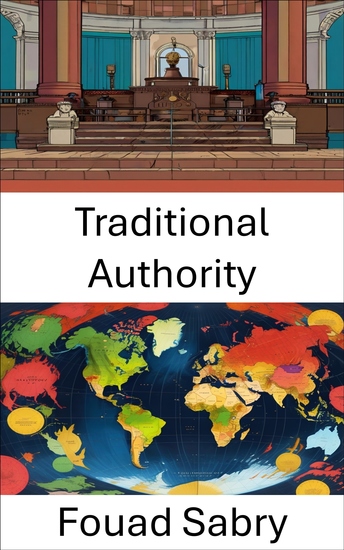
Traditional Authority - Understanding the Dynamics of Power and Legitimacy in Political Systems - cover

Traditional Authority - Understanding the Dynamics of Power and Legitimacy in Political Systems

Fouad Sabry

Publisher: One Billion Knowledgeable

  • 0
  • 0
  • 0

Summary

In today’s political landscape, the interplay between traditional leadership and modern governance is essential. "Traditional Authority," part of the esteemed "Political Science" series, explores this dynamic, revealing how ancient authority shapes contemporary politics.
 
1: Traditional Authority: Explore the foundational concepts of traditional authority and its enduring role in modern societies.
 
2: Max Weber: Dive into Max Weber’s theories on authority and his contributions to political sociology.
 
3: Charismatic Authority: Examine charismatic authority, its impact on political legitimacy, and its contrast with traditional forms.
 
4: Rational-legal Authority: Discover rational-legal authority and its role in contemporary governance, comparing it with traditional systems.
 
5: Patrimonialism: Analyze patrimonialism’s influence on political stability, offering a historical perspective on its impact.
 
6: Tripartite Classification of Authority: Understand Weber’s three types of authority and their relevance to traditional authority.
 
7: Authority (Sociology): Gain a broader view of authority in sociology, focusing on traditional authority's societal implications.
 
8: Legitimation Crisis: Explore how traditional authority can both contribute to and mitigate legitimacy crises in modern states.
 
9: Fengjian: Investigate Fengjian (feudalism) and its influence on Chinese political structures and traditional authority.
 
10: Feudalism in Pakistan: Delve into feudalism in Pakistan and its historical and modern implications on traditional authority.
 
11: Chinese Law: Examine traditional authority’s reflection in Chinese legal systems and its interaction with modern frameworks.
 
12: Political Sociology: Explore political sociology and how traditional authority influences political behavior.
 
13: Organizational Theory: Understand traditional authority's impact on organizational theory and political institutions.
 
14: Legitimacy (Political): Analyze traditional authority's role in establishing and maintaining political legitimacy.
 
15: Politics as a Vocation: Reflect on how traditional authority shapes political careers and vocations.
 
16: Proconsul: Investigate the historical role of proconsuls and their connection to traditional authority.
 
17: Sultanism: Explore Sultanism as a traditional authority form and its implications for governance.
 
18: Rationalization (Sociology): Understand rationalization and its impact on traditional authority structures.
 
19: Indian Feudalism: Delve into Indian feudalism's complexities and its influence on regional traditional authority.
 
20: Neopatrimonialism: Analyze neopatrimonialism and its relationship with traditional authority in modern politics.
 
21: French and Raven's Bases of Power: Examine French and Raven’s bases of power, focusing on their relevance to traditional authority.
Available since: 10/18/2024.
Print length: 244 pages.


Other books that might interest you

  • Data Independence - Reclaiming Privacy in an Era of Evolving Tech - cover

    Data Independence - Reclaiming...

    Wes Chaar

    • 0
    • 0
    • 0
    In a world where every interaction and transaction leave a digital footprint, our personal data has become the new currency. But who really benefits from this wealth of information? Join the data independence movement and reclaim your data power. Your data, your rules, your “data vote.”
    Show book
  • Fixer-Upper - How to Repair America’s Broken Housing Systems - cover

    Fixer-Upper - How to Repair...

    Jenny Schuetz

    • 0
    • 0
    • 0
    Much ink has been spilled in recent years talking about political divides and inequality in the United States. But these discussions too often miss one of the most important factors in the divisions among Americans: the fundamentally unequal nature of the nation's housing systems. 


    And this divide deepens other inequalities. Increasingly, important life outcomes—performance in school, employment, even life expectancy—are determined by where people live and the quality of homes they live in. 


    Public policies enacted by federal, state, and local governments helped create and reinforce the bad housing outcomes endured by too many people. Taxes, zoning, institutional discrimination, and the location and quality of schools, roads, public transit, and other public services are among the policies that created inequalities in the nation's housing patterns. 


    Fixer-Upper is the first book assessing how the broad set of local, state, and national housing policies affect people and communities. It proposes practical policy changes than can make stable, decent-quality housing more available and affordable for all Americans in all communities.
    Show book
  • Global and Historical Perspectives - Exploring the Past and Global Relations (4 in 1) - cover

    Global and Historical...

    Zoey Fraisers

    • 0
    • 0
    • 0
    Prepare to see world history and international dynamics through an entirely new lens. 
    This revealing collection examines the hidden forces that have shaped our past and continue to influence global affairs today. Drawing from declassified documents and scholarly research, this guide offers critical insights into history and international relations. 
    THE SHOCKING TRUTH ABOUT HISTORICAL EVENTS 
     How pivotal moments in history have been misrepresented in popular accounts. Uncover the concealed motivations behind famous conflicts, the suppressed perspectives of marginalized groups, and how historical narratives are crafted to serve political ends. 
    THE SHOCKING TRUTH ABOUT HISTORICAL FIGURES 
     The complex realities behind idealized or vilified historical personalities. Explore how cultural heroes often had troubling beliefs, supposed villains showed unexpected humanity, and how nuanced individuals are flattened into simplistic caricatures. 
    THE SHOCKING TRUTH ABOUT INTERNATIONAL RELATIONS 
     The hidden mechanisms driving nation-state behaviors beyond official diplomatic channels. Discover how economic interests frequently override stated values, the role of intelligence operations in shaping world events, and the power dynamics that determine which voices influence global policy. 
    THE SHOCKING TRUTH ABOUT INTERNATIONAL AID 
     The gap between humanitarian intentions and on-the-ground impacts. Learn how aid programs can perpetuate dependency, how funding is diverted from intended recipients, and which approaches actually deliver sustainable improvements versus those that primarily serve donor interests. 
    Knowledge creates informed citizens. 
    This essential guide transforms your understanding of history and global affairs, moving beyond simplistic narratives to reveal the complex truths that shape our world.
    Show book
  • On the Cannibals - cover

    On the Cannibals

    Michel de Montagrie

    • 0
    • 0
    • 0
    'I am not sorry we note the barbarous horror of cannibalism, but grieved that, prying so narrowly into their faults, we are so blinded in ours.'
    
    First translated into English in 1603, 'On the Cannibals' is an essay reflecting on a remarkable trip to Brazil which Michel de Montaigne undertook at the end of the sixteenth century.
    
    A study into the customs and practices of indigenous peoples in the Americas, Montaigne delves into the concept of 'civilisation', contrasting the behaviour of so-called 'barbarians' with Western society. He challenges the idea that European values are superior, understanding the practices of the Tupinambá people and arguing that the horrors inflicted by the soldiers of Portugal on their enemies at the time are – in many ways – far worse. It remains a persuasive and compelling argument for cultural relativism. This audiobook edition is expertly narrated by Malk Williams.
    Michael de Montaigne (1533 – 1592) was a French philosopher and writer, and a significant figure in the French Renaissance. He is widely known for popularising the essay, amalgamating anecdotes with memoir and intellect. He has been a huge influence on several Western writers, including William Shakespeare.
    Show book
  • The Pursuit of Dominance - 2000 Years of Superpower Grand Strategy - cover

    The Pursuit of Dominance - 2000...

    Christopher J. Fettweis

    • 0
    • 0
    • 0
    The United States is the most powerful actor in the international system, but it is facing a set of challenges that might lead to its decline as this century unfolds. 


    In The Pursuit of Dominance, Christopher J. Fettweis examines the grand strategy of previous superpowers to see how they maintained, or failed to maintain, their status. Over the course of six cases, from Ancient Rome to the British Empire, he seeks guidance from the past for present US policymakers. Like the United States, the examples Fettweis uses were the world's strongest powers at particularly moments in time, and they were hoping to stay that way. Rather than focusing on those powers' rise or how they ruled, however, Fettweis looks at how they sought to maintain their power. From these cases, one paramount lesson becomes clear: Dominant powers usually survive even the most incompetent leaders. Fettweis is most interested in how these superpowers defined their interests, the grand strategies these regimes followed to maintain superiority over their rivals, and how the practice of that strategy worked. 


    A sweeping history of grand strategy, The Pursuit of Dominance looks at the past 2,000 years to highlight what—if anything—current US strategists can learn from the experience of earlier superpowers.
    Show book
  • Ethics of Redistribution The: Book Summary & Analysis - cover

    Ethics of Redistribution The:...

    Briefly Summaries

    • 0
    • 0
    • 0
    This is a concise summary and analysis of The Ethics of Redistribution, by 
    Bertrand de Jouvenel.
     
    It is not the original book and is not affiliated with or endorsed by Bertrand de Jouvenel.
    Ideal those seeking a quick and insightful overview.
     
    In The Ethics of Redistribution, the author delves into the philosophical and economic implications of wealth redistribution, challenging commonly held assumptions about equality and social justice. The book explores the ethical boundaries of government intervention in economic systems, questioning whether redistributive policies truly benefit society or hinder individual freedoms and innovation. Through incisive arguments and historical examples, this work provides a thought-provoking critique of the role of the state in shaping economic fairness, making it an essential read for anyone interested in political philosophy, economics, or public policy.
    Show book