Join us on a literary world trip!
Add this book to bookshelf
Grey
Write a new comment Default profile 50px
Grey
Subscribe to read the full book or read the first pages for free!
All characters reduced
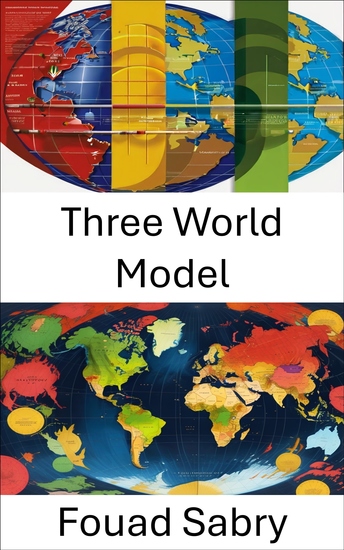
Three World Model - Exploring Global Political Frameworks and Their Implications - cover

Three World Model - Exploring Global Political Frameworks and Their Implications

Fouad Sabry

Publisher: One Billion Knowledgeable

  • 0
  • 0
  • 0

Summary

Explore the "Three World Model," a crucial addition to the Political Science series. This book introduces a transformative geopolitical theory that redefines our view of global dynamics and international cooperation. Ideal for professionals, students, and enthusiasts, it offers essential insights into the forces shaping our world today.
 
Chapter Overviews:
 
1. Three-world Model: Uncover the core concept and its impact on global geopolitics.
 
2. Sinatra Doctrine: Understand its Cold War influence on Soviet foreign policy.
 
3. Third World: Analyze Third World nations' rise and struggle for autonomy.
 
4. First World: Study First World nations' Cold War-era dominance.
 
5. Second World: Grasp the Second World’s geopolitical role in global stability.
 
6. Cold War: Gain insights into the ideological battles shaping modern order.
 
7. Origins of the Cold War: Explore the roots leading to global polarization.
 
8. Alfred Sauvy: Discover Sauvy’s contributions to international relations.
 
9. Three Worlds Theory: Delve into its framework and global power dynamics.
 
10. Contemporary History: Trace the Model’s evolution and current influence.
 
11. Western Europe: Investigate its role in the Cold War's geopolitical landscape.
 
12. Eastern Europe: Discover its strategic significance in global power balance.
 
13. Yalta Conference: Analyze its outcomes in shaping post-war politics.
 
14. Eastern Bloc: Understand its formation and Cold War significance.
 
15. Bamboo Curtain: Explore its geopolitical implications during the Cold War.
 
16. Cold War (1985–1991): Study the events leading to the Cold War’s end.
 
17. Modern Era: Assess the transition from Cold War to modern geopolitics.
 
18. Cold War (1962–1979): Examine key events during this critical period.
 
19. Iron Curtain: Understand its symbolic significance in Europe’s division.
 
20. Eastern Bloc Emigration: Analyze its impact on international relations.
 
21. Cold War (1947–1948): Explore foundational Cold War events.
 
Engage with the "Three World Model" to gain deep insights into global power dynamics and historical events that shape our world. This book is more than an academic resource; it's a valuable investment in understanding international relations.
Available since: 09/04/2024.
Print length: 416 pages.

Other books that might interest you

  • We Uyghurs Have No Say - An Imprisoned Writer Speaks - cover

    We Uyghurs Have No Say - An...

    Ilham Tohti

    • 0
    • 0
    • 0
    The words of China's most famous political prisoner 


    In Xinjiang, the large northwest region of China, the government has imprisoned more than a million Uyghurs in reeducation camps. One of the incarcerated—whose sentence, unlike most others, has no end date—is Ilham Tohti, an intellectual and economist, a prolific writer, and formerly the host of a website, Uyghur Online. In 2014, Tohti was arrested; accused of advocating separatism, violence, and the overthrow of the Chinese government; subjected to a two-day trial; and sentenced to life. Nothing has been heard from him since. 


    Here are Tohti's own words, a collection of his plain-spoken calls for justice, scholarly explanations of the history of Xinjiang, and poignant personal reflections. While his courage and outspokenness about the plight of China's Muslim minorities is extraordinary, these essays sound a measured insistence on peace and just treatment for the Uyghurs. 


    Winner of the PEN/Goldsmith Freedom to Write Award and the Sakharov Prize for Freedom of Thought while imprisoned, this book is the only way to hear from a man who has been called "a Uyghur Mandela."
    Show book
  • A Question of Standing - The History of the CIA - cover

    A Question of Standing - The...

    Rhodri Jeffreys-Jones

    • 0
    • 0
    • 0
    The mission of the CIA has always been intelligence. Seventy-five years ago, in the year of its creation, the National Security Act gave the agency, uniquely in world history up to that point, a democratic mandate to pursue that mission of intelligence. It gave the CIA a special standing in the conduct of United States foreign relations. That standing diminished when successive American presidents ordered the CIA to exceed its original mission. When they tasked the agency secretly to overthrow democratic governments, the United States lost its international standing, and its command of a majority in the United Nations General Assembly. Such dubious operations, even the government's embrace of assassination and torture, did not diminish the standing of the CIA in United States public opinion. However, domestic interventions did. CIA spying on domestic protesters led to tighter congressional oversight from the 1970s on. 


    A Question of Standing offers a balanced narrative and perspective on recognizable episodes in the CIA's history. Famous incidents include the Bay of Pigs invasion, the War on Terror, 9/11, the weapons of mass destruction deception, the Iran estimate of 2007, the assassination of Osama bin Laden, and Fake News. The book also defends the CIA's exposure of foreign meddling in United States elections.
    Show book
  • American Presidents in Diplomacy and War - Statecraft Foreign Policy and Leadership - cover

    American Presidents in Diplomacy...

    Thomas R. Parker

    • 0
    • 0
    • 0
    American Presidents in Diplomacy and War chronicles the major foreign policy crises faced by twelve American presidents in order to uncover the reoccurring patterns of successful and less successful uses of diplomatic, economic, and military power. In this book, Thomas R. Parker reveals how America's most successful leaders manage events instead of allowing events to control them. 


    Parker explores how the U.S. presidency, from the days of the early Republic to the present, shaped the world. Ranging from George Washington to George H. W. Bush, Parker shows how successful statecraft requires the understanding of complex situations, the prudent evaluation of various courses of action, the ability to adapt and to anticipate, and personal determination. Parker compares each of these leaders to their contemporaries—reasonable political leaders who nonetheless made serious mistakes, such as Thomas Jefferson and Barack Obama—to examine the dangers of being unable to strike the right balance of aggressiveness and caution and to examine the costs of inexperience and ambivalence toward military power. The book concludes by discussing the increasingly complex international situation of today, particularly the manifold challenges posed by China and Russia to U.S. foreign policy, and the continued necessity of effective statecraft.
    Show book
  • Ancient Myths And Nazi Propaganda - How Hitler Twisted Ancient History to Justify the Aryan Race Myth - cover

    Ancient Myths And Nazi...

    Davis Truman

    • 0
    • 0
    • 0
    A chilling exposé of how one of history’s most infamous regimes distorted the ancient past to engineer a deadly future. 
    In Ancient Myths and Nazi Propaganda, Davis Truman unveils the shocking ways Adolf Hitler and the Nazi elite co-opted classical mythology, archaeology, and pseudo-history to fabricate the myth of Aryan supremacy. Drawing from original documents, Nazi-era publications, and modern scholarship, this groundbreaking work exposes how ancient symbols and legends were weaponized to create a false historical narrative, one that fueled genocide, war, and the darkest chapter of the twentieth century. 
    From misused Greco-Roman iconography to twisted interpretations of Indo-European migration theories, Truman traces the roots of Nazi ideology through a manipulated lens of antiquity. He explores how fabricated “evidence” of ancient Aryan civilization was used to justify racial purity laws, territorial expansion, and the cultural erasure of entire populations. 
    With compelling clarity and academic precision, Ancient Myths and Nazi Propaganda offers a powerful warning: when history is rewritten to serve an ideology, the consequences are catastrophic. 
    Perfect for readers of history, politics, WWII studies, and anyone seeking to understand how ancient and modern myths can be used to manipulate truth and justify atrocity.
    Show book
  • The Architecture of Disability - Buildings Cities and Landscapes beyond Access - cover

    The Architecture of Disability -...

    David Gissen

    • 0
    • 0
    • 0
    Disability critiques of architecture usually emphasize the need for modification and increased access, but The Architecture of Disability calls for a radical reorientation of this perspective by situating experiences of impairment as a new foundation for the built environment. With its provocative proposal for "the construction of disability," this book fundamentally reconsiders how we conceive of and experience disability in our world. 


    Stressing the connection between architectural form and the capacities of the human body, David Gissen demonstrates how disability haunts the history and practice of architecture. Examining various historic sites, landscape designs, and urban spaces, he deconstructs the prevailing functionalist approach to accommodating disabled people in architecture and instead asserts that physical capacity is essential to the conception of all designed space. 


    By recontextualizing the history of architecture through the discourse of disability, Gissen presents a unique challenge to current modes of architectural practice, theory, and education. Envisioning an architectural design that fully integrates disabled persons into its production, it advocates for looking beyond traditional notions of accessibility and shows how certain incapacities can offer us the means to positively reimagine the roots of architecture.
    Show book
  • The Disunited States - Threats of Secession in Red and Blue America and Why They Won't Work - cover

    The Disunited States - Threats...

    Ryan D Griffiths

    • 0
    • 0
    • 0
    There is a growing interest in American secession. In February 2023, Marjorie Taylor Greene tweeted that "We need to separate by red states and blue states." Recent movements like Yes California have called for a national divorce along political lines. A 2023 Axios poll shows that 20 percent of Americans favor a national divorce. These trends show a sincere interest in American secession, and they will likely increase in the aftermath of the 2024 Presidential election.Proponents of secession make three arguments: the two sides have irreconcilable differences; secession is a legal right; and smaller political units are better. Through interviews with secessionist advocates in America, Ryan Griffiths explores the case for why Red America and Blue America should split up.But as The Disunited States shows, secession is the wrong solution to the problem of polarization. Red and Blue America are not neatly sorted and geographically concentrated. Splitting the two parts would require a dangerous unmixing of the population, one that could spiral into violence and state collapse. Drawing on his expertise on secessionism worldwide, he shows how the process has played out internationally—and usually disastrously. Ultimately, this book will disabuse listeners of the belief that secession will fix America's problems.
    Show book