Join us on a literary world trip!
Add this book to bookshelf
Grey
Write a new comment Default profile 50px
Grey
Subscribe to read the full book or read the first pages for free!
All characters reduced
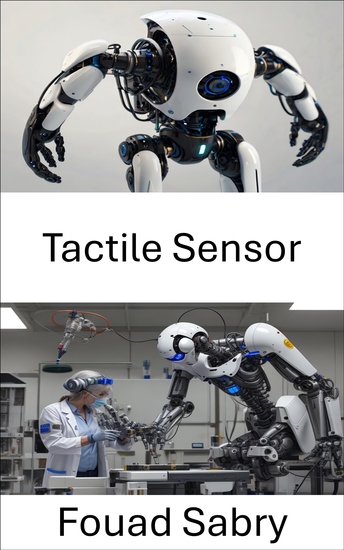
Tactile Sensor - Advancing Humanlike Perception in Robotic Touch Systems - cover

Tactile Sensor - Advancing Humanlike Perception in Robotic Touch Systems

Fouad Sabry

Publisher: One Billion Knowledgeable

  • 0
  • 0
  • 0

Summary

Explore the transformative world of tactile sensors, an essential facet of robotics science that bridges human touch and artificial perception. "Tactile Sensor" brings a unique journey for professionals, students, and robotics enthusiasts alike, offering a blend of theory and practical insights into cuttingedge haptic technology and robotic perception. This book serves as an invaluable resource in the exploration of tactile sensors, equipping readers with knowledge applicable across various industries.
 
Chapters Brief Overview:
 
1: Tactile sensor: An introduction to tactile sensors and their role in robotics applications.
 
2: Sensor: A detailed look at sensor technology as it pertains to touch perception.
 
3: Haptic technology: Unpacking the technology behind tactile feedback and interaction.
 
4: Strain gauge: Exploring strain gauges and their integration into haptic systems.
 
5: Mechanoreceptor: Insight into biological mechanoreceptors and their engineering parallels.
 
6: Touchscreen: Delving into touchscreen technology and its reliance on tactile sensors.
 
7: Simultaneous localization and mapping: Techniques for accurate mapping using tactile data.
 
8: Pacinian corpuscle: Understanding sensory structures that inspire tactile sensor designs.
 
9: Sensory substitution: How tactile sensors enable substitute perception in robotics.
 
10: Proximity sensor: The role of proximity sensors in enhancing tactile sensing systems.
 
11: Ultrasonic transducer: Using ultrasonic transducers for precise tactile feedback.
 
12: Machine perception: How tactile sensors inform machine perception in robotics.
 
13: Tactile discrimination: Techniques to enhance a robot’s tactile sensitivity.
 
14: Haptic perception: Bridging physical touch and digital perception in robots.
 
15: Capacitive sensing: Capacitive methods used to detect touch and pressure.
 
16: Robotics: A comprehensive view of tactile sensors’ role in robotic applications.
 
17: Somatosensory system: Drawing from biology to improve tactile sensing in machines.
 
18: Affective haptics: Emotional and social aspects of touch in haptic technology.
 
19: Robotic sensing: Core principles of tactile sensors in robotic perception.
 
20: Soft robotics: Soft robotics and its reliance on tactile sensing systems.
 
21: Artificial lateral line: Emulating nature’s lateral line for robotic tactile sensing.
 
This book is more than an academic resource—it’s an investment in understanding the future of robotics. Professionals, students, and hobbyists alike will find in this work the depth, utility, and inspiration necessary to advance their grasp of tactile sensing in today’s evolving world.
Available since: 01/28/2025.
Print length: 240 pages.

Other books that might interest you

  • From a Cowboy to a World-Renowned Inventor - The Extraordinary Life and Legacy of Slim Spurling - cover

    From a Cowboy to a...

    Slim Spurling

    • 0
    • 0
    • 0
    Discover the remarkable journey of Slim Spurling, a man whose roots as a cowboy led him to become a pioneering inventor with a global impact. In this inspiring audiobook, Slim’s tells his story from humble beginnings to groundbreaking discoveries in energy harmonizing technology. 
    Dive into the world of dowsing, geopathic stress, and the Hartmann grid, as Slim reveals his methods for restoring balance to the planet. More than just an inventor, Slim was a visionary whose work continues to support the well-being of individuals and the Earth itself. Today, his legacy lives on through his wife, Katharina Spurling-Kaffl and her dedicated team as they continue to manufacture the Light-Life Tools in alignment with his original principles, ensuring a brighter, more harmonious future for generations to come. 
    This audiobook is perfect for those seeking alternative health solutions, energy healing, or simply enjoy listening to the story of a true innovator who dared to change the world.
    Show book
  • Splinters of Infinity - Cosmic Rays and the Clash of Two Nobel Prize-Winning Scientists over the Secrets of Creation - cover

    Splinters of Infinity - Cosmic...

    Mark Wolverton

    • 0
    • 0
    • 0
    Set in a revolutionary era of physics and science when a series of rapid-fire discoveries was upending our understanding of the universe, Splinters of Infinity by Mark Wolverton tells a little-known story: the tale of two of America's foremost physicists, Robert Millikan (1868–1953) and Arthur Compton (1892–1962), who found themselves locked in an intense, often deeply personal, conflict about cosmic rays. Confirmed in 1912, cosmic rays—enigmatic forms of penetrating radiation—seemed to raise all new questions about the origins of the universe, but they also offered the potential to explain everything—or reveal the existence of God. 


    In engaging, accessible prose, Wolverton takes the listener through the twists and turns of the Millikan-Compton debate, one of the first major public examples of how heated the controversies among scientists could become—and the lengths that scientists would go to settle their disputes. Along the way, Wolverton probes the forever elusive question, still unanswered today, about where cosmic rays come from and what they reveal about black holes, distant galaxies, the existence of dark matter and dark energy, and the birth of the universe, concluding that these splinters of infinity may not hold the keys to the secret of creation but do bring us ever closer to it.
    Show book
  • Why? The Purpose of the Universe - cover

    Why? The Purpose of the Universe

    Philip Goff

    • 0
    • 0
    • 0
    Why are we here? What's the point of existence? On the "big questions" of meaning and purpose, Western thought has been dominated by the dichotomy of traditional religion and secular atheism. In this pioneering work, Philip Goff argues that it is time to move on from both God and atheism. Through an exploration of contemporary cosmology and cutting-edge philosophical research on consciousness, Goff argues for cosmic purpose: the idea that the universe is directed towards certain goals, such as the emergence of life. 


    In contrast to religious thinkers, Goff argues that the traditional God is a bad explanation of cosmic purpose. Instead, he explores a range of alternative possibilities for accounting for cosmic purpose, from the speculation that we live in a computer simulation to the hypothesis that the universe itself is a conscious mind. Goff scrutinizes these options with analytical rigor, laying the foundations for a new paradigm of philosophical inquiry into the middle ground between God and atheism. Ultimately, Goff outlines a way of living in hope that cosmic purpose is still unfolding, involving political engagement and a non-literalist interpretation of traditional religion.
    Show book
  • Facing America's Greatest Enemy - cover

    Facing America's Greatest Enemy

    Rich Germaine

    • 0
    • 0
    • 0
    "Facing America's Greatest Enemy" by Rich Germaine delves into the pervasive issue of apathy within American society, exploring its historical roots, psychological underpinnings, and extensive impact on various facets of life. The book opens with a compelling introduction that frames apathy and indifference as a silent yet formidable adversary threatening the foundations of democracy and societal progress. Germaine traces the emergence of apathy from post-revolutionary disinterest to contemporary political indifference, emphasizing how crises and prosperity alike have fostered disengagement. 
    Germaine provides historical examples, such as the rise of Nazi Germany and the low voter participation in recent U.S. elections, to underscore the dire consequences of public disengagement. 
    In the digital age, the paradox of connectivity is examined, where social media's potential to mobilize is countered by the overwhelming influx of information, leading to 'slacktivism'—a superficial form of engagement. The manuscript also addresses the role of education in combating apathy, advocating for curricula that foster critical thinking, empathy, and active citizenship. 
    Parental apathy is explored as a significant factor in children's moral and educational development, highlighting the need for active parental involvement despite modern challenges. The author also incorporates a biblical worldview, urging Christians to act against apathy through faith-driven engagement and community building. 
    Concluding with actionable steps, calling for a collective commitment to rekindle civic engagement and counter the inertia threatening American self-government. This comprehensive exploration offers a roadmap for individuals and communities to overcome apathy and foster a more involved, empathic, and active society.
    Show book
  • The Environment - A History of the Idea - cover

    The Environment - A History of...

    Sverker Sorlin, Libby Robin,...

    • 0
    • 0
    • 0
    Is it possible for the economy to grow without the environment being destroyed? Will our lifestyles impoverish the planet for our children and grandchildren? Is the world sick? Can it be healed? Less than a lifetime ago, these questions would have made no sense. This was not because our ancestors had no impact on nature—nor because they were unaware of the serious damage they had done. What people lacked was an idea: a way of imagining the web of interconnection and consequence of which the natural world is made. 


    In this fascinating book, Paul Warde, Libby Robin, and Sverker Sörlin trace the emergence of the concept of the environment following World War II, a period characterized by both hope for a new global order and fear of humans' capacity for almost limitless destruction. It was at this moment that a new idea and a new narrative about the planet-wide impact of people's behavior emerged, closely allied to anxieties for the future. 


    With the rise of "the environment," the authors argue, came new expertise, making certain kinds of knowledge crucial to understanding the future of our planet. The untold history of how people came to conceive, to manage, and to dispute environmental crisis, The Environment is a must-listen book for anyone who wants to help protect the environment from the numerous threats it faces today.
    Show book
  • Big Techs Hi 5 - cover

    Big Techs Hi 5

    Mike Blake

    • 0
    • 0
    • 0
    Big Techs: Hi 5  (Social Media Book 2) 
    A Poem about : The 5 Biggest 'Tech' Companies in the Western World. 
    In Chrono order: Microsoft, Apple, Amazon, Facebook (Meta), Alphabet (Google). 
    A brief overview of these 5 biggest Social Media Tech companies and their emergence in chronological order. 
    As they came springing forth as the Internet developed.. 
    https://www.amazon.com/dp/B09RW7WS43
    Show book