Join us on a literary world trip!
Add this book to bookshelf
Grey
Write a new comment Default profile 50px
Grey
Subscribe to read the full book or read the first pages for free!
All characters reduced
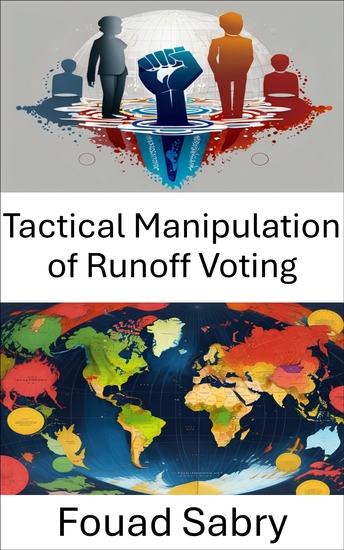
Tactical Manipulation of Runoff Voting - Strategic Dynamics in Electoral Systems - cover

Tactical Manipulation of Runoff Voting - Strategic Dynamics in Electoral Systems

Fouad Sabry

Publisher: One Billion Knowledgeable

  • 0
  • 0
  • 0

Summary

Explore the complex world of runoff voting and its strategic implications in this insightful guide. Aimed at professionals, students, and enthusiasts, this book unveils the subtle tactics that can dramatically shape election outcomes.
 
1: Tactical Manipulation of Runoff Voting: Grasp how tactical manipulation can shift electoral results, shaping the outcome.
 
2: Strategic Voting: Understand how voters may cast votes not solely by preference but for favorable outcomes.
 
3: Independence of Irrelevant Alternatives: Explore how election results are affected by non-winning candidates.
 
4: Vote Pairing: Learn how voters agree to swap votes to achieve mutually beneficial results.
 
5: Vote Splitting: Analyze how multiple similar candidates can split votes, affecting results.
 
6: 2002 French Presidential Election: A case study illustrating tactical voting in the 2002 French presidential election.
 
7: Coombs' Method: Explore an elimination-based voting system that removes the least popular candidates.
 
8: Exhaustive Ballot: Understand how this system works by eliminating candidates one by one.
 
9: Contingent Vote: Explore a hybrid system combining elements of plurality and instant-runoff voting.
 
10: Instant-Runoff Voting: Learn the mechanics of ranking candidates and how votes transfer in rounds.
 
11: Approval Voting: Discover a system where voters can approve multiple candidates at once.
 
12: Plurality Voting: Examine the plurality system, where the most votes win, despite possible manipulation.
 
13: Two-Round System: Learn about this system, which calls for a second voting round if no majority is achieved.
 
14: Bullet Voting: Understand the practice of voting for only one candidate despite having more options.
 
15: 2002 French Legislative Election: Analyze another case study of tactical voting in French legislative elections.
 
16: Supplementary Vote: Learn about this variation of instant-runoff voting in elections.
 
17: Plural Left: Study the coalition within the Plural Left and its electoral influence.
 
18: Borda Count: Explore a ranking system where points are assigned based on candidates' positions.
 
19: Schulze STV: Learn about this method, which aims to minimize wasted votes.
 
20: 2016 The Republicans Presidential Primary: A case study on strategic voting in the 2016 French Republican primary.
 
21: STAR Voting: Understand the STAR voting system, combining scoring and runoff methods.
 
Through this exploration, you’ll unlock the hidden strategies used in elections and gain the tools to analyze or participate in political systems with greater expertise. With in-depth insights into voting systems from around the globe, you’ll be well-equipped to navigate and influence electoral outcomes more strategically. Whether you're involved in political campaigns or academic research, this guide offers a transformative understanding of runoff voting tactics.
Available since: 10/16/2024.
Print length: 302 pages.

Other books that might interest you

  • The Critique of Pure Reason - cover

    The Critique of Pure Reason

    Immanuel Kant

    • 0
    • 0
    • 0
    The Critique of Pure Reason is a philosophical work written by Immanuel Kant, published in 1781. The book is divided into two main parts: the first part deals with what Kant calls "Transcendental Aesthetic," which is concerned with the nature of space and time and the way in which our minds perceive them. The second part deals with what Kant calls "Transcendental Logic," which is concerned with the nature of our understanding and how we reason about the world. 
    In the Critique of Pure Reason, Kant aims to investigate the limits and conditions of knowledge, particularly in the context of metaphysics. He argues that all knowledge must be based on experience, but that our understanding is not limited to the information that we can gain through our senses. Rather, he posits that we have certain innate concepts and categories that allow us to make sense of the world and that shape our perception and understanding of reality. 
    Kant's approach to metaphysics is known as transcendental idealism, which holds that the world as it appears to us is not necessarily the same as it is in itself. He argues that we can only know the world as it appears to us, not as it is in itself, and that our knowledge is necessarily limited by the nature of our minds and our perception. 
    Overall, the Critique of Pure Reason is a complex and influential work that has had a profound impact on philosophy, particularly in the fields of epistemology and metaphysics. It is considered a foundational text of modern philosophy and is still widely studied and debated today.
    Show book
  • One Great Family: Domestic Relationships in Samuel Richardson's Novels - cover

    One Great Family: Domestic...

    Simone Höhn

    • 1
    • 3
    • 0
    This study examines concepts of morality and structures of domestic relationships in Samuel Richardson's novels, situating them in the context of eighteenth-century moral writings and reader reactions. Based on a detailed analysis of Richardson's work, this book maintains that he sought both to uphold hierarchical concepts of individual duty, and to warn of the consequences if such hierarchies were abused. In his final novel, Richardson aimed at a synthesis between social hierarchy and individual liberty, patriarchy and female self-fulfilment. His work, albeit rooted in patriarchal values, paved the way for proto-feminist conceptions of female character.
    Show book
  • Civil War in the Roman Republic - A time of great civil military and political strife that mirrors our own | 106 to 44BCE - cover

    Civil War in the Roman Republic...

    Cicero, Cato The Younger, Mark...

    • 0
    • 0
    • 0
    While compiling and narrating these speeches, I've often been struck by how easily they could be translated into a modern day context. Frequently, a speech has reminded me of the news of the day, somewhere in the world. Nowhere has this been more evident than in these speeches. Given over two thousand years ago, every single one could be applied to situations and people today with barely any revision.The late republic (from about 133BCE) was characterized by civil discontent, with three Servile Wars, two attempted coups, a Social War between Rome and Italian allies, and endless conflict.We begin in 110-106BCE with two speeches railing against the fixed social order and corruption of the highborn, as well as the scorn poured on those of lower birth. We then jump to the Cataline Conspiracy in 63 BCE, an attempt to overthrow the Senate that was only defeated at great cost, and continued to be a symbol of Rome’s troubles. Here we see Cataline exhorting his troops, Cato arguing for harsh punishment, C icero calling Cataline every contemptible name under the sun, and the only known speech of Julius Caesar, in which he argues for a sensible and jurisprudential response to this great crime.Cicero’s leadership of Rome is then documented, covering the beliefs and actions that saw him exiled and then returned to power by the Senate. Finally, we have Mark Antony’s hagiographic oration of Julius Caesar, and then two speeches of Cicero’s railing against the perversion of Caesar’s legacy that Mark Antony was putting into practice, and the need to hold onto tradition for the right reasons, not simply to cover the misdeeds of politicians. Antony became Consul in this time, and Cicero saw in him the final downfall of the republic, which lasted for only seventeen years after this moment before becoming an Empire.
    Show book
  • Black Hearts and Painted Guns - A Battalion's Journey into Iraq's Triangle of Death - cover

    Black Hearts and Painted Guns -...

    Kelly Eads, Daniel S. Morgan

    • 0
    • 0
    • 0
    “Will give readers a feeling for what it was like to fight in the Global War on Terror and the kind of young people who stepped forward to do it.” —On Point: The Journal of Army HistoryKelly Eads joined the 101st Airborne Division soon after 9/eleven, his experience reflecting the patriotism and commitment of so many young men and women who responded to the attack. He deployed to Iraq twice with the 2nd Battalion, 502nd Infantry Regiment.Early in their deployment to Iraq, the 2nd Battalion brought the fight directly to the enemy by setting up patrol bases in the local areas where they lived and operated. Soon they built a reputation for themselves, becoming known to the enemy as the Black Hearts—The 502nd had been distinguished on the battlefield by black hearts on their helmets since World War II. Their Scout Platoon became known as Painted Guns due to their practice of camouflaging their rifles.During Eads’ deployments, the battalion would experience thousands of Improvised Explosive Devices and firefights. They would spend countless hours in blistering 120-degree desert heat, controlling roads and preventing enemy freedom of movement; and would dedicate months to hunting enemy mortar teams and terror cells.With the help of Dan Morgan, an Infantry officer who deployed multiple times to Iraq and Afghanistan as a commander and operations officer, Eads takes the reader on a rollercoaster of combat experiences during the hunt for the most violent terrorist in Iraq, Abū Muṣʻab Zarqāwī, bringing to life the painstaking and horrid details of combat in a sectarian war. He tells the story of the soldiers’ camaraderie, built through adversity, and the love of family that sustained them.
    Show book
  • A Sometimes Paradise - Reflections on Life in a Wyoming Ranch Family - cover

    A Sometimes Paradise -...

    Mark E. Miller

    • 0
    • 0
    • 0
    "Outstanding memoir . . . as well as closely observed, poignant, and wistful." —C. J. Box, #1 New York Times bestselling author of Three-Inch Teeth 


    A captivating, unfiltered account of growing up on a ranch, where every decision defines character 


    A Sometimes Paradise is a moving personal journey into the rugged beauty and hardscrabble challenges of Wyoming ranch life that shaped Mark Miller as a boy and then as a young man. 


    Against the backdrop of deadly ice storms and punishing droughts in a harsh, unforgiving environment, Mark shares stories of adventures, misadventures, and invaluable lessons he learned along the way. As he adapted to the rugged Wyoming terrain, he forged an unbreakable connection with the land and animals—and discovered the true power of family and friendship. 


    An eloquent account of self-discovery, A Sometimes Paradise paints a vivid portrait of resilience and a steadfast commitment to a vanishing way of life. More than a memoir, it is a testament to the enduring spirit of the American West and the people who call it home.
    Show book
  • The American Operations in WW2: Northern Solomons - cover

    The American Operations in WW2:...

    U.S. Army Center of Military...

    • 0
    • 0
    • 0
    World War II was the largest and most violent armed conflict in the history of mankind. Highly relevant today, World War II has much to teach us, not only about the profession of arms, but also about military preparedness, global strategy, and combined operations in the coalition war against fascism. This book follows military operations of the US Army in the Pacific from 22 February 1943 to 21 November 1944. 
    From the Allied vantage point early in the spring of 1943, progress clearly had been made in the wars against Germany and Italy in Europe and the Mediterranean and Japan in the Pacific. During the winter an entire German army had been killed or captured deep within the Soviet Union at Stalingrad. In Africa, once-invincible Axis forces were in full-scale retreat, eventually to surrender in mid-May. The specter of continued Axis expansion in Europe was no longer the threat it had been a year before.
    Halfway around the world, the Japanese offensive in the Pacific also had crested. The May 1942 Battle of the Coral Sea, followed quickly by the great American victory at Midway, had cost Japan the strategic initiative. By February 1943 American and Australian troops had thwarted a Japanese pincer movement in Papua New Guinea, defeating an overland drive on Port Moresby, evicting the Japanese from Buna, and beating back an attack against Wau. That same month, hundreds of miles to the east in the Solomon Islands, American troops had wrested Guadalcanal from the Japanese. Victory required seven months of torturous fighting, but it secured the Allied line of communications to Australia. The Allied High Command now could take advantage of its improved strategic position...
    Show book