Join us on a literary world trip!
Add this book to bookshelf
Grey
Write a new comment Default profile 50px
Grey
Subscribe to read the full book or read the first pages for free!
All characters reduced
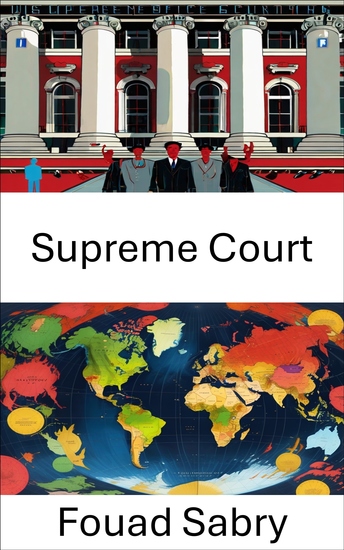
Supreme Court - Guardians of Justice and the Constitution - cover

Supreme Court - Guardians of Justice and the Constitution

Fouad Sabry

Publisher: One Billion Knowledgeable

  • 0
  • 0
  • 0

Summary

The Supreme Court is the highest authority in legal systems globally, wielding significant power over constitutional law, civil rights, and democracy. Understanding the role of Supreme Courts is essential for scholars, students, and anyone interested in judicial governance and its impact on political science.
 
This book explores Supreme Courts worldwide, examining how they shape legal precedents, interpret laws, and influence national policy. It offers insights into judicial systems from the U.S. to South Korea, Germany to the Philippines, providing a comparative view of justice.
 
1: Supreme Court - An introduction to the Supreme Court’s function and authority.
 
2: Appellate Court - The relationship between Supreme Courts and appellate courts in legal reviews.
 
3: State Supreme Court - The roles of state-level supreme courts and their unique responsibilities.
 
4: State Court (U.S.) - A look at U.S. state courts within the federal system.
 
5: Certiorari - This legal tool allows the Supreme Court to select cases for review.
 
6: Federal Judiciary of the U.S. - Structure and importance of the U.S. federal judiciary.
 
7: Judiciary of Australia - An overview of Australia’s judiciary, focusing on its Supreme Court.
 
8: Supreme Court of Spain - Impact of Spain's Supreme Court on national law and the European system.
 
9: Judiciary of Colombia - How Colombia’s Supreme Court shapes law in a post-conflict society.
 
10: Judiciary of Brazil - The role of Brazil's Supreme Court in political and legal reforms.
 
11: Judiciary of Germany - Focus on the Federal Constitutional Court and its defense of democracy.
 
12: Superior Court - The influence of superior courts on national laws worldwide.
 
13: Tribunal - The tribunal systems in various countries and their relation to higher courts.
 
14: Court System of Canada - The Supreme Court's role in shaping Canada’s constitutional law.
 
15: Judicial System of Turkey - Turkey’s judiciary balancing secularism and tradition.
 
16: Judiciary of Pakistan - Challenges and successes of Pakistan's judiciary in maintaining rule of law.
 
17: Judiciary of Belgium - The Supreme Court’s role in protecting civil liberties in Belgium.
 
18: Judiciary of Burundi - Navigating legal complexities in Burundi's sensitive political environment.
 
19: Judiciary of Bangladesh - The Supreme Court’s evolving role in Bangladesh’s democracy.
 
20: Judiciary of the Philippines - The Supreme Court's influence on national and international legal matters.
 
21: Judiciary of South Korea - The role of South Korea's Constitutional Court in democratic governance.
 
Each blends historical context with modern developments, making this book a must-read for understanding the pivotal role of Supreme Courts.
 
By reading "Supreme Court," you’ll gain insights into the crucial mechanisms of power, law, and governance in today’s political landscape.
Available since: 10/02/2024.
Print length: 269 pages.

Other books that might interest you

  • The Art of Advocacy in Singapore - cover

    The Art of Advocacy in Singapore

    Margaret Thomas, Constance Singam

    • 0
    • 0
    • 0
    Advocacy is a tricky pursuit in Singapore. Your motives can be questioned, your activities monitored, and your scope for action limited.  Despite the constraints, civil society activists have persisted, finding ways to pursue their cause and to try to bring about the changes they believe important for Singapore. 
     
     
    In 2013 a small group of civil society stalwarts set out to acknowledge the contributions of these unsung heroes. The Singapore Advocacy Awards was launched, a 3-year project that saw a total of 18 individuals and organisations being honoured. 
     
     
    In this book, 37 activists, many of them winners of the Awards, write about their causes and discuss the strategies shaped and lessons learnt as they practise the delicate art of advocacy in Singapore. Reflecting the nature of civil society, there is a diversity of voices.  Some give a more personal account, while others describe the institutional experience of advocacy work. Some essays are short and sweet, others long and detailed. They appear ordered alphabetically by the cause.
    Show book
  • On the Legal Democratic Mass Movement - cover

    On the Legal Democratic Mass...

    José Maria Sison

    • 0
    • 0
    • 0
    The crisis of the world capitalist system and that of the Philippine ruling system have become worse than in any period after World War II. The US-instigated policies of neoliberal globalization, state terrorism and aggressive war have wrought havoc on the lives of the people and continue to escalate oppression and exploitation. The Filipino people cannot tolerate their suffering and they are fighting back against imperialism and all reaction. 
      
    The loss or erosion of livelihoods is the most concrete and widespread impact of the current crisis of the world capitalist system on people's lives, both in the advanced capitalist countries as well as in the underdeveloped countries. Despite recent pronouncements from state officials and the business press that economic recovery is in sight, the global economy continues to tumble with the gross domestic product of the leading capitalist countries still contracting, consumer spending still in decline and unemployment still rising.
    Show book
  • The Virus and the Host - Protect Yourself from Infectious Disease by Reducing Toxicity Improving Immunity and Minimizing Chronic Illness - cover

    The Virus and the Host - Protect...

    Dr. Chris Chlebowski

    • 0
    • 0
    • 0
    There will almost certainly be more pandemics in our future. Yet, during the coronavirus crisis, not a single major public-health official took the simple step of telling Americans what we all need to hear: robust good health?healthy immunity, low inflammation, low toxic burden, and freedom from stealth infection and chronic disease?is our best defense against infectious viral disease. The way our bodies interact with infectious disease is complicated?both a function of the “germ” and the “terrain”?the virus and the host. In The Virus and the Host, Dr. Chlebowski succinctly describes emerging science on the virome and how toxic exposure, chronic inflammation, infections, and chronic diseases interact and predispose us to poor outcomes from acute viral infection. He then clearly outlines the tools needed for better health, including these: -The best nutrients to supercharge your immunity -How to harness the power of botanical medicine -How to detoxify simply and safely at home -Valuable information on simple treatment and recommended diagnostic tests for given conditions As we move forward from the tragedy of COVID-19, it is essential that we come together to learn from our mistakes and work hard?and work together?to prevent a similar crisis in the future. When the next pandemic hits, we need to be better prepared. Now is the time to do something, and it is the best investment we can make so that when the next one hits we can keep our loved ones and ourselves safe and healthy.
    Show book
  • The Scheme - How the Right Wing Used Dark Money to Capture the Supreme Court - cover

    The Scheme - How the Right Wing...

    Jennifer Meller, Senator Sheldon...

    • 0
    • 0
    • 0
    Following his book Captured on corporate capture of regulatory and government agencies, and his years of experience as a prosecutor, Senator Sheldon Whitehouse here turns his attention to the right-wing scheme to capture the courts, and how it influenced the Trump administration's appointment of over 230 "business-friendly" judges, including the last three justices of the United States Supreme Court. 


    Whitehouse traces the motive to control the court system back to Lewis Powell's notorious memo, which gave a road map for corporate influence to target the judiciary, and chronicles a hidden-money campaign using an armada of front groups and helped by the infamous Citizens United Supreme Court decision. The scheme utilized the Federalist Society as an appointments turnstile, spent secret millions to support the nominees, orchestrated an "amicus brief" signaling apparatus, and propped up front-group litigants to "fast-lane" strategic test cases to the friendly justices. 


    Whitehouse finds the same small handful of right-wing billionaires and corporations running operations that he likens to "covert ops," ultimately enticing the Senate to break rules, norms, and precedents to confirm wildly inappropriate nominees who would advance the anti-government agenda of a small number of corporate oligarchs.
    Show book
  • A World Torn Apart - Understanding the Global Refugee Crisis - cover

    A World Torn Apart -...

    Dr. David K. Ewen

    • 0
    • 0
    • 0
    Prepare to embark on a captivating journey as you delve into the pages of this remarkable book. The author fearlessly explores the intricate web of the global refugee crisis, unearthing its roots, triggers, and far-reaching ramifications. Brace yourself as you are taken on a gripping expedition, dissecting numerous significant crises that have shaken the world, from the heart-wrenching Syrian conflict to the turbulent upheavals in Afghanistan, South Sudan, Venezuela, Rohingya, and Ukraine.With meticulous attention to detail, the author dissects each humanitarian emergency, uncovering the unique challenges they present and the staggering scale of displacement they have caused. Prepare to be enlightened as you witness the unraveling of these complex events, gaining a profound understanding of the plight endured by millions.Throughout the narrative, the spotlight shines brightly on the international response, revealing the heroic efforts of countless humanitarian organizations. Witness firsthand the tireless dedication and unwavering commitment as these beacons of hope extend a lifeline to those in dire need. Their vital aid and unwavering support become the catalyst for survival in the face of adversity.As you turn the final page, a resounding call reverberates within your soul. It is a call for collective action, for empathy to triumph over indifference. The author's poignant conclusion embodies a rallying cry, urging us all to unite in the face of distressing circumstances. Together, we can forge a brighter future, one that nurtures enduring solutions and brings solace to the millions affected by forced displacement.Embark now on this enthralling journey, for within these pages lies a tapestry of humanity, resilience, and the transformative power of compassion.
    Show book
  • A Very Short History of the Israel–Palestine Conflict - cover

    A Very Short History of the...

    Ilan Pappé

    • 0
    • 0
    • 0
    An indispensable guide to understanding the Israel–Palestine conflict, and how we might yet still find a way out of it. 


    "Ilan Pappe is the most original, radical and hard-hitting of Israel's 'new historians.'" —Avi Shlaim, author of Three Worlds 


    The devastation of 7 October 2023 and the horrors that followed astounded the world. But the Israel–Palestine conflict didn't start on 7 October. It didn't start in 1967 either, when Israel occupied the West Bank, or in 1948 when the state of Israel was declared. It started in 1882, when the first Zionist settlers arrived in what was then Ottoman Palestine. Ilan Pappe untangles the history of two peoples, now sharing one land. Going back to the founding fathers of Zionism, Pappe expertly takes us through the twists and turns of international policy towards Israel–Palestine, Palestinian resistance to occupation, and the changes taking place in Israel itself.
    Show book