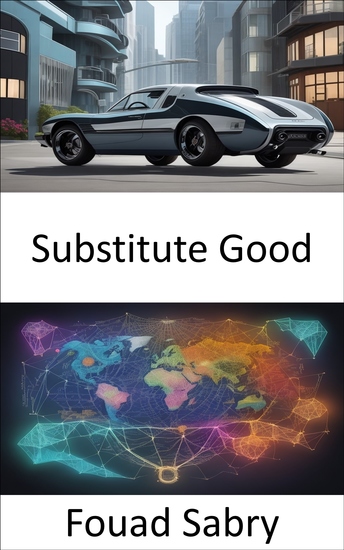
Substitute Good - Unveiling the Economics of Choice and Powering Your Decisions
Fouad Sabry
Publisher: One Billion Knowledgeable
Summary
What is Substitute Good

When it comes to microeconomics, two different products are considered to be substitutes if they are able to fulfill the same function for the consumers. To put it another way, a customer views both things as being comparable or comparable to one another, and as a result, the consumer desires less of the other item when they experience more of the first good. Substitute goods, in contrast to complementary goods and independent goods, have the potential to replace one another in usage as a result of shifting economic environment conditions. Coca-Cola and Pepsi are two examples of substitute goods. The interchangeability of both products is due to the fact that they serve the same function, which is to satisfy the wants and needs of consumers for soft drinks. The term "close substitutes" can be used to refer to certain particular types of substitutes.

How you will benefit

(I) Insights, and validations about the following topics:

Chapter 1: Substitute good

Chapter 2: Monopoly

Chapter 3: Monopolistic competition

Chapter 4: Perfect competition

Chapter 5: Deadweight loss

Chapter 6: Price discrimination

Chapter 7: Elasticity (economics)

Chapter 8: Price elasticity of demand

Chapter 9: Cross elasticity of demand

Chapter 10: Consumer choice

Chapter 11: Law of demand

Chapter 12: Complementary good

Chapter 13: Demand curve

Chapter 14: Utility maximization problem

Chapter 15: Location model (economics)

Chapter 16: Slutsky equation

Chapter 17: Constant elasticity of substitution

Chapter 18: Tax incidence

Chapter 19: Demand

Chapter 20: Derived demand

Chapter 21: Small but significant and non-transitory increase in price

(II) Answering the public top questions about substitute good.

(III) Real world examples for the usage of substitute good in many fields.

Who this book is for

Professionals, undergraduate and graduate students, enthusiasts, hobbyists, and those who want to go beyond basic knowledge or information for any kind of Substitute Good.
Available since: 02/02/2024.
Print length: 296 pages.