Join us on a literary world trip!
Add this book to bookshelf
Grey
Write a new comment Default profile 50px
Grey
Subscribe to read the full book or read the first pages for free!
All characters reduced
Strike Action - Unveiling the Dynamics of Labor Revolts in Modern Democracies - cover

Strike Action - Unveiling the Dynamics of Labor Revolts in Modern Democracies

Fouad Sabry

Publisher: One Billion Knowledgeable

  • 0
  • 0
  • 0

Summary

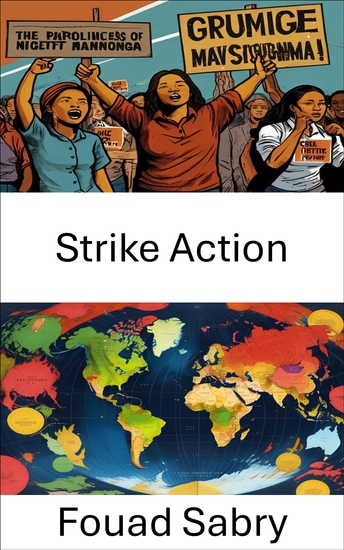
Unlock the secrets behind the power of labor strikes with "Strike Action," a key addition to the "Political Science" series. This groundbreaking book explores the complex relationship between labor strikes and political dynamics, offering a comprehensive look at how these actions influence policy, shape public opinion, and redefine democratic engagement. Essential for students, professionals, and enthusiasts alike, "Strike Action" provides insights into the strategic and political impacts of labor movements.
 
1: Strike Action: Introduces strike action, outlining its significance and impact on modern democracies.
 
2: Labour Law: Explores foundational legal frameworks governing labor actions and their implications.
 
3: National Labor Relations Act of 1935: Delves into landmark legislation that transformed labor relations in the U.S.
 
4: Taft–Hartley Act: Analyzes this pivotal act balancing labor and management powers.
 
5: Collective Bargaining: Examines the significance of collective bargaining in labor agreements.
 
6: Union Shop: Investigates the union shop concept and its impact on membership dynamics.
 
7: Union Violence: Explores instances of violence in union activities and its implications.
 
8: United States Labor Law: Overview of U.S. labor laws and their influence on labor practices.
 
9: Enterprise Bargaining Agreement: Discusses enterprise bargaining agreements and their negotiation roles.
 
10: Picketing: Examines strategies and effectiveness of picketing as protest.
 
11: Strikebreaker: Analyzes strikebreakers' roles and their impact on labor dynamics.
 
12: La Follette Committee: Examines the committee’s findings on labor practices and reforms.
 
13: Union Busting: Discusses union busting tactics and implications for worker rights.
 
14: Trade Union and Labour Relations Act 1992: Covers key features of this U.K. legislation impacting labor relations.
 
15: Labor Relations: Explores theories and practices shaping labor movements.
 
16: Remington Rand Strike of 1936–1937: Investigates this significant strike and its effects on labor relations.
 
17: The Blue Eagle at Work: Analyzes the National Industrial Recovery Act and its labor impacts.
 
18: Wildcat Strike Action: Understands wildcat strikes' nature and implications for labor movements.
 
19: NLRB v. Mackay Radio & Telegraph Co.: Explores this landmark case's implications for labor rights.
 
20: History of Union Busting in the U.S.: Covers the evolution of union busting tactics and their effects.
 
21: NLRB v. Columbian Enameling & Stamping Co.: Delves into a critical case shaping labor law and union activities.
 
"Strike Action" is not just a book—it's a vital tool for anyone seeking to understand the intersection of labor movements and political strategy. The insights offered far outweigh the investment, making it an indispensable resource for those passionate about political science and labor relations.
Available since: 10/13/2024.
Print length: 332 pages.
Other books that might interest you

  • History of China - Specific Events Causes and Consequences - cover

    History of China - Specific...

    Kelly Mass

    • 0
    • 0
    • 0
    This is a combo of 5 titles with different topics related to Chinese history. The topics are the following: 
    Ancient China: It’s hard to cover all of China’s vast history in a short book, but for the sake of leaving out details, we will still give it a try. In this guide, you will be able to learn more about the most important turning events, eras, dynasties, leaders, wars, and cultural aspects of ancient China. 
    Chinese Mythology: Chinese folklore is mythology from the geographical area now called China that has been given orally or documented. Several myths from different local and cultural customs are included in Chinese folklore. Much of folklore includes thrilling stories including impressive characters and beings, the use of magic powers, and normally occurs in a mythologically unique area or time. 
    Confucius: Confucius was a Chinese thinker and political leader who was considered as the apotheosis of Chinese sages. Confucius' theories and philosophy, commonly seen as one of the most essential and prominent individuals in human history, created the structure of East Asian civilization and civilization, and stay appropriate across China and East Asia today. Confucianism, his philosophical theories, highlighted personal and governmental morality, social connection precision, justice, generosity, and genuineness. 
    Mao Zedong: Mao Zedong has had a tremendous impact on the Chinese nation. During his Great Leap Forward, he was responsible for more deaths than both Hitler and Stalin, making him the biggest mass murderer in history. What happened during the Great Leap Forward? Why did so many farmers starve to death? And what else did Mao Zedong do during his reign? 
    Portuguese Macau: Macau is known as the Las Vegas of China. It attracts many tourists every year, and it has a unique set of laws and history behind it. How did it become this way? Well, one of the reasons is that it used to be part of the Portuguese Empire.
    Show book
  • Progress and poverty: Book Summary & Analysis - cover

    Progress and poverty: Book...

    Henry George

    • 0
    • 0
    • 0
    "Progress and Poverty" is a seminal work written by Henry George, first published in 1879. The book addresses economic and social issues, particularly focusing on the unequal distribution of wealth and the causes of poverty in the midst of progress and economic growth. In "Progress and Poverty," Henry George explores the relationship between economic progress and the persistence of poverty. He critiques the existing economic system and advocates for a single tax on land as a solution to address wealth inequality and eradicate poverty. George argues that land, as a resource, should be treated as a common good, and the benefits of land value increases should be shared by the community. The book gained widespread attention and sparked discussions on economic reform and social justice.
    Show book
  • Wheels of normality - Building trust through standards - cover

    Wheels of normality - Building...

    Alex Gertschen

    • 0
    • 1
    • 0
    Norms and standards make it easier for companies and other organisations to reliably meet high expectations. They thus contribute to our trust in a normality that is characterised by quality, safety and comfort - and is therefore by no means "normal". As necessary and effective as norms and standards are for a society based on the division of labour and complexity, the public awareness of them is low. That is why this non-fiction book provides for the first time an overview of norms and standards systems in Switzerland.
    From a historical and a future-oriented perspective, the book takes up the following questions: Why and how have norms and standards become so important in recent decades? How exactly do they create their economic and social benefits? To what extent can they hinder or promote innovation and transformation - and what potential does this offer for sustainable development?
    Journalists, academics and other experts provide answers based on fundamental articles and case studies from companies and other organisations.
    Show book
  • Red White & Blind - The Truth About Disinformation and the Path to Media Consciousness - cover

    Red White & Blind - The Truth...

    Tony Brasunas

    • 0
    • 0
    • 0
    Why were the sordid deeds of Jeffery Epstein concealed for two decades? Why was inquiry into the origin of covid suppressed? Why are social media sites censoring scientists, doctors, journalists, and scholars? 
    Through dozens of absorbing exposés, Red White & Blind reveals the corporate media's deliberate lies, tendentious censorship, and ironic use of the term "disinformation." This deceit has driven faith in corporate news to all-time lows, but it has also birthed an independent media revolution—a New Enlightenment—enabling Americans to see through the walls of "confirmation bias" and perceive the world more directly and accurately than ever before. 
    In this book, you will learn:How the Father of Propaganda convinced Americans to love bananas, World War I, and the color green.Why the notion of "objective, professional journalism" was invented in the early 1900s.How the CIA placed agents in the media and why they likely still do.How to understand family and friends with any set of political views.Why today's social media censorship violates the First Amendment.Why "fact-checking" websites almost always fail.The meaning of "gaslighting," "shadowbanning," and "narrative management."
    Show book
  • From Enlightenment To Revolution - Pitt Burke & Robespierre 1766-1794 - cover

    From Enlightenment To Revolution...

    Maximillian Robespierre, Edmund...

    • 0
    • 0
    • 0
    History is often concentrated into short bursts of change, with long periods of shifting before and waves of alteration afterwards. Nowhere is this more obvious than the thirty year interregnum between the Enlightenment and the Industrial Revolution. In this period, three figures stand tall; Pitt, the elder stateman who saw the need for genuine constitutionalism; Burke, the consummate parliamentarian, speaking for the glory of empire; and Robespierre, the legendary and controversial frontman of the French Revolution.William Pitt The Elder speaks about the need for key changes to the body politic. The first speech here predates the interregnum, being from 1738, when he was merely thirty, and covers a key factor in Britain’s colonial problems for the next two centuries, being the complete internal corruption of the army.Edmund Burke represents the height of Royalist sympathy as the age of revolution gets underway. He speaks on the need for conciliation with America after the disaster of the Stamp Act and revolution, on the need to punish Warren Hastings for treating his Asian holdings as his own empire to fill with his own corruption, and on the end of an era with the passing of Marie Antoinette.Finally, the age of revolution, both industrial and political, has begun. Robespierre argues for the dignity of man; for rejecting the divinity of royal authority in favour of that of the human spirit; against the death penalty, as being below the dignity of a truly humanist state; on enemies, internal and external, who push the people to reject their own interests for those of the powerful. This is but a small selection of the man’s incredible output - in 1791 alone, he gave three hundred and twenty-eight speeches.Spitting bile and flame in his last speech, which closes this volume, Robespierre truly inaugurates the era when revolution against centuries-old powers brought their end, and their nations found their renewal.
    Show book
  • Become Ungovernable - An Abolition Feminist Ethic for Democratic Living - cover

    Become Ungovernable - An...

    H.L.T. Quan

    • 0
    • 0
    • 0
    "Phenomenal . . . Offers us possibilities for rescuing the concept of democracy from its fatal entanglement with racial, heteropatriarchal capitalism." —Angela Y. Davis 


    "A compelling and inspiring book that belongs in our movements and our classrooms." —Chandra Talpade Mohanty, author of Feminism Without Borders 


    Become Ungovernable is a provocative new work of political thought setting out to reclaim "freedom", "justice", and "democracy", revolutionary ideas that are all too often warped in the interests of capital and the state. Revealing the mirage of mainstream democratic thought and the false promises of liberal political ideologies, H. L. T. Quan offers an alternative approach: an abolition feminism drawing on a kaleidoscope of refusal praxes, and on a deep engagement with the Black Radical Tradition and queer analytics. 


    With each chapter anchored by episodes from the long history of resistance and rebellions against tyranny, Quan calls for us to take up a feminist ethic of living rooted in the principles of radical inclusion, mutuality, and friendship as part of the larger toolkit for confronting fascism, white supremacy, and the neoliberal labor regime.
    Show book