Join us on a literary world trip!
Add this book to bookshelf
Grey
Write a new comment Default profile 50px
Grey
Subscribe to read the full book or read the first pages for free!
All characters reduced
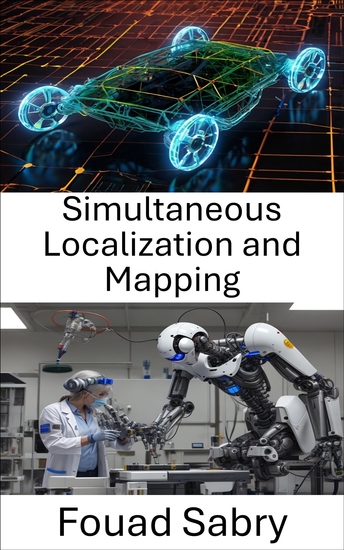
Simultaneous Localization and Mapping - Navigation and Mapping Techniques for Autonomous Systems - cover

Simultaneous Localization and Mapping - Navigation and Mapping Techniques for Autonomous Systems

Fouad Sabry

Publisher: One Billion Knowledgeable

  • 0
  • 0
  • 0

Summary

In the fastevolving field of robotics, understanding Simultaneous Localization and Mapping (SLAM) is crucial for the advancement of autonomous systems. This book delves into SLAM, offering insights into the theories, algorithms, and realworld applications that power robotic navigation, positioning, and mapping technologies. Whether you're a professional in robotics, a student, or a hobbyist, this book will provide you with the foundational and cuttingedge knowledge needed to excel in this dynamic field.
 
Chapters Brief Overview:
 
1: Simultaneous localization and mapping: Explore the core concepts of SLAM and its role in autonomous robotics.
 
2: Robotic mapping: Learn about the mapping techniques used to create accurate digital models of environments.
 
3: Condensation algorithm: Understand how this algorithm improves SLAM's reliability in uncertain environments.
 
4: Transfer learning: Discover how transfer learning enhances robotic performance by applying knowledge across different tasks.
 
5: Monte Carlo localization: Dive into probabilistic methods that help robots localize themselves in dynamic settings.
 
6: Wolfram Burgard: Study the contributions of Wolfram Burgard to the development of SLAM technologies.
 
7: Indoor positioning system: Gain insights into positioning systems designed specifically for indoor environments.
 
8: Robot navigation: Delve into the navigation strategies that allow robots to make decisions based on their environment.
 
9: Occupancy grid mapping: Understand how occupancy grids are used to represent navigable and nonnavigable areas in robotic systems.
 
10: 3D reconstruction: Learn how robots create 3D models of their surroundings through advanced imaging techniques.
 
11: Visual odometry: Explore how robots track their movement using visual cues, improving their navigation abilities.
 
12: Exploration problem: Examine how robots autonomously explore and map unknown environments.
 
13: Mobile Robot Programming Toolkit: Discover this essential toolkit for building and simulating mobile robots.
 
14: Covariance intersection: Understand how this technique enhances state estimation in uncertain environments.
 
15: Robotics Toolbox for MATLAB: Learn how this toolkit simplifies the development of robotic applications using MATLAB.
 
16: 3D sound localization: Explore how robots can use sound to locate their position in threedimensional spaces.
 
17: Intrinsic localization: Understand how robots use internal sensors to localize themselves without external references.
 
18: Pose tracking: Discover the importance of pose tracking in maintaining accurate robot localization.
 
19: Margarita Chli: Learn about Margarita Chli’s influential work in the field of robotics and localization.
 
20: Layered costmaps: Understand how layered costmaps help robots navigate efficiently in complex environments.
 
21: Autonomous robot: Delve into the design and development of fully autonomous robots capable of making decisions in real time.
 
This book is a mustread for anyone seeking a deep understanding of robotics, especially those working with autonomous systems, SLAM, and navigation. It provides valuable insights for professionals, students, and enthusiasts looking to stay ahead in the rapidly growing field of robotics science.
Available since: 12/28/2024.
Print length: 186 pages.
Other books that might interest you

  • Data Analysis - Book 1 - cover

    Data Analysis - Book 1

    Jim D Johnston

    • 0
    • 0
    • 0
    DATA ANALYSIS 
    Data is everywhere. Insight is rare. 
    Every click, transaction, survey, sensor, and business process generates data. Yet collecting information is only the beginning. The real value lies in knowing how to transform raw data into meaningful insights that drive smarter decisions. 
    Data Analysis is a practical guide to understanding, interpreting, and communicating data with confidence. Whether you're working in business, technology, healthcare, finance, marketing, education, or research, this book provides the essential concepts and techniques needed to make sense of today's data-driven world. 
    Inside this book, you'll discover how to:Understand the complete data analysis process from collection to decision-making.Clean, organize, and prepare data for accurate analysis.Identify patterns, trends, and relationships hidden within datasets.Apply descriptive, diagnostic, predictive, and prescriptive analysis techniques.Use statistics and visualization to communicate findings clearly.Avoid common analytical mistakes and misleading conclusions.Make evidence-based decisions using reliable data.Integrate AI and modern analytical tools into everyday workflows. 
    Rather than focusing on complex mathematics or a single software platform, this book emphasizes the principles that make effective data analysis possible regardless of the tools you use. 
    You'll learn how successful analysts approach problems, ask better questions, validate assumptions, and transform information into actionable knowledge. 
    Whether you're a student, business professional, manager, entrepreneur, researcher, or aspiring data analyst, this book provides a strong foundation for building one of the most valuable skills in the modern economy. 
    In a world overflowing with information, competitive advantage belongs to those who can separate signal from noise. 
    Data doesn't make decisions. People do. Data analysis simply helps them make better ones.
    Show book
  • The Science of Reading - Information Media and Mind in Modern America - cover

    The Science of Reading -...

    Adrian Johns

    • 0
    • 0
    • 0
    For the first time, the story of how and why we have plumbed the mysteries of reading, and why it matters today. 
      
    Reading is perhaps the essential practice of modern civilization. For centuries, it has been seen as key to both personal fulfillment and social progress, and millions today depend on it to participate fully in our society. Yet, at its heart, reading is a surprisingly elusive practice. This book tells for the first time the story of how American scientists and others have sought to understand reading, and, by understanding it, to improve how people do it. 
     
    Starting around 1900, researchers—convinced of the urgent need to comprehend a practice central to industrial democracy—began to devise instruments and experiments to investigate what happened to people when they read. They traced how a good reader’s eyes moved across a page of printed characters, and they asked how their mind apprehended meanings as they did so. In schools across the country, millions of Americans learned to read through the application of this science of reading. At the same time, workers fanned out across the land to extend the science of reading into the social realm, mapping the very geography of information for the first time. Their pioneering efforts revealed that the nation’s most pressing problems were rooted in drastic informational inequities, between North and South, city and country, and white and Black—and they suggested ways to tackle those problems. 
     
    Today, much of how we experience our information society reflects the influence of these enterprises. This book explains both how the science of reading shaped our age and why, with so-called reading wars still plaguing schools across the nation, it remains bitterly contested.
    Show book
  • Thinking Clearly With AI - A Practical Guide to Using AI Responsibly Creatively and Strategically - cover

    Thinking Clearly With AI - A...

    Yeneneh (Yen) Wakjira

    • 0
    • 0
    • 0
    This audiobook is narrated by an AI Voice. 
    Thinking Clearly With AI is a practical guide for anyone who wants to use artificial intelligence with confidence, credibility, and good judgment. Written for everyday professionals, students, creators, and leaders, this book explains what modern AI can do, where it falls short, and how to avoid common mistakes such as over-trust, misinformation, and “polished but wrong” outputs. 
     
    Through clear explanations, real-world examples, checklists, and reusable workflows, readers learn how to separate AI-generated drafts from verified knowledge, use AI responsibly in creative and professional work, protect human judgment, and prepare for the future of AI without hype or fear. 
     
    This is not a book of prompt tricks. It is a practical roadmap for building AI literacy, making better decisions, and using AI as a thoughtful partner while keeping humans accountable for truth, ethics, and action.
    Show book
  • 50 Projects for Building Your Backyard Homestead Updated Edition - A Hands-On Step-By-Step Sustainable-Living Guide - cover

    50 Projects for Building Your...

    David Toht

    • 0
    • 0
    • 0
    Ready for new 10 new practical ideas for creating your backyard homestead? 50 Projects for Building Your Backyard Homestead: A Hands-On, Step-By-Step Sustainable-Living Guide updates one of the most popular books on the subject with the addition of 10 new projects to help your homestead thrive. Inside, experienced homesteader and contractor, David Toht, will teach you backyard homestead project ideas like accessible garden paths, insulated chicken coops, and backyard essentials from fences to feeders. Are you a beginner? Don't worry; you'll learn how to handle simple builds like raised gardens. Getting a little more advanced as a homesteader? Learn how to build a drought-resistant landscape or build passive ventilation systems to keep your chickens comfortable. Gardens, gates, PVC, pens, aquaponics, hydroponics, wind turbines, solar panels, roofing--it's all here. No matter what your homestead looks like, you'll come away from 50 Projects for Building Your Backyard Homestead, Updated Edition with encyclopedic knowledge and inspiration for what project to tackle next. This is an all-encompassing, comprehensive guide for those looking to expand their current homestead or embark on a more self-sustaining lifestyle.    
    Show book
  • Math-ish - Finding Creativity Diversity and Meaning in Mathematics - cover

    Math-ish - Finding Creativity...

    Jo Boaler

    • 0
    • 0
    • 0
    From Stanford professor, author of Limitless Mind, youcubed.org founder, and leading expert in the field of mathematics education Jo Boaler comes a groundbreaking guide to finding joy and understanding by adopting a diverse approach to learning math. 
    “Every once in a while, someone revolutionizes an approach to a difficult subject and changes it forever. That is what Jo Boaler has done for math. Fresh, smart, and inclusive, Jo Boaler's strategy eschews the one-size-fits-a-few approach and instead allows math to be seen and solved by everyone. A huge achievement. Math-ish is the only math book I’ve ever enjoyed reading in my entire life. Honestly.” -Bonnie Garmus, author of Lessons in Chemistry 
    Mathematics is a fundamental part of life, yet every one of us has a unique relationship with learning and understanding the subject. Working with numbers may inspire confidence in our abilities or provoke anxiety and trepidation. Stanford researcher, mathematics education professor, and the leading expert on math learning Dr. Jo Boaler argues that our differences are the key to unlocking our greatest mathematics potential. 
    In Math-ish, Boaler shares new neuroscientific research on how embracing the concept of “math-ish”—a theory of mathematics as it exists in the real world—changes the way we think about mathematics, data, and ourselves. When we can see the value of diversity among people and multi-faceted approaches to learning math, we are free to truly flourish. Utilizing the latest research on math education, Jo guides us through seven principles that can radically reframe our relationship with the subject: 
    • The power of mindset on learning 
    • Utilizing a visual approach to math 
    • The impact of physical movement and communication on understanding 
    • Understanding the value of an ""ish"" perspective - in mathematics and beyond 
    • The importance of connected and flexible knowledge 
    • New data on diverse teaching modes that work with different learning styles, not against them 
    • The value of diversity in learning mathematics—and beyond 
    When mathematics is approached more broadly, inclusively, and with a greater sense of wonder and play—when we value the different ways people see, approach, and understand it—we empower ourselves and gain a beneficial understanding of its value in our lives. 
    ?Supplemental enhancement PDF accompanies the audiobook.
    Show book
  • Cashvertising Online - How to Use the Latest Findings in Buyer Psychology to Explode Your Online Ad Response - cover

    Cashvertising Online - How to...

    Drew Eric Whitman

    • 0
    • 0
    • 0
    The latest book from Dr. Direct™ will show you how to master online advertising and enhance your social media strategies. This is the perfect companion to the author’s bestselling book Ca$hvertising.   Cashvertising revealed the secrets of ad agencies to the masses. With Cashvertising Online Whitman reveals even more and how to implement his advice in clear-language to increase your bottom line. Most books discussing online ads teach things like: how to create accounts, how to select demographics, what options to select (video vs. carousel vs. slideshow, etc.), and other topics like maximizing the use of Facebook pixels for fine-tuning your target audience. To create successful Facebook, Instagram, Twitter ads, not only do you need to know copywriting basics, but you also need to understand the highly personal nature of the medium. The successful copywriter needs to make the shift to the highly personal “you and me” approach and learn how to sell without expressing the typical appearance of salesmanship. Likewise, a number of books teaching email marketing primarily focus on things like mailing lists, segmentation, funnels, and automation. All important stuff to be sure, but unless your sales copy is persuasive, these things aren’t worth a damn. The majority of these books spend little time teaching readers how to use the power of advertising and consumer psychology in the Facebook and email environments to cause people to actually respond—the whole purpose of advertising! Cashvertising Online is not a book on general copywriting. Instead, it examines the hidden principles specific to actual successful online ads and email promotions and the numerous and potent psychological techniques they employ that make them so persuasive.
    Show book