Join us on a literary world trip!
Add this book to bookshelf
Grey
Write a new comment Default profile 50px
Grey
Subscribe to read the full book or read the first pages for free!
All characters reduced
Script Theory - Fundamentals and Applications - cover

Script Theory - Fundamentals and Applications

Fouad Sabry

Publisher: One Billion Knowledgeable

  • 0
  • 0
  • 0

Summary

What Is Script Theory
 
The Script Theory is a psychological theory that postulates that the majority of human behavior can be categorized into patterns that are referred to as "scripts" because these patterns work similarly to that of a written script, which is to say that they provide a program for action. Because the purely biological response of affect may be followed by awareness and by what we cognitively do in terms of acting on that affect, Silvan Tomkins realized that more was required to produce a complete explanation of what he called "human being theory." As a result, he created script theory as a further development of his affect theory, which regards human beings' emotional responses to stimuli as falling into categories called "affects." Script theory regards human beings' emotional responses to stimuli as falling into categories called "affects."
 
How You Will Benefit
 
(I) Insights, and validations about the following topics:
 
Chapter 1: Script Theory
 
Chapter 2: Cognitive Science
 
Chapter 3: Cognitive Psychology
 
Chapter 4: Natural-Language Understanding
 
Chapter 5: Schema (psychology)
 
Chapter 6: Roger Schank
 
Chapter 7: Outline of Thought
 
Chapter 8: Frame (artificial intelligence)
 
Chapter 9: Conceptual Dependency Theory
 
Chapter 10: Outline of Natural Language Processing
 
(II) Answering the public top questions about script theory.
 
(III) Real world examples for the usage of script theory in many fields.
 
(IV) 17 appendices to explain, briefly, 266 emerging technologies in each industry to have 360-degree full understanding of script theory' technologies.
 
Who This Book Is For
 
Professionals, undergraduate and graduate students, enthusiasts, hobbyists, and those who want to go beyond basic knowledge or information for any kind of script theory.
Available since: 06/30/2023.
Print length: 139 pages.

Other books that might interest you

  • Among Typhoons And Pirate Craft - cover

    Among Typhoons And Pirate Craft

    Lindsay Anderson

    • 0
    • 0
    • 0
    Anderson served as third officer aboard the Eamont. Eamont was an opium clipper built in Cowes. Eamont was involved in the opening of Japan to foreigners in 1858, serving as a dispatch boat between Nagasaki and Shanghai, and was one of the first vessels to open up a trade with Formosa. The Eamont was employed in the negotiations for the first commercial treaty with Japan. On this occasion she ran into Nagasaki and quietly dropped anchor, in spite of the fact that opposition to the proposed commercial treaty was very strong at the time. On the following morning 150 boat-loads of Japanese attempted to tow her to sea, being evidently ignorant of an anchor's raison d'etre. But though they attempted several similar methods to get rid of her they refrained from any armed attack, and, eventually, her mission was completely successful. This was in 1858, and the Eamont's crew saw many wonderful sights in that tierra incognita. The September Typhoon of 1858 destroyed several well-known opium clippers at Double Island, including the Anonyma, Gazelle, Pantaloon, and Mazeppa. Eamont was anchored off Double Island, with "150 fathoms of chain out and a second anchor backed on it at 60 fathoms." The waves in the anchorage were estimated to be as large as 40 feet, and the Eamont’s crew had to cut away her masts. Eamont was one of only two ships in that anchorage to survive the night, the other being the Hazard. (See Wikipedia article on Eamont (schooner)) ( wikipedia and david wales)
    Show book
  • The Second History of Man - cover

    The Second History of Man

    MD John Bershof

    • 0
    • 0
    • 0
    In the spirit of medieval writer Chaucer, all human activity lies within the artist’s scope, the History of Man Series uses medicine as a jumping off point to explore precisely that, all history, all science, all human activity since the beginning of time. The jumping off style of writing takes the reader, the listener into worlds unknown, always returning to base, only to jump off again. History of Man are stories and tales of nearly everything. 
    The Second History of Man focuses mostly on bacteria and bacterial infections as the foundation, jumping off into Darwin and evolution, gin & tonics and the discovery of the first antibiotic to treat infection (and it wasn’t penicillin), visiting with those clever chaps who cook up drugs in the lab. We’ll call upon poets & poetry, celebrities like Frank Sinatra, the Rat Pack, and Bobby Darin, the classical music of Haydn, Mozart and Beethoven, the tragic story of World War II, Anne Frank and the Holocaust, tuberculosis, and a few of the rich & famous who suffered from TB, travelling back in time to the Black Death which wiped out 25 percent of humans on Earth, exploring the origins of a salon and a saloon, Columbus and the Age of Discovery, the lost generations of childhood, ending with the invention of the Internet.
    Show book
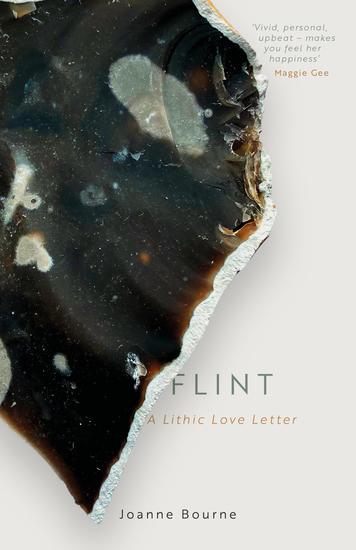
  • Flint - a lithic love letter - cover

    Flint - a lithic love letter

    Joanne Bourne

    • 0
    • 0
    • 0
    'A very British love-letter to the beauty of flint' Daily Telegraph
    Joanne Bourne has been in awe of flint as long as she can remember.
    It was all around her where she grew up in Kent: used for garden walls, to edge drives and weight dustbin lids, as well as to build pubs, churches, Roman villas and castles. For centuries it was the only building stone available.
    It is also magical. Made from the remains of plankton and sea sponges, it is second only in hardness to a diamond and can be used to make fire. Part of human development for three million years, it was used as a weapon to hunt and in war, and hung as protection against thunderbolts and fairies.
    In a deeply personal love letter to this extraordinary 'biogenic' rock, Bourne traces its geological, architectural and social history and invites us to roam with her in search of it on her beloved North Downs.
    Fusing science, poetry, history and a profound love of landscape, this is her heartfelt, thoroughly persuasive tribute to the stone she calls 'an art project of the great divine'.
    Show book
  • Best Practices Pediatrics - cover

    Best Practices Pediatrics

    M.D. Charles Raymond Bell

    • 0
    • 0
    • 0
    This audiobook is narrated by an AI Voice.  This eloquent anthology encapsulates the essence of pediatric care, threading the delicate interweave of medical acumen and heartfelt empathy. It guides caregivers through childhood's myriad health and emotional landscapes, advocating for equitable healthcare and championing the union of science and compassion. From addressing the nuances of family dynamics to the special considerations for LGBTQIA+ youth, it serves as a guide and beacon of informed, nurturing care. This tome is a homage to the guardians of childhood's fleeting innocence, offering wisdom and support to foster each child's health to its fullest potential.
    Show book
  • Hamburg Climate Futures Outlook 2024 - Conditions for Sustainable Climate Change Adaptation - cover

    Hamburg Climate Futures Outlook...

    Anita Engels, Jochem Marotzke,...

    • 0
    • 0
    • 0
    Many countries, communities, and social actors around the world are struggling to cope with the impacts of climate change. Adapting to climate change in a sustainable manner involves a huge collective effort and is barely happening. How can sustainable climate change adaptation become plausible? The Hamburg Climate Futures Outlook 2024 provides a unique systematic and global assessment of the context conditions for sustainable climate change adaptation, evaluating the social dynamics of deep decarbonization and the physical dynamics in regional climate variability and extremes. Through nine case studies across the globe, the assessment provides insights into key barriers and opportunities for sustainable climate change adaptation.
    Show book
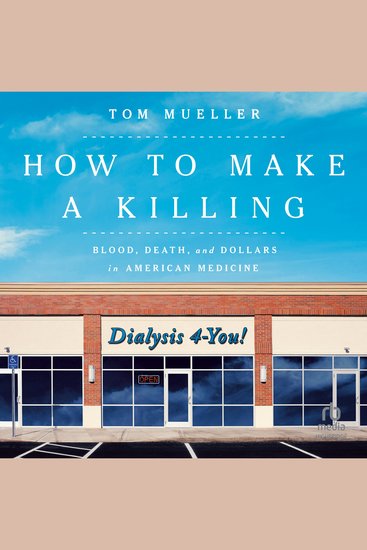
  • How to Make a Killing - Blood Death and Dollars in American Medicine - cover

    How to Make a Killing - Blood...

    Tom Mueller

    • 0
    • 0
    • 0
    Six decades ago, visionary doctors achieved the impossible: the humble kidney, acknowledged since ancient times to be as essential to life as the heart, became the first human organ to be successfully replaced with a machine. Yet huge dialysis corporations, ambitious doctor-entrepreneurs, and Beltway lobbyists soon turned this medical miracle into an early experiment in for-profit medicine—and one of the nation's worst healthcare catastrophes. 


    With powerful insight and on-the-ground reporting, Tom Mueller introduces an unforgettable cast of characters. Heroic patients risk their lives to blow the whistle on how they've been mistreated. An unpaid activist living in a south Georgia trailer park fights to save patients from involuntary discharge from their lifesaving care. Industry insiders put their careers on the line to speak out about the endemic wrongs and pervasive inequality they've witnessed—and about dialysis executives who dress as musketeers and Star Wars characters to exhort their employees to more aggressive profit-seeking. 


    How to Make a Killing reveals dialysis as a microcosm of American medicine and poses a vital challenge: find a way to fix dialysis, and we'll have a fighting chance of fixing our country's dysfunctional healthcare system as a whole, restoring patients, not profits, as its true purpose.
    Show book