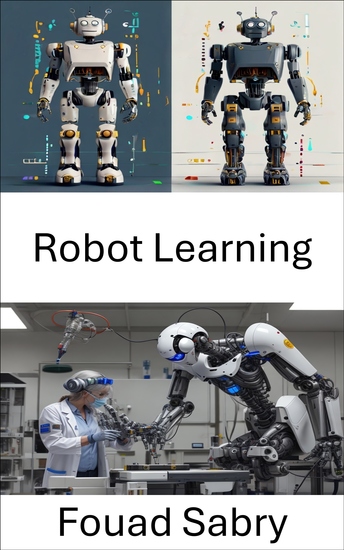
Robot Learning - Enhancing Intelligent Behavior Through Adaptive Algorithms
Fouad Sabry
Publisher: One Billion Knowledgeable
Summary
Robot learning-This chapter introduces the concept of robot learning, explaining how robots can autonomously acquire knowledge from their environment to improve their performance and decisionmaking

Domo (robot)-The Domo robot is explored as a case study in the evolution of robot learning, with insights into its learning methods and its ability to adapt through sensory feedback

Developmental robotics-This chapter covers the fundamentals of developmental robotics, focusing on how robots can learn progressively over time, similar to human cognitive development

ICub-A deep dive into the iCub robot, emphasizing its role in studying cognitive development and humanrobot interaction, showcasing its advanced learning capabilities

Programming by demonstration-Discussing how robots can be programmed through demonstrations by human operators, this chapter highlights the ease and efficiency of teaching robots complex tasks

Neurorobotics-Neurorobotics blends neuroscience with robotics, and this chapter examines how robot learning is influenced by understanding the brain's processes and how they can be replicated in machines

Daniela Rus: Focused on the work of Daniela Rus, a leading researcher in the field of robotics, this chapter examines her contributions to robot learning and autonomous systems

Situated approach (artificial intelligence)-A look at the situated approach in AI, where robots learn by interacting directly with their environments, emphasizing the importance of realworld context in robot learning

Google Brain: This chapter explores the intersection of deep learning and robotics, specifically the impact of Google Brain's research on enhancing robot learning through advanced algorithms and neural networks

James J. Kuffner Jr.-An analysis of James J. Kuffner's pioneering work in robotics and his contributions to motion planning and robot learning techniques that allow robots to perform complex tasks

Cloud robotics: Cloud robotics is reshaping the way robots learn by leveraging cloud computing to process and store large amounts of data. This chapter outlines how this innovation impacts robot learning and its scalability

JeanChristophe Baillie-Focusing on the work of JeanChristophe Baillie, this chapter delves into his exploration of robot learning from a systems perspective, particularly in mobile robotics and sensory processing

Stephen E. Levinson-This chapter examines Stephen E. Levinson's contributions to robot learning, particularly his work in integrating robotics with natural language processing and cognitive science

Ashutosh Saxena-Ashutosh Saxena's work in creating robots that learn from human actions is discussed in this chapter, highlighting how robots can be trained to understand and replicate human behavior

Aude Billard-Aude Billard's research in humanrobot interaction is covered here, focusing on the development of robots that can learn from social cues and human collaboration

Vivian Chu-Vivian Chu's work on robot learning, particularly in the context of robotic arm movements and realtime learning through feedback, is explored in this chapter

Juyang Weng-This chapter covers Juyang Weng's approach to embodied cognition in robotics, highlighting how robots can learn from their own experiences in the physical world

Andy Zeng-Andy Zeng's contributions to deep reinforcement learning in robotics are explored, focusing on how robots can adapt and learn complex behaviors autonomously

Android (robot)-The Android robot, known for its humanlike appearance and learning capabilities, is examined, offering insights into how robots can be designed to closely replicate human intelligence

Humanoid robot-Humanoid robots, their design, and their learning algorithms are discussed in this chapter, focusing on their role in improving humanrobot interaction and learning capabilities
Available since: 12/18/2024.
Print length: 174 pages.