
Join us on a literary world trip!
Add this book to bookshelf
Grey
Write a new comment Default profile 50px
Grey
Subscribe to read the full book or read the first pages for free!
All characters reduced
Realpolitik - The Art of Strategic Power in Global Politics - cover

Realpolitik - The Art of Strategic Power in Global Politics

Fouad Sabry

Publisher: One Billion Knowledgeable

  • 0
  • 0
  • 0

Summary

Unlock the strategic depths of Realpolitik with this latest entry in the "Political Science" series. "Realpolitik" delivers essential insights into a pragmatic approach to politics, focusing on power and practicality over ideals. Designed for professionals, students, and enthusiasts alike, this book serves as a guide to understanding the key forces that shape global political affairs.
 
Chapters Brief Overviews:
 
1: Realpolitik – Discover its core principles and role in political strategy.
 
2: Geopolitics – Explore Realpolitik's influence on global power dynamics.
 
3: Hans Morgenthau – Delve into the theories of Realist thinker Hans Morgenthau.
 
4: Diplomacy – Analyze the pragmatic role of diplomacy in Realpolitik.
 
5: Realism (international relations) – Understand Realism’s link to Realpolitik.
 
6: Operation Coldstore – Investigate this pivotal event in Singaporean politics.
 
7: History of Singapore – Trace Realpolitik in Singapore's political history.
 
8: Lee Kuan Yew – Examine Lee Kuan Yew’s Realpolitik style of governance.
 
9: People's Action Party – Assess the PAP’s role in Singapore’s Realpolitik.
 
10: Singapore in Malaysia – Explore Singapore’s political maneuvers within Realpolitik.
 
11: 1964 Race Riots – Understand how these riots shaped Singapore's strategy.
 
12: Lee Kuan Yew School – Analyze this institution’s role in teaching Realpolitik.
 
13: Nanny State – Discuss the "nanny state" concept in Realpolitik governance.
 
14: Sunanda K. Datta-Ray – Examine Datta-Ray's perspectives on Realpolitik.
 
15: Eu Chooi Yip – Learn about Yip’s contributions to Singaporean political strategy.
 
16: Ludwig von Rochau – Discover how Rochau defined Realpolitik.
 
17: Lee Kuan Yew's Death – Reflect on the Realpolitik implications of his passing.
 
18: John Bew – Gain insights from historian John Bew's analyses.
 
19: Lee Kuan Yew’s Political Positions – Review his alignment with Realpolitik.
 
20: Equator Art Society – Delve into its influence on Realpolitik discourse.
 
21: Leadership Studies – Analyze leadership strategies through the lens of Realpolitik.
 
This book is a must-read for anyone seeking a deeper understanding of political realism. It goes beyond mere theory, offering valuable lessons that transcend the cost of the book, making it an investment in strategic thinking. Readers will come away with a comprehensive view of how Realpolitik drives global and local political strategies.
Available since: 10/07/2024.
Print length: 266 pages.
Other books that might interest you

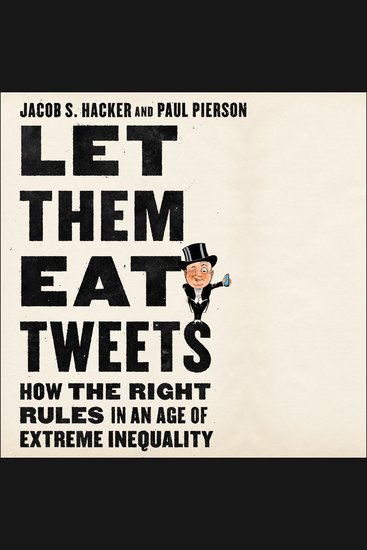
  • Let Them Eat Tweets - How the Right Rules in an Age of Extreme Inequality - cover

    Let Them Eat Tweets - How the...

    Anonymous

    • 0
    • 0
    • 0
    Does the GOP represent "forgotten" Americans? Or does it represent the superrich? 


    In Let Them Eat Tweets, bestselling political scientists Jacob S. Hacker and Paul Pierson offer a definitive answer: the Republican Party serves its plutocratic masters to a degree without precedent in modern global history. Conservative parties, by their nature, almost always side with the rich. But when faced with popular resistance, they usually make concessions, allowing some policies that benefit the working and middle classes. After all, how can a political party maintain power in a democracy if it serves only the interests of a narrow and wealthy slice of society? 


    Today's Republicans have shown the way, doubling down on a truly radical, elite-benefiting economic agenda while at the same time making increasingly incendiary racial and cultural appeals to their almost entirely white base. Telling a forty-year story, Hacker and Pierson demonstrate that since the early 1980s, when inequality started spiking, extreme tax cutting, union busting, and deregulation have gone hand in hand with extreme race-baiting, outrage stoking, and disinformation. As Hacker and Pierson argue, Trump isn't a break with the GOP's recent past. On the contrary, he embodies its tightening embrace of plutocracy and right-wing extremism.
    Show book
  • Cage Eleven - Prison Writings from Long Kesh - cover

    Cage Eleven - Prison Writings...

    Gerry Adams

    • 0
    • 1
    • 0
    Long before he became President of Sinn Féin, Gerry Adams was a civil rights activist who took part in sit-ins, marches and protests in Northern Ireland. Along with hundreds of other men, Adams was interned on the Maidstone prison ship and in Long Kesh prison – without charge or trial – during the 1970s for his political activities. Women were interned also, in Armagh Women's Prison. Cage Eleven is his own account – sometimes passionate, often humorous – of life in Long Kesh. Written while Adams was a prisoner, the pieces were smuggled out for publication.
    This updated edition includes a new introduction and sketches drawn in Cage Eleven by another prisoner at the time, Danny Devenny.
    'Offers a unique insight into … the experience of internment … an unrivalled representation of the resilience and humour that were as much a part of the life of the political prisoner as the adherence to a set of political ideals.' Irish Herald
    Show book
  • Why Johnny Still Can't Read or Write or Understand Math - And What We Can Do About It - cover

    Why Johnny Still Can't Read or...

    Andrew Bernstein

    • 0
    • 0
    • 0
    The current school system churns out millions of illiterates and mental zombies—but here's how we're going to fix it, starting today. 


    Coming out of the COVID-19 pandemic, parents across the nation grapple with a new and horrifying understanding of just how bad our educational system has become. It all adds up to a system that seems hopelessly, terribly, and irrevocably broken. But as an educator and author, Andrew Bernstein reminds us that American education in the nineteenth through early-twentieth century was superb. This nation once knew how to turn out the brightest, most resourceful and independent-thinking people the world had ever seen. We can do it again.
    Show book
  • Proposed Roads to Freedom - cover

    Proposed Roads to Freedom

    Bertrand Russell

    • 0
    • 0
    • 0
    In this work, Russell presents his views on the problems of modern society and offers his proposals for a better future. He critiques both capitalism and socialism as inadequate solutions, and instead advocates for a system based on guild socialism, where workers control the means of production and are organized into functional groups. Russell argues that the ultimate goal of society should be the development of the individual, and proposes a society that is organized around individual freedom and fulfillment rather than material wealth. He advocates for the abolition of the wage system and the establishment of a system of economic cooperation and communal ownership. He also discusses the role of education in a free society, arguing that it should be aimed at cultivating creativity, critical thinking, and individuality. Read in English, unabridged.
    Show book
  • Born This Way - Science Citizenship and Inequality in the American LGBTQ+ Movement - cover

    Born This Way - Science...

    Joanna Wuest

    • 0
    • 0
    • 0
    The story of how a biologically driven understanding of gender and sexuality became central to US LGBTQ+ political and legal advocacy. 
     
    Across protests and courtrooms, LGBTQ+ advocates argue that sexual and gender identities are innate. Oppositely, conservatives incite panic over “groomers” and a contagious “gender ideology” that corrupts susceptible children. Yet, as this debate rages on, the history of what first compelled the hunt for homosexuality’s biological origin story may hold answers for the queer rights movement’s future. 
    Born This Way tells the story of how a biologically based understanding of gender and sexuality became central to LGBTQ+ advocacy. Starting in the 1950s, activists sought out mental health experts to combat the pathologizing of homosexuality. As Joanna Wuest shows, these relationships were forged in subsequent decades alongside two broader, concurrent developments: the rise of an interest-group model of rights advocacy and an explosion of biogenetic and bio-based psychological research. The result is essential reading to fully understand LGBTQ+ activism today and how clashes over science remain crucial to equal rights struggles.
    Show book
  • EU Enlargement and European Integration: Challenges and Perspectives - 14th Network Europe Conference - Stockholm 25–26 September 2023 - cover

    EU Enlargement and European...

    Andreas Kellerhals, Tobias...

    • 0
    • 0
    • 0
    This publication comprises the contributions presented at the 14th Network Europe Conference held in Stockholm/Sweden, in September 2023. The conference addressed various challenges for the European integration process in light of current global crises, as well as aspects of the EU enlargement perspectives.
    Show book