Join us on a literary world trip!
Add this book to bookshelf
Grey
Write a new comment Default profile 50px
Grey
Subscribe to read the full book or read the first pages for free!
All characters reduced
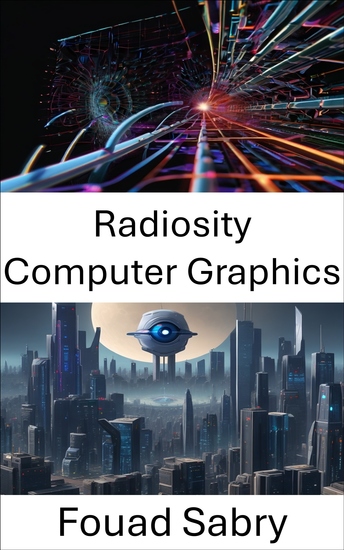
Radiosity Computer Graphics - Advancing Visualization through Radiosity in Computer Vision - cover

Radiosity Computer Graphics - Advancing Visualization through Radiosity in Computer Vision

Fouad Sabry

Publisher: One Billion Knowledgeable

  • 0
  • 0
  • 0

Summary

What is Radiosity Computer Graphics
 
In 3D computer graphics, radiosity is an application of the finite element method to solving the rendering equation for scenes with surfaces that reflect light diffusely. Unlike rendering methods that use Monte Carlo algorithms, which handle all types of light paths, typical radiosity only account for paths which leave a light source and are reflected diffusely some number of times before hitting the eye. Radiosity is a global illumination algorithm in the sense that the illumination arriving on a surface comes not just directly from the light sources, but also from other surfaces reflecting light. Radiosity is viewpoint independent, which increases the calculations involved, but makes them useful for all viewpoints.
 
How you will benefit
 
(I) Insights, and validations about the following topics:
 
Chapter 1: Radiosity (computer graphics)
 
Chapter 2: Rendering (computer graphics)
 
Chapter 3: Global illumination
 
Chapter 4: Ray tracing (graphics)
 
Chapter 5: Phong reflection model
 
Chapter 6: Metropolis light transport
 
Chapter 7: Photon mapping
 
Chapter 8: Shading
 
Chapter 9: Ray casting
 
Chapter 10: Rendering equation
 
(II) Answering the public top questions about radiosity computer graphics.
 
(III) Real world examples for the usage of radiosity computer graphics in many fields.
 
Who this book is for
 
Professionals, undergraduate and graduate students, enthusiasts, hobbyists, and those who want to go beyond basic knowledge or information for any kind of Radiosity Computer Graphics.
Available since: 05/13/2024.
Print length: 101 pages.
Other books that might interest you

  • Fermi Remembered - cover

    Fermi Remembered

    James W. Cronin

    • 0
    • 0
    • 0
    Nobel laureate and scientific luminary Enrico Fermi (1901-54) was a pioneering nuclear physicist whose contributions to the field were numerous, profound, and lasting. Best known for his involvement with the Manhattan Project and his work at Los Alamos that led to the first self-sustained nuclear reaction and ultimately to the production of electric power and plutonium for atomic weapons, Fermi's legacy continues to color the character of the sciences at the University of Chicago. During his tenure as professor of physics at the Institute for Nuclear Studies, Fermi attracted an extraordinary scientific faculty and many talented students—ten Nobel Prizes were awarded to faculty or students under his tutelage. Born out of a symposium held to commemorate the hundredth anniversary of Fermi's birth, Fermi Remembered combines essays and newly commissioned reminiscences with private material from Fermi's research notebooks, correspondence, speech outlines, and teaching to document the profound and enduring significance of Fermi's life and labors. The volume also features extensives archival material—including correspondence between Fermi and biophysicist Leo Szilard and a letter from Harry Truman—with new introductions that provide context for both the history of physics and the academic tradition at the University of Chicago. Edited by James W. Cronin, a University of Chicago physicist and Nobel laureate himself, Fermi Remembered is a tender tribute to one of the greatest scientists of the twentieth century. Contributors: Harold Agnew Nina Byers Owen Chamberlain Geoffrey F. Chew James W. Cronin George W. Farwell Jerome I. Friedman Richard L. Garwin Murray Gell-Mann Maurice Glicksman Marvin L. Goldberger Uri Haber-Schaim Roger Hildebrand Tsung Dao Lee Darragh Nagle Jay Orear Marshall N. Rosenbluth Arthur Rosenfeld Robert Schluter Jack Steinberger Valentine Telegdi Al Wattenberg Frank Wilczek Lincoln Wolfenstein Courtenay Wright Chen Ning Yang Gaurang Yodh
    Show book
  • Touchpad Plus Ver 40 Class 6 - cover

    Touchpad Plus Ver 40 Class 6

    Nidhi Gupta

    • 0
    • 0
    • 0
    Computer Science Textbook with New Pedagogical Approaches 
    
    KEY FEATURES 
    - National Education Policy 2020 
    - Tech Funda: This section provides a practical information or tip to the students. 
    - Clickipedia: This section provides interesting computer facts. 
    - Lab Session: This is a lab activity to develop practical skills. (Subject Enrichment) 
    - Explore More: This section contains supplement topics for add-on knowledge. 
    - QR Code: Scan the QR Code given on the first page of each chapter to start chapter animation. 
    - Mind Boggler: This section has puzzle or fun based activity to help understand the concepts better. 
    
    DESCRIPTION 
    Computer technology has become essential and an integral part of life at work, in recreation, social networking and education too. With the constant development of new technology, it has become more significant in helping and preparing students for jobs. Computers have revolutionised the way education is imparted to children. 
    
    Touchpad Plus Version 4.0 is a complete computer science curriculum solution for grades 1-8. It is based on Windows 10 and MS Office 2019, with new and future-ready content. Fun is the most important element of learning. Keeping in mind the concept of Joyful Learning, varied activities have been designed based on multiple intelligences and 21st century skills for holistic development. 
    
    The books have a conversational style introduction of each chapter to make learning fun and engaging. The topics and their approaches are integrated in different themes as per ICT learning. Grade I and II books have four-line writing space to enhance writing skills in children. Each book is accompanied by digital learning resources that offer interesting animation and interactive tests for the student to supplement classroom learning with independent learning. 
    
    The books are curated in a way that they make students and teachers equal partners in the learning process and take learning beyond classroom. We welcome and look forward to all meaningful and valuable suggestions for improving the book 
    
    WHAT WILL YOU LEARN 
    You will learn about: 
    - Digital World 
    - Cyber World 
    - Coding World 
    - Computational Thinking 
    - Artificial Intelligence 
    
    WHO THIS BOOK IS FOR 
    Grade 6 
    
    TABLE OF CONTENTS 
    1. PowerPoint 2019 
    2. More on Excel 2019 
    3. Formulas and Functions in Excel 2019 
    4. Digital Drawing in Krita 
    5. Introduction to HTML5 & CSS3 
    6. Internet Services 
    7. Algorithmic Intelligence 
    8. Introduction to Programming 
    9. Python 
    10. Intelligence and AI Approaches 
    ADD-ONS 
    ASSESSMENTS
    Show book
  • Time - A Very Short Introduction - cover

    Time - A Very Short Introduction

    Jennan Ismael

    • 0
    • 0
    • 0
    What is time? What does it mean for time to pass? Is it possible to travel in time? What is the difference between the past and future? Until the work of Newton, these questions were purely topics of philosophical speculation. Since then we've learned a great deal about time, and its study has moved from a subject of philosophical reflection to instead became part of the subject matter of physics. 


    This Very Short Introduction introduces listeners to the current physical understanding of the direction of time, from the Second Law of Thermodynamics to the emergence of complexity and life. Jenann Ismael charts the line of development in physical theory from Newton, via Einstein's Theory of Relativity, to the current day. In this new vision, time is one of the dimensions in which the universe is extended alongside the spatial dimensions. The universe appears as a static block of events, in which there is no more a difference between past and future than there is between east and west. Discussing the controversy and philosophical confusion which surrounded the reception of this new vision, Ismael also covers the contemporary mixture of statistical mechanics, cognitive science, and phenomenology that point the way to reconciling the familiar time of everyday sense with the vision of time presented in Einstein's theories.
    Show book
  • Relational Databases - Mastering the Fundamentals of SQL Design and Optimization for Efficient Data Handling - cover

    Relational Databases - Mastering...

    SAM CAMPBELL

    • 0
    • 0
    • 0
    “Relational Databases" is an indispensable resource for students, database professionals, and software developers who are keen on mastering the art and science of managing structured data with relational databases. As the foundation of data storage and retrieval systems used in everything from small applications to global information systems, understanding relational databases is crucial for anyone looking to thrive in the technology field. 
    This comprehensive guide takes you on a journey from the basic principles of relational databases to advanced strategies for data design, optimization, and SQL programming. 
    "“Relational Databases" is designed to equip you with a solid foundation in relational databases, enabling you to design, build, and manage database solutions that are robust, scalable, and efficient. By demystifying the complexities of relational databases, this book empowers you to leverage the full potential of structured data management in your professional projects and endeavors.
    Show book
  • Ultimate Cilium and eBPF for Cloud Native Development - Master eBPF and Cilium for Unmatched Cloud Security Performance and Observability in Modern Cloud Environments - cover

    Ultimate Cilium and eBPF for...

    Gaurav Shekhar

    • 0
    • 0
    • 0
    Unlock the Power of Cilium and eBPF to Revolutionize Cloud-Native Security and Networking
    Book Description
    Ciliume and BPF are revolutionizing cloud-native development by providing unparalleled observability, security, and performance enhancements. Ultimate Cilium and eBPF for Cloud Native Development bridges the knowledge gap, empowering developers, DevOps engineers, and IT professionals to leverage these technologies for building robust, scalable cloud-native applications.
    This book explores eBPF and Cilium in depth, starting with core concepts and fundamental principles to establish a solid foundation. Subsequent chapters cover practical applications, including tutorials on implementing Cilium in Kubernetes, optimizing network performance, and enhancing security with eBPF. Key takeaways include mastering eBPF programming, deploying Cilium for networking, monitoring applications, and leveraging eBPF for advanced security. Real-world case studies and hands-on examples provide practical insights and reinforce learning.
    By the end of this book, you will be equipped to implement and manage eBPF and Cilium in cloud-native projects. You will gain the skills to optimize performance, ensure robust security, and achieve superior observability, positioning yourself at the forefront of cloud-native development.
    Table of Contents
    1. Introduction to Cloud Native Networking
    2. Fundamentals of eBPF
    3. Getting Started with Cilium
    4. Advanced Cilium Features
    5. eBPF Programming for Cloud-Native Environments
    6. Cilium Internals
    7. Security with Cilium and eBPF
    8. Observability and Monitoring
    9. Load Balancing and Service Discovery
    10. Performance Optimization
    11. Troubleshooting and Debugging
    12. Extended Use Cases
    13. Future of Cloud Native Networking with eBPF      
    
    Index
    Show book
  • Our Western spring - Where is political divide leading us ? - cover

    Our Western spring - Where is...

    Nir Shvalb

    • 0
    • 0
    • 0
    "Progress is not just electronics and robots; it’s also adaptation and correction of social structures in light of these technological advances," Shvalb asserts, warning that "the old democracy won't survive if we don’t adjust it to the new era." 
    After reviewing the social phenomena leading societies to dangerous places, he points out, "History teaches us that civilizations tend to fade, and when they do, it can happen very suddenly." He then explores the influence of social networks on public discourse, noting that "fake news spreads six times faster than truthful news." As a scientist in the field of hard sciences, he examines the dangers of advancing technology, particularly the role of AI in societal unrest. Shvalb questions, "Can technological mega-giants know us intimately enough to control our choices?" 
    Life as we knew it no longer exists. The benefits technology has given us come with a heavy price. In a world where social interactions are shaped by powerful platforms guiding the way we think, behave, buy, and choose, there is a real risk to our societies that we must consider. The last part of the book is dedicated to practical solutions and suggestions. Yet, despite its serious themes, "Our Western Spring: Where is Political Divide Leading Us?" is engaging and fun to read. If you're curious about who suffered from scrotal ascites, what is considered the worst film of all time, or why China's government hates Winnie-the-Pooh, this book is for you. This blend of intriguing trivia and insightful analysis makes the book both thought-provoking and enjoyable, offering readers a captivating journey through the complexities of modern society.
    Show book