Join us on a literary world trip!
Add this book to bookshelf
Grey
Write a new comment Default profile 50px
Grey
Subscribe to read the full book or read the first pages for free!
All characters reduced
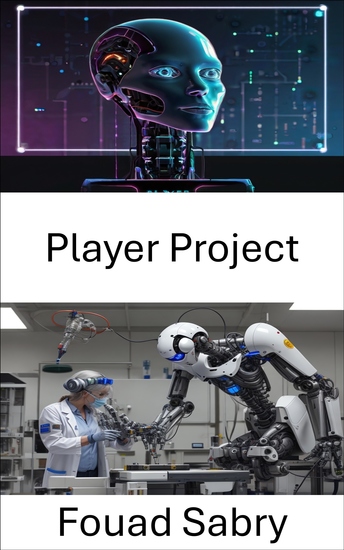
Player Project - Advancing Intelligent Systems Through Autonomous Robotics - cover

Player Project - Advancing Intelligent Systems Through Autonomous Robotics

Fouad Sabry

Publisher: One Billion Knowledgeable

  • 0
  • 0
  • 0

Summary

"Player Project" is an essential read for anyone invested in the future of robotics. Whether you're a professional, a student, or an enthusiast, this book offers comprehensive insights into key tools and concepts that drive robotics innovation. By exploring various robotics development environments and simulators, "Player Project" equips readers with the knowledge to navigate and succeed in the world of robotics. It is an indispensable resource that provides value beyond its cost.
 
Chapters Brief Overview:
 
1: Player Project: Introduction to the Player Project software platform, a vital tool for robotics programming and simulation.
 
2: Application software: Overview of software applications in robotics and how they enable practical implementations.
 
3: Visual programming language: A dive into visual programming languages and their role in simplifying complex robotic tasks.
 
4: TORCS: Detailed discussion on The Open Racing Car Simulator (TORCS) and its application in robotic control and simulation.
 
5: Microsoft Robotics Developer Studio: Exploring Microsoft's powerful tool for building and testing robotic applications.
 
6: IRobot Create: An introduction to the IRobot Create platform and its uses in developing autonomous robots.
 
7: Robotics suite: Examination of robotics suites and how they integrate various tools for enhanced robot development.
 
8: KDE Education Project: Insights into how the KDE Education Project aids in the teaching and learning of robotics.
 
9: Webots: A deep dive into Webots, a popular robot simulator used for research, education, and development.
 
10: Robotics simulator: An exploration of various robotics simulators and their importance in testing robotic systems.
 
11: AnyKode Marilou: Introduction to AnyKode Marilou, a key software for simulating and programming robots.
 
12: Mobile Robot Programming Toolkit: A look at the Mobile Robot Programming Toolkit and its contributions to mobile robot development.
 
13: Robot Operating System: Explanation of ROS, a flexible framework for building robot software and integrating robotics systems.
 
14: Opensource robotics: Focus on the growing impact of opensource robotics and its role in collaborative innovation.
 
15: Robotics middleware: Overview of robotics middleware and how it connects various software components in robotic systems.
 
16: Simbad robot simulator: Insights into the Simbad robot simulator and its applications in multirobot systems research.
 
17: RoboCup 2D Soccer Simulation League: Analysis of the RoboCup 2D Soccer Simulation League and its significance in robotics competitions.
 
18: Gazebo (simulator): A detailed guide to Gazebo, a powerful robotics simulator for complex robot modeling and simulation.
 
19: Crossplatform software: Exploration of crossplatform robotics software tools and their importance in universal compatibility.
 
20: Amiga software: History and influence of Amiga software on early robotics development and programming.
 
21: Aptana: Discussion of Aptana's role in robotics development, particularly in integrating web technologies for robots.
 
"Player Project" is an invaluable asset for anyone looking to deepen their understanding of robotics science. By mastering these tools and platforms, readers can unlock their potential in the field of robotics, gaining both theoretical knowledge and handson experience. Perfect for professionals, students, and hobbyists alike, this book delivers a wealth of valuable insights that will pay dividends throughout your career.
Available since: 01/03/2025.
Print length: 209 pages.

Other books that might interest you

  • Black Bear - A Story of Siblinghood and Survival - cover

    Black Bear - A Story of...

    Trina Moyles

    • 0
    • 0
    • 0
    When Trina Moyles was five years old, her father, a wildlife biologist known in Peace River as "the bear guy," brought home an orphaned black bear cub for a night before sending it to the Calgary Zoo. This brief but unforgettable encounter spurred Trina's lifelong fascination with Ursus americanus—the most populous bear on the northern landscape, often considered a nuisance to human society. As a child roaming the shores of the Peace in the footsteps of her beloved older brother, Brendan, she understood bears to be invisible entities: always present but mostly hidden and worthy of respect.After years of working for human rights organizations, Trina returned to northern Alberta for a job as a fire tower lookout. Over four summers, Trina begins to move beyond fear and observe the extraordinary essence of the maligned black bear—a keystone species who is as subject to the environmental consequences of the oil economy as humans. At the same time, she searches for common ground with Brendan on the land that bonded them.Impassioned and eloquent, Black Bear is a story of grief and a vision of peaceful coexistence in a divided world. It captures the fragility of our relationships with human and nonhuman species alike, and the imperative to protect the wild—along with the people we hold closest.
    Show book
  • Flatland: A Romance of Many Dimensions - cover

    Flatland: A Romance of Many...

    Edwin A. Abbott

    • 0
    • 0
    • 0
    Flatland: A Romance of Many Dimensions is a satirical novella by the English schoolmaster and clergyman Edwin Abbott Abbott. The story describes a two-dimensional world occupied by geometric figures, where of women are simple line-segments, while men are polygons with various numbers of sides. Written pseudonymous by "A Square", the book used the fictional two-dimensional world of Flatland to comment on the hierarchy of Victorian culture, but the novella's more enduring contribution is its examination of dimensions. This masterpiece of science (and mathematical) fiction is a delightfully unique and highly entertaining satire that has charmed readers for more than 100 years.
    Show book
  • HowExpert Guide to Fishkeeping - 101 Tips on How to Set Up and Maintain a Fish Tank & Aquarium Keep Your Fish Alive & Healthy and Become a Better Fishkeeper - cover

    HowExpert Guide to Fishkeeping -...

    HowExpert, Aurora Sandelands

    • 0
    • 0
    • 0
    Welcome to your fabulous new hobby and a magnificent new world. This helpful guide will ensure your success in your new endeavor by teaching you the basics, and a little more, of fishkeeping. Learn every step of the way with 101 helpful tips so you can become an efficient fishkeeper in no time!  
    In this book, you will learn the various kinds of fish and plants that can live in your tank, along with the temperatures, decor, and equipment that goes along with it all. Learn the proper way to introduce fish into your tank and cycle your tank correctly to avoid any unnecessary fish loss. You may also learn about fishy misconceptions and the proper way to care for each type of fish, like temperature and what foods to feed them. Don’t forget; this guide will also help you choose a proper tank for your wants and needs so you don’t bite off more than you can chew or get bored with your tank too quickly! 
    So, pick up this book, settle in, and get ready to become a better fishkeeper, and soon you will have the fish tank of your dreams. 
    About the Author 
    Aurora Sandelands has been a passionate fish keeper for over two years and a writer for over 10. As soon as she got her first one-gallon beta tank, she knew she couldn’t stop and gradually made her way up to a 75-gallon cichlid tank (After learning a lot through research and firsthand experience). She graduated from her state college with an AA in creative writing in 2014 and is currently pursuing her bachelor’s at the Rocky Mountain College of Art and Design. She loves to write and paint watercolor next to her two cats, her Pit Bull, and her 30 fish in her hometown of Minneapolis, Minnesota. 
    HowExpert publishes how to guides by everyday experts. Visit HowExpert.com to learn more.
    Show book
  • Multisolving - Creating Systems Change in a Fractured World - cover

    Multisolving - Creating Systems...

    Elizabeth Sawin

    • 0
    • 0
    • 0
    For most of Elizabeth Sawin's career, she was not a multisolver. Instead, she worked on a single, albeit immensely important problem: climate change. Despite tremendous effort, she felt like she was chasing her tail. Unless people began to recognize the multitude of unexpected benefits from ratcheting down emissions, climate change would remain a losing political issue.That experience, along with the guidance of leaders in systems thinking and racial justice, convinced her that the world's thorniest problems may be easier to tackle together than one by one. That's multisolving: using a single investment of time or money to solve many problems at the same time. Multisolving addresses the current mismatch between complex, deeply intertwined societal issues and our siloed approach to them.This unique resource is for local school boards that need revenue for their students but don't want to overtax low-income seniors. It is for nonprofits working to reduce food waste and combat the root causes of hunger while increasing racial justice. It is for seaside communities that can protect themselves from flooding while also improving biodiversity with a living coastline. It may also be for you: doing the work you know is imperative but that is sometimes overwhelming, a tiny drop in a swirling ocean.
    Show book
  • Embracing the Science of Life Without Free Will - "Master Life's Mysteries! Experience audio lessons crafted for understanding life without the illusion of free will" - cover

    Embracing the Science of Life...

    Lincoln Evershaw

    • 0
    • 0
    • 0
    Embracing the Science of Life Without Free Will 
    ⭐⭐ Simplified Audio Guide ⭐⭐ 
    Are you seeking to elevate your understanding of life and grasp the profound implications of living without free will? 
    Looking for an all-encompassing guide that delves into the science behind our lack of free will? 
    Your search ends here! 
    This audiobook serves as your ultimate companion for deepening your understanding, applying your insights, and engaging in thought-provoking exercises. With this, you're set for a transformative experience. 
    Updated for the latest scientific understandings of life without free will. 
    Key features of this enriched guide: 
    - Profound insights about living without free will 
    - Detailed explanations of what it means to exist without free will 
    - Effective strategies for incorporating this understanding into your daily life 
    Our guide stands out through its comprehensive coverage, which is essential for grasping these complex ideas. Concepts aren't merely skimmed; they are delved into with precision. 
    Please note that this guide is not affiliated with any official scientific entity and is purely an independent resource for your benefit. 
    Designed with clear structure and easy-to-understand language, our guide ensures smooth transitions between topics. Say goodbye to dense jargon and welcome clear, precise, and scientifically accurate content. 
    So, why wait? Click the BUY NOW button, secure your guide, and begin your journey to understanding life in a new, enlightening way!
    Show book
  • Celestial Conundrums - Nine Space Oddities Challenging Scientific Understanding - cover

    Celestial Conundrums - Nine...

    John Harpoon

    • 0
    • 0
    • 0
    Dark matter, a mysterious and invisible substance, remains one of the most profound puzzles in modern astrophysics. Despite being undetectable by conventional means, its presence is inferred through its gravitational effects on visible matter, radiation, and the large-scale structure of the universe. Comprising roughly 27% of the universe’s total mass-energy content, dark matter far outweighs the ordinary matter that makes up stars, planets, and galaxies. However, scientists have yet to identify its true nature. 
    The origins of the dark matter hypothesis trace back to the early 20th century when astronomers noticed an unusual phenomenon. The visible mass of galaxies and clusters of galaxies appeared insufficient to explain their observed gravitational behavior. In the 1930s, Swiss astronomer Fritz Zwicky first coined the term “dark matter” while studying galaxy clusters. He realized that the galaxies within these clusters were moving too quickly for the amount of visible matter present, suggesting the existence of an unseen mass exerting a gravitational pull. Since then, dark matter has become an essential concept for understanding the dynamics of galaxies and the larger structure of the universe. 
    Over the decades, further evidence for dark matter has emerged, from the rotation curves of galaxies to the behavior of galaxy clusters. When astronomers measure how fast stars orbit the center of a galaxy, they find that stars on the outer edges move much faster than expected based on the mass visible in the galaxy. If only the observed matter were present, the stars would not have enough gravitational pull to remain bound to the galaxy. This discrepancy is explained by the presence of an unseen mass—dark matter—scattered throughout the galaxy. Additionally, observations of the cosmic microwave background radiation, which reflects the early universe, also point to dark matter's existence as a key player in the formation of the cosmos.
    Show book