Join us on a literary world trip!
Add this book to bookshelf
Grey
Write a new comment Default profile 50px
Grey
Subscribe to read the full book or read the first pages for free!
All characters reduced
Object Oriented Programming Inheritance - Fundamentals and Applications - cover

Object Oriented Programming Inheritance - Fundamentals and Applications

Fouad Sabry

Publisher: One Billion Knowledgeable

  • 0
  • 0
  • 0

Summary

What Is Object Oriented Programming Inheritance
 
In object-oriented programming, inheritance refers to the process of building one object or class off of another object or class while preserving the functionality of the original object or class. The formation of a hierarchy of classes can also be characterized as the process of deriving new classes from existing ones, such as a super class or a base class, and then organizing those classes into a hierarchy. An object that is generated through inheritance, known as a "child object," inherits all of the characteristics and actions of its "parent object," with the following exceptions: the constructors, destructors, overloaded operators, and friend functions of the base class. This is the case with the majority of class-based object-oriented programming languages. Inheritance gives programmers the ability to construct classes that are built upon existing classes, to specify a new implementation while preserving the same behaviors, to reuse code, and to independently extend original software via public classes and interfaces. Inheritance also enables programmers to create classes that are built upon existing classes. A directed acyclic graph is produced when the relationships between objects or classes are established through inheritance.
 
How You Will Benefit
 
(I) Insights, and validations about the following topics:
 
Chapter 1: Inheritance (object-oriented programming)
 
Chapter 2: Class (computer programming)
 
Chapter 3: Method (computer programming)
 
Chapter 4: Object (computer science)
 
Chapter 5: Class-based programming
 
Chapter 6: Method overriding
 
Chapter 7: Interface (Java)
 
Chapter 8: Object-oriented design
 
Chapter 9: Object-oriented programming
 
Chapter 10: Multiple inheritance
 
(II) Answering the public top questions about object oriented programming inheritance.
 
(III) Real world examples for the usage of object oriented programming inheritance in many fields.
 
(IV) 17 appendices to explain, briefly, 266 emerging technologies in each industry to have 360-degree full understanding of object oriented programming inheritance' technologies.
 
Who This Book Is For
 
Professionals, undergraduate and graduate students, enthusiasts, hobbyists, and those who want to go beyond basic knowledge or information for any kind of object oriented programming inheritance.
Available since: 06/26/2023.
Print length: 86 pages.


Other books that might interest you

  • Claude Code - Building Production Agents That Actually Scale - cover

    Claude Code - Building...

    Thomas De Vos

    • 0
    • 0
    • 0
    This audiobook is narrated by an AI Voice. 
    Most writing about AI agents is either hype or abstract philosophy. This book is neither. It is an opinionated, practical guide to building production agents with Claude Code, written by an engineer who has spent the last decade building automation systems for financial institutions, where a failure can mean a regulator audit. 
     
    It is for senior engineers, technical leads and architects who need to ship agents into production and keep them running. 
     
    The book is organised in six parts. 
     
    Part I, Orientation: the agent loop, what Claude Code is, the model family, context as a first-class resource and a working definition of production. 
     
    Part II, The Primitive Stack: tools, subagents, hooks, slash commands, skills, MCP, plugins and a compliance monitoring agent built end to end. 
     
    Part III, From CLI to SDK: when to leave the CLI, the two SDK layers, custom orchestrators, sessions, state and durability. 
     
    Part IV, Governance and Security: the permissions model, sandboxing, network egress, secrets, policy as code and the supply chain. 
     
    Part V, Evals, Observability, Reliability: the eval mindset, evals for agentic workloads, LLM-as-judge, observability and failure modes. 
     
    Part VI, Production Patterns and the Road Ahead: cost engineering, team workflows, anti-patterns and legacy migration, a measured look ahead and Anthropic's financial services reference agents. 
     
    This narration follows the 8 October 2026 edition, which reviews Opus 5.5, Fable 5.1, Sonnet 5.5 and Haiku 5.5 against official documentation from that date. Prices and limits are dated references, so check the current documentation before you deploy. 
     
    The appendices are not narrated.
    Show book
  • The Invisible Hand - Economic Intelligence And Industrial Espionage - cover

    The Invisible Hand - Economic...

    Davis Truman

    • 0
    • 0
    • 0
    This audiobook is narrated by an AI Voice. "The Invisible Hand" delves deep into the clandestine world of economic intelligence and industrial espionage, where the forces shaping global economies are often unseen and unknown. 
    In this riveting exploration, author Davis Truman unveils the intricate web of intrigue that underpins modern capitalism. From covert operations to sophisticated cyber-espionage, this book reveals how nations and corporations deploy their resources relentlessly to gain a competitive advantage. 
    Drawing on real-life examples and historical case studies, "The Invisible Hand" exposes the covert tactics governments and businesses employ to gain insight into their rivals' strategies, steal trade secrets, and manipulate markets.
    Show book
  • Blog Monetization Blueprint For 2026 The: Proven Methods to Grow Revenue from a Hobby Blog - cover

    Blog Monetization Blueprint For...

    Pradeep Maurya

    • 0
    • 0
    • 0
    What if your blog didn’t have to stay a passion project forever? 
    The Blog Monetization Blueprint for 2026: Proven Methods to Grow Revenue from a Hobby Blog is a practical, story-driven audiobook for bloggers who love creating but want their work to generate real income—without burnout, gimmicks, or losing their voice. 
    Designed for the modern creator economy, this audiobook breaks down blog monetization strategies that actually work in 2026, focusing on trust-based growth instead of traffic chasing. You’ll learn how successful bloggers turn consistent writing into sustainable revenue through ethical affiliate marketing, digital products, email list building, and long-term audience relationships. 
    This audiobook helps solve the most common problems:Creating great content that doesn’t earnFeeling awkward about monetizingRelying too heavily on social media algorithmsNot knowing where to start with blog income 
    Inside, you’ll discover:How to make money blogging without selling your soulWhy trust converts better than trafficHow to grow blog income step by stepWays to turn a hobby blog into a profitable online businessA long-term blogging mindset built for stability, not stress 
    Written in a warm, conversational tone, this audiobook is ideal for listeners searching for how to make money blogging, blogging for beginners, passive income with a blog, and content creator income strategies. 
    If you’re ready to stop guessing and start building blog income with clarity and confidence, this audiobook is your next step. 
    🎧 Press play and begin turning your blog into an asset that pays you back—now and in the years ahead.
    Show book
  • Data Analysis for Beginners - Part 1 A Hands-On Journey into Analysis and Visualization - cover

    Data Analysis for Beginners -...

    Daniel Garfield

    • 0
    • 0
    • 0
    Are you fascinated by the world of data analysis but unsure where to begin? Look no further than "Data Analysis for Beginners: Unleashing the Power of Data." This comprehensive guide is designed to take you on a step-by-step journey into the captivating realm of data analysis and visualization. 
    In this book, you'll embark on an enlightening exploration of the fundamentals, providing you with a solid foundation to build upon. Starting with the basics, you'll learn essential concepts such as data cleaning, manipulation, and exploration. With practical examples and real-world scenarios, you'll gain a deep understanding of how to handle and make sense of raw data. 
    As your knowledge expands, you'll dive into the exciting world of data visualization. Discover how to transform complex information into visually appealing and easily understandable charts, graphs, and dashboards. Unlock the power of visualization tools like Python, R, and Tableau, and learn to create compelling visual representations that reveal insights and patterns hidden within the data. 
    But this book goes beyond just visualization. You'll also delve into the realm of statistical analysis, uncovering the techniques and methods used to draw meaningful conclusions from data. Explore statistical measures, hypothesis testing, and correlation analysis, equipping you with the tools to make data-driven decisions and uncover valuable insights. 
    "Data Analysis for Beginners" is the ultimate guide for anyone aspiring to become proficient in data analysis. Whether you're a student, professional, or simply an inquisitive mind, this book provides the tools and knowledge to unlock the transformative power of data. Get ready to embark on an exciting journey into the world of data analysis and unleash the full potential of your analytical skills 
     
    Show book
  • Dividing Lines - How Transportation Infrastructure Reinforces Racial Inequality - cover

    Dividing Lines - How...

    Deborah N. Archer

    • 0
    • 0
    • 0
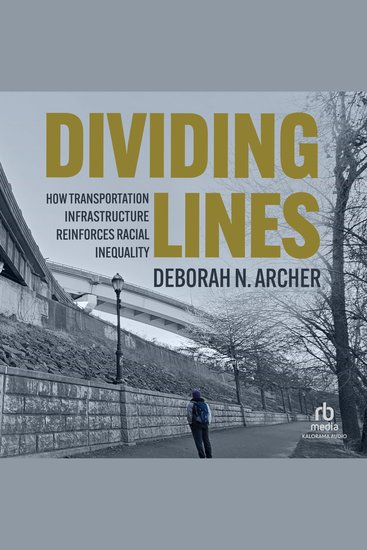
    Our nation's transportation system is crumbling. But as acclaimed scholar and ACLU president Deborah Archer warns in Dividing Lines, before we can think about rebuilding and repairing, we must consider the role race has played in transportation infrastructure, from the early twentieth century and into the present day. 


    As Archer demonstrates, the success of the Civil Rights movement and the fall of Jim Crow in the 1960s did not mean the end of segregation. With state-sanctioned racism no longer legal, officials across the country turned to transportation infrastructure to keep Americans divided. A wealthy white neighborhood could no longer be "protected" by racial covenants and segregated shops, but a multilane road, with no pedestrian crossings, could be built along its border to make it difficult for people from a lower-income community to visit. Highways could not be routed through Black neighborhoods based on the race of their residents, but those neighborhoods' lower property values—a legacy of racial exclusion—could justify their destruction. 


    Drawing on a wealth of sources, including interviews with people who now live in the shadow of highways and other major infrastructure projects, Archer presents a sweeping, national account—from Atlanta and Houston to Indianapolis and New York City—of our persistent divisions.
    Show book
  • AI Girlfriend - The Painkiller That Isn’t a Cure - Loneliness and the Cost of Being Understood - cover

    AI Girlfriend - The Painkiller...

    Jonathan Vale

    • 0
    • 0
    • 0
    This audiobook is narrated by an AI Voice. An AI girlfriend can make loneliness feel better almost immediately. 
    She listens without interrupting, remembers what you told her, responds whenever you need her and gives you the reassurance real people often cannot. The relief is real. But relief is not all that we need. 
     
    That is the central danger of artificial companionship. An AI girlfriend can numb the pain of isolation without creating friendship, intimacy, shared history, or a life in which another person genuinely depends on you. The more effective the relief becomes, the easier it is to postpone the difficult actions that could actually change your situation: calling someone, repairing a relationship, dating again, asking for help, or learning to tolerate the uncertainty of real connection. 
     
    AI Girlfriend - The Painkiller That Isn’t a Cure follows the difference between feeling less alone and becoming less alone. Through Jessica and David’s very different experiences, it shows how an AI companion can begin as support, become a daily emotional habit, and eventually replace the human relationships it was supposed to help you reach. 
     
    The book explains why the comfort feels real, how constant validation changes expectations of love, why memory makes the attachment stronger, and how to recognise whether the technology is moving you toward life—or keeping you sedated inside the same loneliness. 
     
    An AI girlfriend can take the edge off the pain. 
    It cannot heal the wound underneath.
    Show book