Join us on a literary world trip!
Add this book to bookshelf
Grey
Write a new comment Default profile 50px
Grey
Subscribe to read the full book or read the first pages for free!
All characters reduced
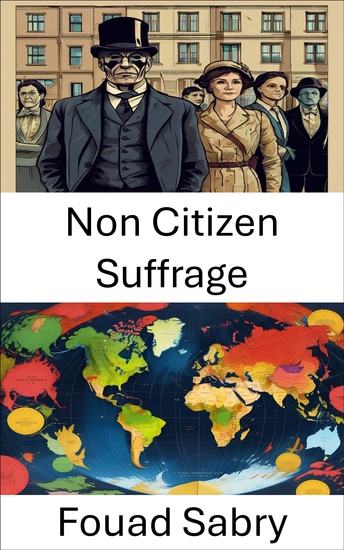
Non Citizen Suffrage - Empowering Voices in Global Democracies - cover

Non Citizen Suffrage - Empowering Voices in Global Democracies

Fouad Sabry

Publisher: One Billion Knowledgeable

  • 0
  • 0
  • 0

Summary

Non-Citizen Suffrage: Understanding Global Voting Rights
 
Explore the complexities of non-citizen voting rights in "Non-Citizen Suffrage," part of the "Political Science" series. This book delves into how enfranchising non-citizens affects global democracy. As citizenship and residency boundaries blur, understanding these rights is key to shaping political equity.
 
Chapters Overviews
 
1: Non-citizen Suffrage – A deep dive into the relevance of non-citizen voting.
 
2: Suffrage – The historical roots and its impact on modern voting.
 
3: Disfranchisement – Exclusion from voting and its political consequences.
 
4: British Subject – Perspectives on non-citizen suffrage in the UK.
 
5: Elections in France – France's stance on non-citizen voting.
 
6: Voter Registration – How systems affect non-citizen participation.
 
7: Permanent Residency – The role of residency in voting rights.
 
8: Elections in Luxembourg – Luxembourg's approach to non-citizen suffrage.
 
9: Elections in Lithuania – Eastern European challenges in voting rights.
 
10: Right of Abode – How residency status impacts suffrage.
 
11: Irish Nationality Law – Nationality laws shaping Irish voting rights.
 
12: Commonwealth Citizen – Commonwealth's influence on voting rights.
 
13: Finnish Nationality Law – Finnish law and its impact on suffrage.
 
14: Maltese Nationality Law – Malta’s approach to non-citizen voting.
 
15: History of Icelandic Nationality – Iceland’s evolving voting practices.
 
16: Non-citizen Suffrage in the U.S. – The debate surrounding U.S. non-citizen voting.
 
17: Black Suffrage – The intersection of race and voting rights.
 
18: Multiple Citizenship – How dual/multiple citizenship affects voting.
 
19: Right of Foreigners to Vote in Switzerland – A Swiss case study on non-citizen voting.
 
20: Right of Expatriates to Vote – Expatriates' role in home-country elections.
 
21: Voting Rights in Belgium – Non-citizen voting in Belgium’s democracy.
 
Conclusion
 
With real-world examples and theoretical analysis, "Non-Citizen Suffrage" is essential for anyone studying voting rights. It offers new insights into global democratic practices and non-citizen participation, making it a must-read for scholars, professionals, and enthusiasts of political science.
Available since: 09/12/2024.
Print length: 353 pages.

Other books that might interest you

  • The Politics - cover

    The Politics

    Aristotle

    • 0
    • 0
    • 0
    One of the most influential works in political philosophy, The Politics by Aristotle explores the nature of government, justice, and the ideal state. In this timeless classic, Aristotle examines different political systems, the role of citizenship, and the balance between power and virtue in governance. His insights continue to shape modern political thought, making this an essential listen for anyone interested in philosophy, politics, or history. 
    Presented in a compelling narration by various voices, this audiobook brings Aristotle’s wisdom to life, offering a deep dive into the foundations of democracy, leadership, and societal organization. 
    Perfect for scholars, students, and anyone seeking to understand the principles that govern societies, The Politics remains as relevant today as it was in ancient Greece.
    Show book
  • The Wannabe Fascists - A Guide to Understanding the Greatest Threat to Democracy - cover

    The Wannabe Fascists - A Guide...

    Federico Finchelstein

    • 0
    • 0
    • 0
    Meet today's almost fascists and learn the warning signs to intercept them on the road from populism to dictatorship. 


    With The Wannabe Fascists, historian Federico Finchelstein offers a precise explanation of why Trumpism and similar movements across the world belong to a new political breed, the last outcome of the combined histories of fascism and populism: the wannabe fascists. This new type of populist politician is typically a legally elected leader who, unlike previous populists who were eager to distance themselves from fascism, turns to totalitarian lies, racism, and illegal means to destroy democracy from within. 


    Drawing on almost three decades of research on the histories of fascism and populism around the world, this book lays out in clear language what the author calls the "four pillars of fascism"—xenophobia, propaganda, political violence, and ultimately dictatorship. Finchelstein carefully explains how and why wannabe fascists like Trump, Bolsonaro, and Modi embrace the first three pillars but don't quite succeed in dictatorship and total suppression of the popular vote. The Wannabe Fascists stresses the importance of preventing despots from reaching this tipping point and offers a clear warning for what's at stake.
    Show book
  • Hidden Hero The: Secrets of an American Spy’s Daring Diplomacy - "Experience thrilling diplomacy! Immerse yourself in 'The Hidden Hero' audiobook and unleash your inner spy!" - cover

    Hidden Hero The: Secrets of an...

    Quinlan Ashford

    • 0
    • 0
    • 0
    The Hidden Hero: Secrets of an American Spy’s Daring Diplomacy 
    ⭐⭐ Simplified Guide & Explanations Included ⭐⭐ 
    Are you eager to advance in your career while reinforcing your knowledge of a remarkable historical figure? 
    Looking for a thorough guide that unearths the crucial elements of this untold story? 
    Your search ends here! 
    This guide is your ultimate companion for enhancing your understanding, applying your insights, and immersing yourself in practical exercises. With this resource, you're set for success. 
    Updated for the most current understanding of unsung bravery and resilience. 
    Key features of this enhanced guide: 
    - In-depth insights into the hidden heroism unveiled in the shadows of history. 
    - Detailed explanations of the compelling acts of an American spy's diplomacy. 
    - Effective strategies for grasping the complexities and nuances of this narrative. 
    Our guide stands out with its comprehensive coverage, which is essential for fully appreciating this story's significance. Concepts aren't merely glossed over; they are explored with depth and clarity. 
    Please note that this guide is independent and not affiliated with any official historical entity. 
    Crafted with a straightforward structure and accessible language, our guide ensures seamless transitions between topics. Say goodbye to complicated jargon and embrace clear, precise, and accurate content. 
    So, why wait? Click the BUY NOW button, secure your guide, and embark on your journey to uncover the hidden heroism within history’s shadows!
    Show book
  • Open Society and Its Enemies The: Book Summary & Analysis - cover

    Open Society and Its Enemies...

    Briefly Summaries

    • 0
    • 0
    • 0
    This is a concise summary and analysis of The Open Society and Its Enemies, by 
    Karl Popper.
    It is not the original book and is not affiliated with or endorsed by 
    Karl Popper.
    Ideal those seeking a quick and insightful overview.
     
    The Open Society and Its Enemies is a groundbreaking exploration of the philosophical underpinnings of totalitarianism and the defense of liberal democracy. This seminal work challenges the ideas of influential thinkers such as Plato, Hegel, and Marx, critiquing their roles in shaping authoritarian ideologies. With incisive logic and clarity, it argues for the necessity of open societies, where individual freedoms, critical thinking, and scientific inquiry thrive. A profound study of the conflict between tyranny and freedom, this book remains a cornerstone in political philosophy and an enduring guide for safeguarding democratic principles.
    Show book
  • Sanctions - What Everyone Needs to Know - cover

    Sanctions - What Everyone Needs...

    Bruce W. Jentleson

    • 0
    • 0
    • 0
    A concise, authoritative overview of a little-understood yet extremely important phenomenon in world politics: the use of economic sanctions by one country to punish another. 


    It's hard to browse the news without seeing reports of yet another imposition of sanctions by one country on another. The United States has sanctions against more than thirty countries. Russia has repeatedly imposed sanctions against former Soviet republics. China has developed its own approach, including targeting private entities such as the NBA. And it's not just major powers: Japan and South Korea have sanctioned each other over WWII and colonial legacies; Saudi Arabia against Qatar because of differences over Iran; and France, Germany, and Norway against Brazil over the Amazon forest and climate change. In Sanctions: What Everyone Needs to Know®, Bruce Jentleson—one of America's leading scholars on the subject—answers the fundamental questions about sanctions today: Why are they used so much? What are their varieties? What are the key factors affecting their success? Why have they become the tool of first resort for states engaged in international conflict? Jentleson demonstrates that examining sanctions is key to understanding international relations and explains how and why they will likely continue to bear on global politics.
    Show book
  • The White Allies Handbook - 4 Weeks to Join the Racial Justice Fight for Black Women - cover

    The White Allies Handbook - 4...

    Lecia Michelle

    • 0
    • 0
    • 0
    You've read White Fragility and How to Be an Antiracist, but what comes next? The answer lies in this clear, actionable guide providing an invaluable four-week program for becoming an ally who makes a real difference in the racial justice fight. 


    Black women have always been the driving force behind real change in this country—especially when it comes to racial justice work. But they shouldn't have to do it alone. If you're ready to stop standing on the sidelines and become anti-racist instead of passively "not racist," then this book is what you need. You'll discover: how to have difficult conversations about white supremacy, racism, and white privilege; how to listen to criticism without defensiveness; why it's harmful to ignore race or claim to be colorblind; and how to expand your racial justice circle by joining groups led by Black women and cultivating a group of like-minded allies. 


    Racism can only be defeated if white people educate themselves and actively engage in antiracism work, especially in their inner circles. With this book, you'll learn how to change from someone who defends and protects racism to someone who fights against it. And you'll become an example to others that true allies are made, not born.
    Show book