Join us on a literary world trip!
Add this book to bookshelf
Grey
Write a new comment Default profile 50px
Grey
Subscribe to read the full book or read the first pages for free!
All characters reduced
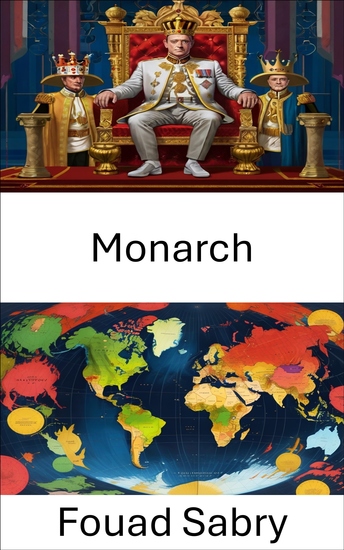
Monarch - The Dynamics of Power and Tradition in Contemporary Governance - cover

Monarch - The Dynamics of Power and Tradition in Contemporary Governance

Fouad Sabry

Publisher: One Billion Knowledgeable

  • 0
  • 0
  • 0

Summary

"Monarch" offers a deep dive into the world of royal governance, exploring how monarchies have shaped, and continue to influence, political systems. As part of the "Political Science" series, this book provides valuable insights into the historical evolution and contemporary relevance of monarchies. With a focus on both constitutional and hereditary systems, "Monarch" is an essential resource for political science students, professionals, and anyone keen on understanding the enduring significance of royal institutions.
 
1: Monarch - Explore the origins and evolution of monarchy as a political institution.
 
2: Constitutional Monarchy - Understand how monarchy and democracy coexist within this hybrid governance system.
 
3: Monarchy - A thorough look into different forms of monarchy and their historical changes.
 
4: Primogeniture - Discover the significance of primogeniture in ensuring dynastic succession.
 
5: Dynasty - Learn about dynastic families and their influence on political power and stability.
 
6: Heir Apparent - Explore the role of the heir apparent in succession and royal legitimacy.
 
7: Crown Prince - Understand the responsibilities of the crown prince within monarchical systems.
 
8: Hereditary Monarchy - Examine the system where power is inherited across generations.
 
9: Elective Monarchy - Delve into systems where monarchs are elected, rather than inheriting the throne.
 
10: List of Current Monarchs of Sovereign States - A comprehensive list of current monarchs worldwide.
 
11: Agnatic Seniority - Understand agnatic seniority and its role in royal succession.
 
12: War of Succession - Analyze conflicts over royal succession and their political consequences.
 
13: Monarchies in Europe - A deep dive into the history and present state of European monarchies.
 
14: List of Monarchies - An extensive list offering a global perspective on royal systems.
 
15: Monarchies in Africa - Examine the role of monarchies within African political systems.
 
16: Order of Succession - Learn the protocols governing the royal line of succession.
 
17: Şehzade - Understand the importance of the title "Şehzade" in Ottoman history.
 
18: Monarchy of Denmark - Explore the history of one of the world’s oldest monarchies.
 
19: Non-Sovereign Monarchy - Discover monarchies without sovereign power but with cultural significance.
 
20: Monarchies of Malaysia - Investigate the unique structure of Malaysia’s monarchy.
 
21: List of Current Monarchies - An updated list of current global monarchies.
 
"Monarch" goes beyond simple history lessons, providing a detailed look at how monarchies have influenced and continue to affect governance across the globe. This book serves as a cornerstone for anyone looking to understand royal institutions, their evolution, and their impact on modern political systems. Its accessible approach ensures that readers from all backgrounds will gain a deeper understanding of this enduring form of governance, making it a must-read for any political science enthusiast.
Available since: 09/21/2024.
Print length: 370 pages.
Other books that might interest you

  • Cold Peace - Avoiding the New Cold War - cover

    Cold Peace - Avoiding the New...

    Michael W. Doyle

    • 0
    • 0
    • 0
    An urgent examination of the world barreling toward a new Cold War. 


    With a historian's eye and a theorist's ingenuity, Michael Doyle, whose writings on liberal peace have revolutionized modern statesmanship, cogently assesses the tectonic shifts threatening a global order that has held for more than seventy years. As tensions among China, Russia, and the US escalate perilously toward a new Cold War, Doyle introduces a radical paradigm that will facilitate the international cooperation necessary to avert the global threats of our time. 


    Combining dramatic history with trenchant analysis and landmark theory, Doyle explores the impacts of cyberwarfare, foreign election meddling, and the unprecedented schism of modern politics on American foreign policy. He demonstrates that there can be no success in addressing climate change without China's cooperation, nor any hope of averting nuclear catastrophe without Russia's. 


    In the tradition of Gaddis's The Cold War and Clark's The Sleepwalkers, Cold Peace provides one of the most necessary analyses of global power in decades.
    Show book
  • Black Consciousness - A Love Story - cover

    Black Consciousness - A Love Story

    Hlumelo Biko

    • 0
    • 0
    • 0
    ‘If Steve Biko were alive today, we would have a country that gladly embraces African culture as the dominant driving force for how society is organised ...’ 
    In 1968, two young medical students, Steve Biko and Mamphela Ramphele, fell in love while dreaming of a life free from oppression and racial discrimination. Their love story is also the story of the founding of the Black Consciousness Movement (BCM) by a group of 15 principled and ambitious students at the University of Natal in Durban in the early 1970s. 
      
    In this deeply personal book, Hlumelo Biko, who was born of Steve and Mamphela’s union, movingly recounts his parents’ love story and how the BCM’s message of black self-love and self-reliance helped to change the course of South African history. 
      
    Based on interviews with some of the BCM’s founding members, Black Consciousness describes the early years of the movement in vivid detail and sets out its guiding principles around a positive black identity, black theology and the practice of Ubuntu through community-based programmes. 
      
    In spiritual conversation with his father, Hlumelo re-examines what it takes to live a Black Consciousness life in today’s South Africa. He also explains why he believes his father – who was brutally murdered by the apartheid police in 1977 – would have supported true radical economic transformation if he were alive today.
    Show book
  • Trade-Offs - An Introduction to Economic Reasoning Third Edition - cover

    Trade-Offs - An Introduction to...

    Harold Winter

    • 0
    • 0
    • 0
    The highly engaging introduction to thinking like an economist, updated for a new generation of readers. 
     
    When economists wrestle with any social issue—be it unemployment, inflation, healthcare, or crime and punishment—they do so impersonally. The big question for them is: what are the costs and benefits, or trade-offs, of the solutions to such matters? These trade-offs constitute the core of how economists see the world—and make the policies that govern it. 
     
    Trade-Offs is an introduction to the economic approach of analyzing controversial policy issues. A useful introduction to the various factors that inform public opinion and policymaking, Trade-Offs is composed of case studies on topics drawn from across contemporary law and society. 
     
    Intellectually stimulating yet accessible and entertaining, Trade-Offs will be appreciated by students of economics, public policy, health administration, political science, and law, as well as by anyone following current social policy debates.
    Show book
  • Free Exercise - Religion the First Amendment and the Making of America - cover

    Free Exercise - Religion the...

    Chris Beneke

    • 0
    • 0
    • 0
    CONGRESS SHALL MAKE NO LAW RESPECTING AN ESTABLISHMENT OF RELIGION, OR PROHIBITING THE FREE EXERCISE THEREOF. Those words, scratched on parchment in 1789, open the US Constitution's First Amendment. From them, countless interpretations have been drawn. As a consequence, an astonishing variety of activities in modern America—prayer after football games, Bible reading in classrooms, company healthcare policies, the baking of wedding cakes, and Ten Commandment displays around courthouses—have been alternately authorized, prohibited, or modified. 


    In this compelling historical account, Chris Beneke explains how the religion clauses came into existence and how they were woven into American culture. He brings prominent early national figures to life, including George Washington, James Madison, and Thomas Paine, while chronicling the First Amendment's relationship to defining social conditions like slavery, civility, family life, and the free market. 


    Going beyond traditional church-state scholarship, Beneke also demonstrates how white women, African Americans, Roman Catholics, Jews, and nonbelievers widened religious liberty's application and illuminated its boundaries. In doing so he makes a groundbreaking contribution to both constitutional history and the history of American pluralism.
    Show book
  • The Velocity of Information - Human Thinking During Chaotic Times - cover

    The Velocity of Information -...

    David P. Perrodin

    • 0
    • 0
    • 0
    As chaos erupts, alerts screech on our cell phones and torrents of conflicting-yet-urgent messages gush from media outlets. What is the magnitude of the crisis? What is its cause? And what should people do to protect themselves? Velocity of Information offers understanding to manage chaos and our complex reactions to crisis situations influenced by bias and propaganda. Recognizing indicators to judge the severity of an incident, understanding human predispositions, and joining a member check network to gauge real-time observations from people in your network provide direction to respond to the reality of a situation with impartiality, thus improving outcomes. *This audiobook has a companion PDF document.
    Show book
  • Criminal Fraud and Election Disinformation - Law and Politics - cover

    Criminal Fraud and Election...

    Jeremy Horder

    • 0
    • 0
    • 0
    Deliberate mischaracterization of political opponents and their policies has always been a part of politics; however, lying, dishonesty, and distortion of the facts remain morally wrong and have the potential to obstruct important political interests. For example, a false or misleading claim publicized about an election candidate may lead someone to lose an election that they might otherwise have won. So, does—and should—the law seek to provide protection from the risk of this happening? 


    In attempting to answer this question, Jeremy Horder draws a key distinction between what is called "political viewpoint" fraud and "electoral participation" fraud. In the interests of protecting freedom of speech, false or misleading claims (disinformation) involving political viewpoint content should be tolerated, not only by the criminal law but also by the internet platforms which host political content. By contrast, in the interests of preserving the integrity of democratic electoral processes, disinformation involving electoral participation information should be prohibited by the criminal law and censored by internet platforms. This book explains how the criminal law in various jurisdictions frequently prohibits false or misleading political claims falling into both categories of disinformation, instead of concentrating on electoral participation fraud.
    Show book