

Join us on a literary world trip!
Add this book to bookshelf
Grey
Write a new comment Default profile 50px
Grey
Subscribe to read the full book or read the first pages for free!
All characters reduced
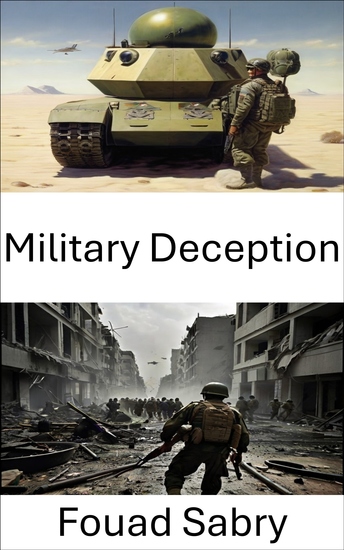
Military Deception - Strategic Illusions The Art and Science of Warfare Deceit - cover

Military Deception - Strategic Illusions The Art and Science of Warfare Deceit

Fouad Sabry

Publisher: One Billion Knowledgeable

  • 0
  • 0
  • 0

Summary

What is Military Deception
 
Military deception (MILDEC) is an attempt by a military unit to gain an advantage during warfare by misleading adversary decision makers into taking action or inaction that creates favorable conditions for the deceiving force. This is usually achieved by creating or amplifying an artificial fog of war via psychological operations, information warfare, visual deception, or other methods. As a form of disinformation, it overlaps with psychological warfare. Military deception is also closely connected to operations security (OPSEC) in that OPSEC attempts to conceal from the adversary critical information about an organization's capabilities, activities, limitations, and intentions, or provide a plausible alternate explanation for the details the adversary can observe, while deception reveals false information in an effort to mislead the adversary.
 
How you will benefit
 
(I) Insights, and validations about the following topics:
 
Chapter 1: Military Deception
 
Chapter 2: Operation Fortitude
 
Chapter 3: Operation Bodyguard
 
Chapter 4: Ruse de guerre
 
Chapter 5: Operation Bertram
 
Chapter 6: Counterattack
 
Chapter 7: Quaker gun
 
Chapter 8: List of military strategies and concepts
 
Chapter 9: Operation Zeppelin (deception plan)
 
Chapter 10: Military dummy
 
(II) Answering the public top questions about military deception.
 
Who this book is for
 
Professionals, undergraduate and graduate students, enthusiasts, hobbyists, and those who want to go beyond basic knowledge or information for any kind of Military Deception.
Available since: 06/03/2024.
Print length: 80 pages.
Other books that might interest you

  • Georgy Zhukov: The Life and Legacy of the Soviet Union’s Greatest General during World War II - cover

    Georgy Zhukov: The Life and...

    Editors Charles River

    • 0
    • 0
    • 0
    In the warm predawn darkness of June 22, 1941, 3 million men waited along a front hundreds of miles long, stretching from the Baltic coast of Poland to the Balkans. Ahead of them in the darkness lay the Soviet Union, its border guarded by millions of Red Army troops echeloned deep throughout the huge spaces of Russia. This massive gathering of Wehrmacht soldiers from Adolf Hitler's Third Reich and his allied states – notably Hungary and Romania – stood poised to carry out Operation Barbarossa, Hitler's surprise attack against the country of his putative ally, Soviet dictator Joseph Stalin.  
    Of the Soviet generals, none played as crucial a role in the war as Georgy Konstantinovich Zhukov, one of the most highly decorated army officers in Russian military history. At critical stages during the Second World War, it seemed as if it was Zhukov alone who stood between Russian defeat and German victory. Zhukov was ultimately involved in all the major battles on the Eastern Front, including Moscow, Leningrad, Stalingrad, Kursk, Bagration, and the final assaults into Poland and Germany to capture Berlin.  
    Stalin came to depend on Zhukov’s ruthless military skills for victory, but in the cut-throat Soviet Union, that was always a double-edged sword, because it seemed that Stalin envied Zhukov and feared him as well. Zhukov, who could be as aggressive and blunt as Stalin, was one of the few people prepared to stand up to the Soviet dictator and argue with him, and as many Soviet politicians and generals learned to their detriment, going toe to toe with one of the most brutal leaders of the 20th century was a highly risky venture. However, the mutual understanding they forged as they confronted the Germans may have played the biggest role in Hitler’s demise. 
    Show book
  • In the Footsteps of Fear - The Unabomber's Manifesto Ideology Anarchy And The Pursuit of Revolution - cover

    In the Footsteps of Fear - The...

    Davis Truman

    • 0
    • 0
    • 0
    The Footsteps of Fear: The Unabomber's Manifesto, Ideology, Anarchy, and the Pursuit of Revolution takes readers on a gripping and thought-provoking journey into the life and mind of Theodore Kaczynski, the notorious figure known as the Unabomber. Delving deep into his motives, beliefs, and actions, this captivating book unravels the complex tapestry of his radical ideology and its lasting impact on society. 
    This book explores the early life and formative years of Theodore Kaczynski, shedding light on the experiences and events that shaped his worldview. From his academic brilliance to his disillusionment with modern society, we uncover the intriguing factors that propelled him toward a path of extremism. 
    Examining Kaczynski's infamous manifesto, "Industrial Society and Its Future," reveals the core ideologies and philosophical arguments underpinning his controversial worldview. Engaging in thoughtful analysis, the book explores the reception and impact of his manifesto, probing its influence on public discourse and its relevance in today's ever-changing world. 
    The book goes beyond mere examination, delving into the ethical implications of Kaczynski's actions and the wider debate surrounding them. It invites readers to reflect on the consequences of extremist violence and the boundaries of activism, challenging us to navigate the complexities of political and social discourse responsibly and compassionately. 
    It challenges readers to grapple with complex questions surrounding extremism, ideology, societal change, and the ethics of activism. The Footsteps of Fear is essential for anyone seeking a deeper understanding of one of modern history's most intriguing and impactful cases.
    Show book
  • The Way to Wealth - cover

    The Way to Wealth

    Benjamin Franklin

    • 0
    • 0
    • 0
    The Way to Wealth is a treasury of the wisdom and values that can lead you to financial security. Franklin refines his maxims and homilies in order to make them more subtle and sophisticated. As a successful author, inventor, scientist, statesman and one of the Founding Fathers of America, he exemplifies the emerging American nation. This book will teach you how to start a business, make money and save for the future. 
    Some phrases quoted in The Way to Wealth include: "There are no gains, without pains”, "One today is worth two tomorrows”, "A life of leisure and a life of laziness are two things”, "Get what you can and what you get hold”, "Sloth, like rust, consumes faster than labor wears, while the used key is always bright”, "Have you somewhat to do tomorrow, do it today”, "The eye of a master will do more work than both his hands”, "Early to bed, and early to rise, makes a man healthy, wealthy and wise"
    Show book
  • Devil in the Belfry - Another classic from the master of the genre - cover

    Devil in the Belfry - Another...

    Edgar Allan Poe

    • 0
    • 0
    • 0
    Edgar Poe was born in Boston Massachusetts on 19th January 1809. His father abandoned his family the following year and within a year his mother had died leaving him an orphan.   
    He was taken in by the Allan family but never formally adopted although he now referred to himself as Edgar Allan Poe.  His father alternatively spoiled or chastised him and tension was frequent over gambling debts and monies for his education.  His university years to study ancient and modern languages was cut short by lack of money and he enlisted as a private in the army claiming he was 22, it is more probable he was 18. After 2 years he obtained a discharge in order to take up an appointment at the military academy, West Point, where he failed to become an officer. 
    Poe had released his 1st poetry volume in 1827 and after his 3rd turned to prose and placing short stories in several magazines and journals.  At age 26 he obtained a licence to marry his cousin.  She was a mere 13 but they stayed together until her death from tuberculosis 11 years after. 
    In January 1845 ‘The Raven’ was published and became an instant classic.  Thereafter followed the prose works for which he is now so rightly famed as a master of the mysterious and the macabre. 
    Edgar Allan Poe died at the tragically early age of 40 on 7th October 1849 in Baltimore, Maryland. Newspapers at the time reported Poe's death as ‘congestion of the brain’ or ‘cerebral inflammation’, common euphemisms for death from disreputable causes such as alcoholism but the actual cause of death remains a mystery.
    Show book
  • Edited Story An - From their pens to your ears genius in every story - cover

    Edited Story An - From their...

    Morley Roberts

    • 0
    • 0
    • 0
    The bookshelves of British literature are incredible collections that have gathered together centuries of very talented authors.  From these Isles their fame spread and whilst among their number many are now forgotten or neglected their talents endure.  Among them is Morley Roberts.
    Show book
  • Diary of a Lunatic - From their pens to your ears genius in every story - cover

    Diary of a Lunatic - From their...

    Leo Tolstoy

    • 0
    • 0
    • 0
    Leo Tolstoy was born in 1828 in the Russian province of Tula to a wealthy noble family. As a child, he had private tutors but he showed little interest in any formal education. When he went to the University of Kazan in 1843 to study oriental languages and law, he left without completing his courses.  Life now was relaxed and idle but with some writing also taking place.  Gambling debts forced an abrupt change of path and he joined the army to fight in the Crimean War.  He was commended for his bravery and promoted but was appalled at the brutality and loss of life.  He recorded these and other earlier experiences in his diaries which formed the basis of several of his works. 
    In 1852 ‘Childhood’ was published to immediate success and was followed by ‘Boyhood’ and ‘Youth’. 
    His experience in the army and the horrors he witnessed resulted in ‘The Cossacks’ in 1862 and the trilogy ‘Sevastopol Tales’. After the war he travelled around Europe, visiting London and Paris and meeting such luminaries as Victor Hugo and Charles Darwin.  
    It was now that Tolstoy began his masterpiece, ‘War and Peace’. Published in 1869 it was an epic work that changed literature. He quickly followed this with ‘Anna Karenina’.  
    These successes made Tolstoy rich and helped him accomplish many of his dreams but also brought problems as he grappled with his faith and the lot of the oppressed poor. These revolutionary views became so popular that the authorities now kept him under surveillance.  
    He led a life of asceticism and vegetarianism and put his socialist ideals into practice by establishing numerous schools for the poor and food programmes. He also believed in giving away his wealth, which caused much discord with his wife.  
    His writing continued to bring forth classics such as ‘The Death of Ivan Ilyich’ and many brilliant and incisive short stories such as ‘How Much Land Does A Man Need’.  
    In 1901 Tolstoy was excommunicated from the Church and controversially deselected for the Nobel Prize for Literature. 
    Whilst undertaking a pilgrimage by train in October 1910 with his daughter Aleksandra he caught pneumonia in the nearby town of Astapovo.  Leo Tolstoy died on November 9th, 1910, he was 82.
    Show book
