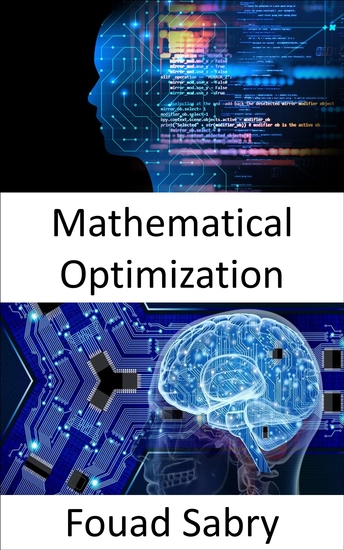
Mathematical Optimization - Fundamentals and Applications
Fouad Sabry
Publisher: One Billion Knowledgeable
Summary
What Is Mathematical Optimization

Mathematical optimization, often known as mathematical programming, is the process of choosing, from among a group of potential solutions, one that is optimal with relation to a set of predetermined criteria. Discrete optimization and continuous optimization are the two subfields that make up the majority of this field. Problems related to optimization appear in each and every one of the quantitative subfields, from computer science and engineering to operations research and economics. For millennia, the field of mathematics has been interested in the creation of methods that may solve these problems.

How You Will Benefit

(I) Insights, and validations about the following topics:

Chapter 1: Mathematical optimization

Chapter 2: Brachistochrone curve

Chapter 3: Curve fitting

Chapter 4: Deterministic global optimization

Chapter 5: Goal programming

Chapter 6: Least squares

Chapter 7: Process optimization

Chapter 8: Simulation-based optimization

Chapter 9: Calculus of variations

Chapter 10: Vehicle routing problem

(II) Answering the public top questions about mathematical optimization.

(III) Real world examples for the usage of mathematical optimization in many fields.

(IV) 17 appendices to explain, briefly, 266 emerging technologies in each industry to have 360-degree full understanding of mathematical optimization' technologies.

Who This Book Is For

Professionals, undergraduate and graduate students, enthusiasts, hobbyists, and those who want to go beyond basic knowledge or information for any kind of mathematical optimization.
Available since: 06/30/2023.
Print length: 140 pages.