Join us on a literary world trip!
Add this book to bookshelf
Grey
Write a new comment Default profile 50px
Grey
Subscribe to read the full book or read the first pages for free!
All characters reduced
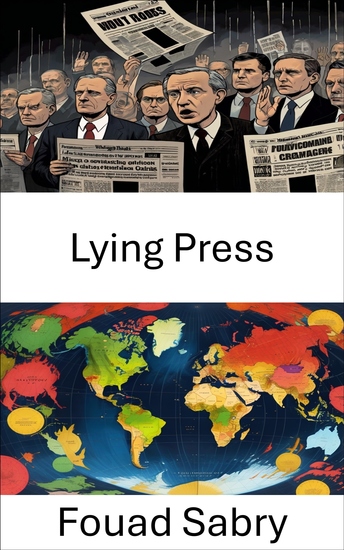
Lying Press - Manipulation and Deception in Modern Media - cover

Lying Press - Manipulation and Deception in Modern Media

Fouad Sabry

Publisher: One Billion Knowledgeable

  • 0
  • 0
  • 0

Summary

In an era where media shapes public opinion, understanding the concept of "Lying Press" is vital. This book, part of the Political Science series, delves into media manipulation and misinformation, revealing how it shapes public perception and undermines democratic integrity. A must-read for those interested in press integrity and its political impact.
 
1: Lying Press: Defines "lying press" and explores media deception’s influence.
 
2: Der Stürmer: Examines the Nazi propaganda paper and its societal impact.
 
3: Propaganda in Nazi Germany: Discusses how the Nazi regime used media to manipulate and gain power.
 
4: Gottfried Feder: Details Feder’s economic theories and media’s role in spreading Nazi ideology.
 
5: Aryanization: Explores media’s role in promoting the exclusion of Jews.
 
6: Nazi Party: Analyzes Nazi media strategies to advance political aims.
 
7: Nazism and Cinema: Examines Nazi use of cinema for propaganda.
 
8: Untermensch: Investigates the "Untermensch" concept in Nazi media and its dehumanizing effects.
 
9: Franz Eher Nachfolger: Describes this key publisher’s role in Nazi propaganda dissemination.
 
10: Glossary of Nazi Germany: A comprehensive guide to essential Nazi media terms.
 
11: Julius Streicher: Focuses on Streicher’s anti-Semitic propaganda in Der Stürmer.
 
12: Nazi Songs: Analyzes Nazi use of music to reinforce their message.
 
13: Ulrich Fleischhauer: Looks at Fleischhauer’s influence in spreading Nazi narratives.
 
14: Amt Rosenberg: Explores this agency’s control over Nazi cultural propaganda.
 
15: Pegida: Draws parallels between Nazi and modern far-right propaganda.
 
16: Jewish Parasite: Investigates the media’s role in spreading anti-Semitic stereotypes.
 
17: Giselher Wirsing: Examines Wirsing’s impact on Nazi public opinion through media.
 
18: Wolfgang Diewerge: Highlights Diewerge’s role in shaping Nazi propaganda.
 
19: Parole der Woche: Analyzes weekly Nazi slogans to manipulate public sentiment.
 
20: Hamburger Anzeiger: Reviews the newspaper’s influence on Nazi propaganda efforts.
 
21: Wirmer Flag: Examines the flag's significance in Nazi media strategies.
 
With its historical insights and thorough analysis, Lying Press is an essential resource for students, professionals, and enthusiasts who want to understand the profound impact of media on public opinion and democracy. It offers critical knowledge about the power dynamics of media influence, both historically and in contemporary contexts.
Available since: 10/05/2024.
Print length: 366 pages.

Other books that might interest you

  • Wake up life is brief death is forever - cover

    Wake up life is brief death is...

    George Rex Omegan

    • 0
    • 0
    • 0
    The message of the book is plain. You have only one chance to experience life, so don’t waste it. Stop dreaming, wishing, hoping, praying, and start living. Make this life about YOU. Be Yourself, Love Yourself, Live for Yourself, and Live Fully. Embrace each aspect of life with unbridled passion and energy. To do anything else is the height of stupidity. 
    In You Only Have One Life and This Is It, the author reveals that by understanding the true nature of reality, the process of becoming aware of it, and how to engage with it, one can live a life of joy and bliss regardless of circumstances. In this companion book, you will learn the essence of the principles covered and how to apply them to free yourself from the enslavement of your genetic, religious, and social conditioning. In doing so, you will miraculously transform every aspect of your life and propel it to heights beyond your imagination.
    Show book
  • Henry Kissinger: A short biography - 5 Minutes: Short on time – long on info! - cover

    Henry Kissinger: A short...

    5 Minutes, 5 Minute Biographies,...

    • 0
    • 0
    • 0
    Henry Kissinger, American statesman with German roots: Life and work in a short biography! Everything you need to know, brief and concise. Infotainment, education and entertainment at its best!
    Show book
  • 100 Quotes about Reason - cover

    100 Quotes about Reason

    Gil Carroll

    • 0
    • 0
    • 0
    Reason has done much of the heavy lifting throughout history. This book presents quotations from many of history's key figures who both recognize the importance of – and also the limitations of – reason.
    Show book
  • Mastering Motivation in the Age of Instant Reward - cover

    Mastering Motivation in the Age...

    Marcus Reed

    • 0
    • 0
    • 0
    Your brain was never built for infinite scroll. Mastering Motivation in the Age of Instant Reward explores the real neuroscience behind dopamine, habit formation, and the modern struggle to stay focused in a world of constant stimulation. Cutting through the myths of “detox culture,” this book explains how dopamine actually works — not as a pleasure chemical, but as the engine of curiosity, learning, and perseverance. It offers a clear, practical framework for rewiring reward systems through deliberate effort, anticipation, and balance, helping you regain control over attention, energy, and purpose. Grounded in modern psychology and motivation science, it’s a guide for anyone seeking meaning in an era of endless distraction — not by rejecting pleasure, but by redefining it.
    Show book
  • Learning Happiness - The Discipline of Transcendence Vol 3 - cover

    Learning Happiness - The...

    Osho

    • 0
    • 0
    • 0
    The Sutra of 42 Chapters is a scripture complied in the first century CE.  Each saying comes from Buddha, but the whole work was a new anthology created especially for introducing Buddhism in a new country. That's why it makes such a good, basic introduction to the world view of Gautam Buddha. It is very simple in its approach, very direct. It is, in essence the whole of Buddha's message, but very simple, not elaborate and very scholarly as other Buddhist scriptures are.
    Osho extracts the kernel of Buddha's profound insight and understanding and presents his everlasting message to the contemporary listener in a manner that is lucid, straightforward and humorous. Far from being just a statue, here Buddha is an amazing human being so far ahead of his time that even now he is only just beginning to be more widely understood.
    In these talks Osho discusses the need for doubt and argument in the spiritual search, the nature of desire and the discipline of non-attachment.
    The talks in this audiobook are a series of original OSHO Talks, titled "The Discipline of Transcendence, Vol.2".
    Vol.03 LEARNING HAPPINESS
    
    - Desire Cannot Be Fulfilled
    - Aloneness Is Your Reality
    - The Passion for Truth
    - A Rich Man Is Very Poor
    - Godhood Is Your Nature
    - I Am Not a Perfectionist
    - Sex Is the Basic Problem
    - The Forbidden Path
    - The World Has Never Lacked Buddhas
    - Religion Is the Ultimate LuxuryAn abridged edition of this series of talks was published as an audiobook under the title "The Buddha Said", which included only the chapters in which Osho comments on the original sutras by Buddha. This series is the full experience.
    ©1976 Osho International Foundation ℗ 2024 Osho International Foundation
    Show book
  • Kushan Empire The: The History and Legacy of the Powerful Ancient Dynasty in South Asia - cover

    Kushan Empire The: The History...

    Editors Charles River

    • 0
    • 0
    • 0
    Long before it was known as Afghanistan, and even longer before it acquired its current reputation, Afghanistan’s modern borders were fairly congruent with the ancient country known as Bactria. Bactria was the seat of several different kingdoms during the course of many centuries, but none were as successful as the Kushan Empire, the dominant political entity in Central Asia from the early 2nd century BCE until the early 3rd century CE, during which time the Kushan rulers played a major role in the first iteration of the trade networks known collectively as the Silk Road. The Kushans began as nomadic steppe warriors who eventually grew tired of constantly migrating and subsequently put their skills and experience to use by conquering Bactria and creating a kingdom that was stronger economically than it was militarily. Taking advantage of their location on the Silk Road trade routes, the Kushan kings charged fees and tolls for goods passing through their empire and developed over-land and sea routes that brought goods from China to Rome and vice versa. But silk, textiles, gold, silver, and other commodities were not the only things that entered the Kushan Empire from the East and West; the Kushan Empire was a focal point for the spread of ideas, diplomats, and diseases. Although the Romans and the Chinese never had direct contact, they both had diplomatic relations with the Kushan kings, who proved to be outstanding diplomats. The Kushan Empire eventually became a transit point of people and ideas, where enormous wealth was exchanged alongside early forms of monotheism, such as Zoroastrianism and Buddhism. The Kushan kings recognized these cultural benefits and so practiced a policy of patronizing different religious philosophies and maintaining peaceful relations with other powers along the Silk Roads to keep the flow of goods moving. 
    Show book