Join us on a literary world trip!
Add this book to bookshelf
Grey
Write a new comment Default profile 50px
Grey
Subscribe to read the full book or read the first pages for free!
All characters reduced
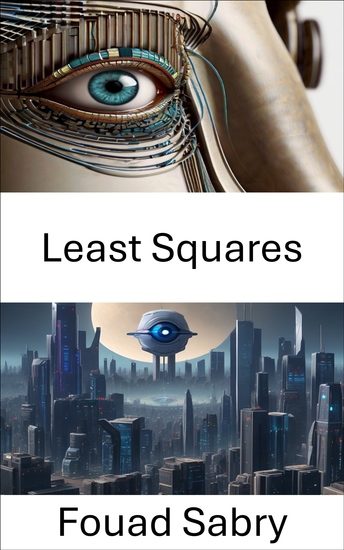
Least Squares - Optimization Techniques for Computer Vision: Least Squares Methods - cover

Least Squares - Optimization Techniques for Computer Vision: Least Squares Methods

Fouad Sabry

Publisher: One Billion Knowledgeable

  • 0
  • 0
  • 0

Summary

What is Least Squares
 
The method of least squares is a parameter estimation method in regression analysis based on minimizing the sum of the squares of the residuals made in the results of each individual equation.
 
How you will benefit
 
(I) Insights, and validations about the following topics:
 
Chapter 1: Least squares
 
Chapter 2: Gauss-Markov theorem
 
Chapter 3: Regression analysis
 
Chapter 4: Ridge regression
 
Chapter 5: Total least squares
 
Chapter 6: Ordinary least squares
 
Chapter 7: Weighted least squares
 
Chapter 8: Simple linear regression
 
Chapter 9: Generalized least squares
 
Chapter 10: Linear least squares
 
(II) Answering the public top questions about least squares.
 
(III) Real world examples for the usage of least squares in many fields.
 
Who this book is for
 
Professionals, undergraduate and graduate students, enthusiasts, hobbyists, and those who want to go beyond basic knowledge or information for any kind of Least Squares.
Available since: 05/11/2024.
Print length: 156 pages.

Other books that might interest you

  • Treatise on Light - cover

    Treatise on Light

    Christiaan Huygens

    • 0
    • 0
    • 0
    Treatise on Light was published in 1690 and is probably the largest scientific volume on light published before Newton's Opticks. The book explains how light travels (i.e., that it has a certain velocity), and what happens when it hits a surface (refraction and reflection). A large portion of the book is devoted to the double refraction occurring in Iceland chrystal, and all drawn conclusions are proved geometrically. Christiaan Huygens (1629 - 1695) was a prominent physicist and astronomer. His main discoveries are the centrifugal force, collision laws for bodies and the argument that light consists of waves. He was a contemporary of Galilei and Descartes, and a member of the French Royal Society since 1663. (Summary by Availle)
    Show book
  • Carbon Paradox The: Why We Know the Truth But Still Can’t Change - cover

    Carbon Paradox The: Why We Know...

    Alex Southwick

    • 0
    • 0
    • 0
    We know the science. We know the stakes. And yet — the emissions keep rising. Why, in the face of overwhelming evidence, does humanity remain frozen between knowledge and action? 
    In The Carbon Paradox, Alex Southwick delves into one of the most unsettling questions of our age: the psychological, cultural, and political forces that make climate change both undeniable and unchangeable. Through interviews with behavioral scientists, activists, economists, and ordinary citizens, Southwick explores the hidden mechanisms of denial, distraction, and disconnection that shape our collective inaction. 
    But this is not a book of blame — it’s a mirror. By tracing the gap between what we know and what we do, The Carbon Paradox reveals the deeper truth: that change depends not on more information, but on reimagining who we are and what we value. 
    Rigorously researched and profoundly human, The Carbon Paradox is both diagnosis and invitation — a call to break through paralysis and rediscover the will to act in a warming world.
    Show book
  • Target Earth - Meteorites Asteroids Comets and Other Cosmic Intruders That Threaten Our Planet - cover

    Target Earth - Meteorites...

    Govert Schilling

    • 0
    • 0
    • 0
    An acclaimed science writer tells the story of cosmic projectiles that may be on a collision course with our Earth. 


    The impact of an asteroid led to the extinction of the dinosaurs. Could another giant cosmic missile soon be heading our way? In Target Earth, acclaimed Dutch astronomy writer Govert Schilling provides a full account of what we know, and need to know, about all the extraterrestrial matter constantly bombarding our planet—from microscopic dust particles and space debris to massive meteorites, comets, and asteroids. 


    Drawing upon the latest scientific discoveries, Schilling explores virtually every aspect of cosmic impacts—from small meteorites to devastating collisions, from the craters that marked our planet's surface to the impacts that left their mark on other celestial bodies, and from searches for near-miss lumps of rock to ways of protecting humanity from an assault from the cosmos. Along the way, he considers near misses in the past and the possibility of others in the future and ponders the positive side of these visitations from space: If our planet had not been the target of cosmic rubble from its very formation, life on Earth would likely never have gotten started.
    Show book
  • The Primacy of Doubt - From Quantum Physics to Climate Change How the Science of Uncertainty Can Help Us Understand Our Chaotic World - cover

    The Primacy of Doubt - From...

    Tim Palmer

    • 0
    • 0
    • 0
    Why does your weather app say “there’s a 10 percent chance of rain” instead of “it will be sunny”? In large part, this is due to the insight of award-winning physicist Tim Palmer, who pioneered the introduction of uncertainty into weather and climate prediction.  
    Now, he wants to apply it to how we study everything else. 
     
    In The Primacy of Doubt, Palmer gives us a revolutionary vision of mathematical uncertainty that provides new insights into a range of practical problems and some of the deepest questions in science and philosophy. He draws connections that are in equal parts unexpected  
    and fascinating: how ensemble forecasts can predict unpredictability, how the brain uses noise for creative thinking, how the geometry of chaos forces us to rewrite the laws of quantum mechanics, and in so doing reconciles determinism, free will, and moral responsibility.  
     
    A tour de force from a brilliant mind, The Primacy of Doubt shows that the fundamental law of the universe might just be to expect the unexpected.
    Show book
  • Stock Market Investing And Trading For Beginners 2 Books In 1 - How To Use Technical Indicators Moving Averages Support & Resistance And Signals & Volumes - cover

    Stock Market Investing And...

    Will Weiser

    • 0
    • 0
    • 0
    2 AUDIOBOOKS IN 1 DEAL! 
    BOOK 1: 
    STOCK MARKET INVESTING FOR BEGINNERS: INDEX FUNDS & DIVIDEND STOCKS: HOW TO INVEST USING TECHNICAL INDICATORS, MOVING AVERAGES, SUPPORT & RESISTANCE AND SIGNALS & VOLUMES 
    BOOK 2: 
    STOCK MARKET INVESTING: FUNDAMENTAL ANALYSIS & TRADING PSYCHOLOGY 
    BEGINNERS GUIDE TO VALUE STOCKS & BECOME A DISCIPLINED TRADER 
    In book 1 you will discover:How To Invest In Index Funds Step By StepBest Highest-Yield Dividend Stocks To BuyThe Stages Of A StockSupport & ResistanceSignals & VolumesTechnical Indicators: Moving AveragesHow To Choose An Investment Account TypeConservative Vs Moderate Vs Aggressive Portfolio BasketHow To Choose An InvestmentDollar Cost Averaging & Rebalancing 
    In book 2 you will discover:Company Management & HierarchyInvestor RelationsValue of a Company & Wall Street AnalystsPrice to Book Ratio, Intrinsic Value & Earnings ValuePEG & PSR Ratio CalculationIncome StatementsCash Flow StatementSupply & DemandPrice to Earnings RatioDividends Coverage RatioKey Financial DocumentsKey Financial Ratios 
    BUY THIS AUDIOBOOK NOW AND GET STARTED TODAY!
    Show book
  • Ultimate Robotics Programming with ROS 2 and Python - Design Develop and Implement Intelligent Robotics Applications with Advanced Navigation Simulation and Computer Vision for Mobile and Industrial Robots - cover

    Ultimate Robotics Programming...

    Jonathan Cacace

    • 0
    • 0
    • 0
    Learn Robotics and ROS 2 with Practical Examples
    Book Description
    Robot Operating System (ROS) and Python are essential tools for developing advanced robotics applications, offering reliability and scalability for both research and industrial solutions. Ultimate Robotics Programming with ROS 2 and Python introduces readers to ROS 2 without requiring prior experience in robotics. It blends theoretical explanations with practical exercises, empowering readers to solve specific robotics problems while understanding the reasoning behind various approaches.
    The book covers a broad spectrum of robotics topics, including mobile robots, industrial manipulators, and aerial robots. These systems are simulated using the modern Gazebo simulator and programmed with ROS 2’s out-of-the-box tools and custom solutions using the ROS 2 API. The book also delves into computer vision, generative AI, and machine learning, providing hands-on examples of real-world applications.
    Table of Contents
    1. Introduction to Robot Operating System
    2. Hands-on ROS 2 Programming Using Python
    3. Supplementary Tools for ROS
    4. Robot Visualization and Simulation
    5. Writing Tests Using Pytest for ROS 2 Nodes
    6. Controlling an Inverted Pendulum with a PID Controller
    7. Laser-based Obstacle Avoidance with a Wheeled Mobile Robot
    8. ROS 2 Behaviour Trees Using Python
    9. Surveillance System Using Behaviour Trees
    10. Robot Navigation Using ROS 2 Navigation Stack (Nav2)
    11. Robot Arm Control Using MoveIt
    12. Programming Aerial Robots Using ROS
    13. Computer Vision Using ROS
    14. Object Detection Using ROS
    15. Using Large Language Models with ROS
    16. Deep Reinforcement Learning Using ROS 2       
    
    Index
    Show book