Join us on a literary world trip!
Add this book to bookshelf
Grey
Write a new comment Default profile 50px
Grey
Subscribe to read the full book or read the first pages for free!
All characters reduced
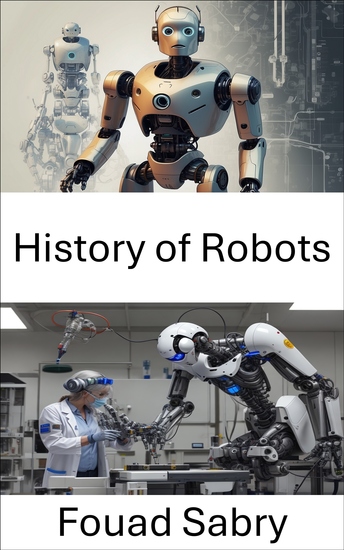
History of Robots - From Ancient Concepts to Modern Innovation - cover

History of Robots - From Ancient Concepts to Modern Innovation

Fouad Sabry

Publisher: One Billion Knowledgeable

  • 0
  • 0
  • 0

Summary

"History of Robots" takes readers on an engaging journey through the evolution of robotics, from early mechanical wonders to modern intelligent machines. Authored by Fouad Sabry, this book is a mustread for professionals, students, and enthusiasts alike who are passionate about robotics and its impact on society. Whether you're an undergraduate or graduate student, a hobbyist, or a researcher, this book provides valuable insights into the historical milestones that have shaped the field of robotics. The combination of rich historical context and cuttingedge technological developments makes this book an indispensable resource for anyone interested in the future of robotics
 
History of robots-This chapter introduces the origins of robots, exploring ancient automata and the early concepts of artificial beings
 
Android (robot)-Delving into humanoid robots designed to resemble humans, this chapter explores the history and development of androids
 
Robot-A deep dive into the term "robot," its origins, and its evolution in science fiction and reality
 
Humanoid robot-Focusing on robots designed to mimic human form and behavior, this chapter highlights breakthroughs in humanoid robotics
 
Machine-This chapter discusses the role of machines in robotics, tracing their development from simple tools to complex automated systems
 
Automaton-Exploring early mechanical devices, this chapter examines the origins of automatons and their influence on modern robotics
 
Ismail alJazari-A look at the work of this pioneering Islamic scholar, who developed complex mechanical devices and early robots
 
Domo (robot)-This chapter presents Domo, a key development in modern robotics, showcasing its role in the evolution of interactive robots
 
Mobile robot-Focuses on mobile robots, exploring their design, capabilities, and applications in various industries and environments
 
Japanese robotics-Examining Japan’s significant contributions to robotics, this chapter highlights its advancements in humanoid robots and robotic systems
 
Robotic art-This chapter connects the fields of robotics and art, discussing the intersection of technology and creativity in robotic design
 
ICub-Introducing the ICub, a humanoid robot designed for research in neuroscience and artificial intelligence, this chapter covers its development
 
History of artificial life-Explores the relationship between artificial life and robotics, emphasizing the creation of lifelike systems
 
Neurorobotics-Focusing on the intersection of neuroscience and robotics, this chapter explores how the human brain inspires robotic systems
 
Robotics-A comprehensive look at the science of robotics, this chapter covers core concepts, technologies, and future developments in the field
 
Domestic robot-This chapter explores robots designed for home use, including domestic helpers and their growing role in society
 
Juggling robot-Discusses the creation of robots capable of complex physical tasks, such as juggling, and the challenges they pose to engineers
 
Cloud robotics-Examines the impact of cloud computing on robotics, discussing how cloudbased systems enable smarter, more adaptable robots
 
Gynoid-Focusing on robots designed to resemble women, this chapter explores their development, uses, and societal implications
 
David Hanson (robotics designer)-An indepth look at the contributions of David Hanson, a key figure in the development of lifelike robots
 
Actroid-This chapter discusses the Actroid, a robot renowned for its realistic appearance and its role in the development of humanoid robotics
Available since: 01/02/2025.
Print length: 258 pages.


Other books that might interest you

  • Younger Dryas Period The: The History of the Earth’s Drastic Climate Change at the End of the Pleistocene Era - cover

    Younger Dryas Period The: The...

    Editors Charles River

    • 0
    • 0
    • 0
    From about 12,900 to 11,700 before present (BP), near Ice Age conditions returned to the Northern Hemisphere of the planet. It was a sudden shift from the warm temperatures that had prevailed for nearly 2,000 years. This period is referred to by archaeologists, geologists, and earth scientists as the Greenland Stadial, but it is more commonly known as the Younger Dryas. The Younger Dryas marked the end of the last glacial period, the end of the Pleistocene Era, and the beginning of the Holocene Era, which is the current era. It was a period of great change, when climate change happened quite quickly, directly affecting the flora, fauna, and humans of the Northern Hemisphere in the process. The impact on the human populations was perhaps most important because, in some places, it virtually destroyed emerging cultures, while in other places, it might have propelled humans to develop new survival traits and technologies later used to move humanity into the Neolithic era. Although scholars now know quite a bit about the Younger Dryas, many elements of it are still debated. Other aspects serve as a predictor of what humans can expect in the future. 
    	There is, however, still plenty of information about the Younger Dryas that remains unknown or open to debate. Not all scholars agree on the dates of the Younger Dryas or how long it lasted. Even more controversial are the alternate theories about what caused the Younger Dryas and the effect it had on the Northern Hemisphere’s bio-populations. This book examines the background of the Younger Dryas, its effects on bio-populations, and how it contributed to the emergence of the Neolithic Era. Alternative theories will be examined and compared to more standard ideas currently prevailing in academia.
    Show book
  • Physics - A Very Short Introduction - cover

    Physics - A Very Short Introduction

    Sidney Perkowitz

    • 0
    • 0
    • 0
    Physics, the fundamental science of matter and energy, encompasses all levels of nature from the subatomic to the cosmic, and underlies much of the technology around us. Understanding the physics of our universe is an essential aspect of humanity's quest to understand our environment and our place within it. Doing physics enables us to explore the interaction between environment and human society, and can help us to work towards the future sustainability of the planet. 


    This Very Short Introduction provides an overview of how this pervasive science came to be and how it works: who funds it, how physicists are trained and how they think, and how physics supports the technology we all use. Sidney Perkowitz presents the theories and outcomes of pure and applied physics from ideas of the Greek natural philosophers to modern quantum mechanics, cosmology, digital electronics, and energy production. Considering its most consequential experiments, including recent results in elementary particles, gravitational waves and materials science, he also discusses outside the lab, the effects of physics on society, culture, and humanity's vision of its place in the universe.
    Show book
  • A Brief History of Timekeeping - The Science of Marking Time from Stonehenge to Atomic Clocks - cover

    A Brief History of Timekeeping -...

    Chad Orzel

    • 0
    • 0
    • 0
    Predating written language and marching on through human history, the desire for ever-better timekeeping has spurred technological innovation and sparked theories that radically reshaped our understanding of the universe and our place in it. 


    Chad Orzel, a physicist and bestselling author, continues his tradition of demystifying thorny scientific concepts by using the clocks and calendars central to our everyday activities as a jumping-off point to explore the science underlying the ways we keep track of our time. Ancient solstice markers depend on the basic astrophysics of our solar system; mechanical clocks owe their development to Newtonian physics; and the ultra-precise atomic timekeeping that enables GPS hinges on the predictable oddities of quantum mechanics. 


    Along the way, Orzel visits the delicate negotiations involved in Gregorian calendar reform, the intricate and entirely unique system employed by the Maya, and how the problem of synchronizing clocks at different locations ultimately required us to abandon the idea of time as an absolute and universal quantity. Sharp and engaging, A Brief History of Timekeeping is a story not just about the science of sundials, sandglasses, and mechanical clocks, but also the politics of calendars and time zones, the philosophy of measurement, and the nature of space and time itself.
    Show book
  • Theoretical Physics - Exploring Advanced Concepts in Physics - cover

    Theoretical Physics - Exploring...

    Mark Hedges

    • 0
    • 0
    • 0
    Theoretical physics is the foundation of our understanding of the universe, providing the mathematical framework that describes physical laws and fundamental interactions. Unlike experimental physics, which relies on observation and experimentation, theoretical physics develops models and equations that predict and explain phenomena, often extending beyond what can currently be tested. From Newton’s laws to Einstein’s theories and quantum mechanics, the field has evolved to encompass a vast range of concepts that shape modern science. 
    Mathematics plays a crucial role in theoretical physics, serving as the language through which physical principles are expressed. Equations such as Newton’s second law, Maxwell’s equations, and Schrödinger’s equation provide precise descriptions of motion, electromagnetism, and quantum mechanics, respectively. The ability to abstractly represent nature through mathematical formalisms allows physicists to derive new predictions and unify disparate concepts. For example, Einstein’s field equations of general relativity describe how mass and energy curve spacetime, leading to predictions of gravitational waves and black holes, both of which were later confirmed through experiments. 
    A key principle in theoretical physics is symmetry, which governs many of the fundamental laws of nature. Symmetries in physical systems often correspond to conservation laws, a relationship formalized by Noether’s theorem. For instance, the symmetry of time invariance leads to the conservation of energy, while spatial symmetry results in the conservation of momentum.
    Show book
  • Data Preprocessing - Optimizing Data Quality and Structure for Effective Analysis and Machine Learning - cover

    Data Preprocessing - Optimizing...

    Brian Murray

    • 0
    • 0
    • 0
    Data Preprocessing: Optimizing Data Quality and Structure for Effective Analysis and Machine Learning is a comprehensive guide to the process of preparing data for analysis and machine learning. With the exponential growth of data in today's world, effective data preprocessing has become a critical step in the success of any data analysis or machine learning project. This book provides a detailed overview of the fundamental concepts, techniques, and best practices involved in data preprocessing, along with practical examples and case studies. 
    The book covers a range of topics, including data cleaning, transformation, integration, reduction, and discretization, as well as specific applications of data preprocessing for image, audio, text, and time-series data. The author provides an overview of the different tools and techniques available for data preprocessing, along with real-world examples and case studies in different industries and domains. 
    Readers will learn how to handle missing values, outliers, and irrelevant data, as well as how to transform, scale, and select features. They will also gain an understanding of the challenges involved in data preprocessing, as well as emerging trends and technologies in the field. Whether you are a data scientist, machine learning engineer, or analyst, this book is an essential resource for optimizing the quality and structure of your data for effective analysis and machine learning. 
     
    Show book
  • Affirmations For Women - cover

    Affirmations For Women

    Affirmational Journey

    • 0
    • 0
    • 0
    Do you find yourself struggling with self-doubt and negative self-talk? Are you seeking a way to empower yourself and embrace your unique strengths and beauty? Imagine waking up every day feeling confident, valued, and unstoppable. 
    Introducing a powerful collection of affirmations designed specifically for women. This audio book provides a transformative experience, guiding you through positive affirmations that will uplift and inspire you. With soothing narration and empowering messages, you’ll embark on a journey of self-discovery and growth, learning to embrace your true potential and inner strength. 
    Whether you're dealing with challenges in your personal life, career, or relationships, these affirmations offer the perfect solution. By incorporating these affirmations into your daily routine, you'll build a strong foundation of self-confidence, resilience, and self-love. Each affirmation is carefully crafted to help you overcome obstacles, celebrate your achievements, and recognize your worth. 
    Don't let self-doubt and negativity hold you back any longer. Embrace this empowering journey and transform your life with the healing power of affirmations. Start today and experience the remarkable impact of affirmations for women, waking up each morning with a renewed sense of confidence, joy, and empowerment. Discover the strength within you and live your life to the fullest.
    Show book