Join us on a literary world trip!
Add this book to bookshelf
Grey
Write a new comment Default profile 50px
Grey
Subscribe to read the full book or read the first pages for free!
All characters reduced
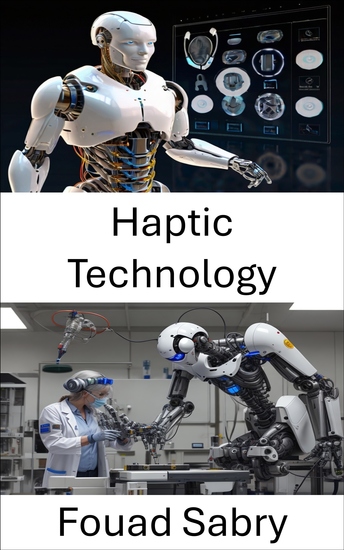
Haptic Technology - Enhancing Interaction through Sensory Feedback - cover

Haptic Technology - Enhancing Interaction through Sensory Feedback

Fouad Sabry

Publisher: One Billion Knowledgeable

  • 0
  • 0
  • 0

Summary

Explore the fascinating world of haptic technology, where touch meets innovation, and experience a groundbreaking shift in interaction within robotics. This book serves as an essential guide for professionals, undergraduate and graduate students, enthusiasts, and hobbyists alike. Delve into how haptic feedback is reshaping user experiences and advancing various applications, from gaming to rehabilitation. By understanding the intricacies of this technology, readers will gain insights that far exceed the investment of this book.
 
Chapters Brief Overview:
 
1: Haptic technology: Discover the foundations of haptic technology and its significance in robotics.
 
2: Keyboard technology: Explore the evolution of keyboard interfaces and their tactile feedback mechanisms.
 
3: Mechanoreceptor: Understand the role of mechanoreceptors in providing touch sensations in virtual environments.
 
4: Output device: Learn about various output devices that deliver haptic feedback to users.
 
5: Sensory substitution: Examine how haptic technology compensates for sensory deficits in innovative ways.
 
6: Tactile graphic: Discover the creation and importance of tactile graphics for visually impaired users.
 
7: Wired glove: Investigate the functionality and applications of wired gloves in virtual interactions.
 
8: Immersion Corporation: Delve into the contributions of Immersion Corporation in advancing haptic technology.
 
9: Sixaxis: Understand the role of Sixaxis technology in enhancing immersive gaming experiences.
 
10: Haptic perception: Explore the psychological aspects of how humans perceive haptic feedback.
 
11: 3D user interaction: Learn about 3D interfaces and their significance in creating interactive environments.
 
12: Somatosensory system: Discover the connection between haptic technology and the human somatosensory system.
 
13: Tactile sensor: Explore the advancements in tactile sensors and their impact on robotics.
 
14: Affective haptics: Understand how emotional responses can be enhanced through haptic feedback.
 
15: Electrovibration: Delve into the technology behind electrovibration and its applications.
 
16: Tixel: Learn about Tixel technology and its role in providing textured touch experiences.
 
17: Haptic suit: Discover the applications and innovations behind fullbody haptic suits.
 
18: Visuohaptic mixed reality: Examine how combining vision and haptics creates immersive experiences.
 
19: Force Touch: Explore the technology of Force Touch and its implications for user interfaces.
 
20: Vincent Hayward: Discover the influential contributions of Vincent Hayward to haptic science.
 
21: SenseGlove: Understand the capabilities and applications of SenseGlove in virtual reality settings.
 
With each chapter, this book provides invaluable knowledge that enhances understanding of haptic technology's pivotal role in the everevolving field of Robotics Science. Whether you're advancing your career or exploring a new interest, this book will equip you with essential insights that can transform your perspective and applications in the realm of touch technology.
Available since: 01/27/2025.
Print length: 192 pages.


Other books that might interest you

  • Internet Marketing - Affiliate Marketing and Digital Niches Explained (2 in 1) - cover

    Internet Marketing - Affiliate...

    David Finstein

    • 0
    • 0
    • 0
    This bundle has 2 titles, which will all help you become a better marketer. The titles are: 
    Affiliate Marketing - Affiliate marketing is a performance-based marketing strategy in which businesses reward individuals, known as affiliates, for driving traffic or sales to their products or services. This model benefits both the merchant and the affiliate: the merchant gains exposure and potential sales, while the affiliate earns commissions based on their promotional efforts. Unlike traditional advertising, affiliate marketing offers affiliates the opportunity to earn income without creating their own products or services, making it an attractive and accessible business model. 
    Digital Niche Marketing - By tailoring campaigns to resonate with these unique groups, brands can foster stronger connections, drive higher engagement, and establish themselves as trusted experts within a particular domain. This approach helps brands stand out in an oversaturated digital environment, where audiences are increasingly selective about what content they engage with and trust.
    Show book
  • Our Universe - But An incoming outgoing wave - cover

    Our Universe - But An incoming...

    Mike Blake

    • 0
    • 0
    • 0
    Our Universe - But. An incoming/outgoing wave:Poem rediscovering the theories of the creation of the Universe.Some think of string theory, others, that waves are involved etc.My poem postulates a possible cosmic wave outward from the Big Bang, in the order of present Scientific theory.
    Show book
  • Agrostology - Grasses of the World: From Lawns to Prairie Ecosystems - cover

    Agrostology - Grasses of the...

    Mike Crawford

    • 0
    • 0
    • 0
    Agrostology, the scientific study of grasses, is a crucial field of botany that explores the diversity, structure, and ecological significance of grasses. Grasses belong to the Poaceae family, one of the largest and most economically important plant families in the world. These plants play a foundational role in ecosystems, agriculture, and human civilization. From the vast prairies and savannas to the rice and wheat fields that sustain billions of people, grasses shape the landscapes of both natural and human-altered environments. 
    The study of grasses has a long history, dating back to early agricultural societies that first domesticated cereal crops. The ancient civilizations of Mesopotamia, Egypt, and China relied on grasses such as wheat, barley, and rice to establish permanent settlements. Over time, the understanding of grass physiology, reproduction, and ecological functions deepened, leading to advancements in agronomy, ecology, and land management. By the 19th and 20th centuries, agrostology emerged as a specialized discipline within botany, focusing on grass classification, physiology, and ecosystem dynamics. 
    Grasses are uniquely adapted to a wide range of environmental conditions. They thrive in temperate, tropical, and even arid climates, displaying remarkable resilience through specialized growth mechanisms. Their ability to reproduce through both seeds and vegetative propagation allows them to colonize and dominate various habitats. Many grass species employ C4 photosynthesis, an efficient metabolic pathway that enables them to survive in hot, dry environments. This adaptability makes grasses a dominant plant group in many ecosystems, providing habitat and food for numerous animal species.
    Show book
  • Roman Medicine and Science - Advances of Ancient Civilization - cover

    Roman Medicine and Science -...

    Rogan Fish

    • 0
    • 0
    • 0
    Roman medicine was a blend of practical knowledge, religious beliefs, and influences from earlier civilizations, particularly the Greeks and Etruscans. While early Roman healing methods were deeply rooted in superstition, the expansion of the empire led to the adoption of more systematic medical practices. Over time, Roman medicine evolved into a structured system that combined natural remedies, surgical techniques, and public health initiatives. 
    Greek influence played a significant role in shaping Roman medical knowledge. Before Rome conquered Greece, healing in the Roman Republic was often associated with household remedies and religious rituals. However, as Greek physicians such as Archagathus and later Galen entered Rome, their advanced knowledge in anatomy, surgery, and pharmacology became widely accepted. Many Roman physicians were either trained by Greek mentors or studied Greek medical texts. Hippocratic principles, which emphasized observation and diagnosis, became foundational in Roman medical education. 
    Despite the growing reliance on scientific methods, religion and superstition remained integral to Roman healing practices. The Romans believed that diseases could be divine punishments or warnings from the gods. Temples dedicated to deities like Aesculapius, the god of medicine, served as healing centers where the sick sought divine intervention. Priests and healers performed rituals and sacrifices to appease the gods and cure ailments. Additionally, charms, amulets, and incantations were commonly used to ward off illness. Even as medical science progressed, many Romans continued to rely on religious customs for healing.
    Show book
  • Sparking Desire: Balancing Intimacy and Everyday Life - "Ignite Passion: Audio Lessons to Harmonize Love and Daily Life for Unmatched Balance!" - cover

    Sparking Desire: Balancing...

    Ethan Lawson

    • 0
    • 0
    • 0
    Sparking Desire: Balancing Intimacy and Everyday Life  
    ⭐⭐ Simplified Guide & Explanations Included⭐⭐   
    Are you looking to transform intimacy and life with balanced passion? 
    Seeking a comprehensive guide that provides all necessary elements to harmonize intimacy and everyday life? 
    Your search ends here! 
    This guide serves as your definitive companion for deepening your understanding, applying your skills, and engaging in hands-on exercises. With this, you're geared for success. 
    Updated for the latest insights and techniques. 
    Key features of this enriched guide: 
    - Profound insights about balancing intimacy and life 
    - Detailed explanation of fostering intimate connections 
    - Fruitful strategies for harmonizing relationships and daily responsibilities 
    Our guide distinguishes itself through comprehensive coverage, which is essential for your personal growth. Concepts aren't merely skimmed; they are delved into with precision. 
    Please note that this guide is not affiliated with any official entity and is purely an independent resource for your benefit. 
    Designed with a clear structure and easy-to-understand language, our guide ensures smooth transitions between topics. Say goodbye to dense jargon and welcome clear, precise, and technically accurate content. 
    So, why wait? Click the BUY NOW button, secure your guide, and begin your journey to balanced intimacy and everyday life transformation!
    Show book
  • Nuclear and Particle Physics - A Comprehensive Introduction to Subatomic Physics - cover

    Nuclear and Particle Physics - A...

    Mark Hedges

    • 0
    • 0
    • 0
    Subatomic physics is the branch of physics that studies the fundamental particles and forces that constitute the universe at the smallest scales. It explores the nature of matter and energy at the level of atomic nuclei and beyond, delving into the complex interactions that govern the behavior of elementary particles. The study of subatomic physics emerged from the broader field of nuclear physics, which initially focused on the structure and properties of atomic nuclei. Over time, discoveries of new particles and interactions led to the expansion of the field into what is now known as particle physics. 
    The foundation of subatomic physics was laid with the discovery of the electron by J.J. Thomson in 1897, which provided the first evidence that atoms were composed of smaller constituent particles. This was followed by the discovery of the proton by Ernest Rutherford in 1917 and the neutron by James Chadwick in 1932, establishing the basic structure of the atomic nucleus. The development of quantum mechanics in the early 20th century provided a theoretical framework for understanding the behavior of these particles, revealing that their properties could only be accurately described through probabilistic wave functions and discrete energy levels. 
    In the mid-20th century, the discovery of a wide variety of new particles, including mesons, baryons, and leptons, suggested that protons and neutrons themselves were composed of more fundamental constituents. This led to the development of the quark model by Murray Gell-Mann and George Zweig in 1964, which proposed that protons and neutrons are made up of combinations of quarks held together by the strong nuclear force, mediated by gluons. The quark model became a central component of the Standard Model of particle physics, which describes the known elementary particles and the fundamental forces—excluding gravity—that govern their interactions.
    Show book