Join us on a literary world trip!
Add this book to bookshelf
Grey
Write a new comment Default profile 50px
Grey
Subscribe to read the full book or read the first pages for free!
All characters reduced
Greed Versus Grievance - Understanding Conflict Drivers in Modern Politics - cover

Greed Versus Grievance - Understanding Conflict Drivers in Modern Politics

Fouad Sabry

Publisher: One Billion Knowledgeable

  • 0
  • 0
  • 0

Summary

Discover the core dynamics of conflict through "Greed Versus Grievance," a pivotal book in the "Political Science" series. This work delves into how material incentives and ideological motivations drive conflict. It is essential reading for those looking to understand political violence and insurgency, offering an analysis of competing theories on the root causes of conflict within political systems.
 
Chapter Overviews:
 
1. Greed vs. Grievance – Introduces economic and ideological conflict drivers.
 
2. Civil War – Examines how greed and grievance ignite civil wars.
 
3. Insurgency – Analyzes insurgent movements' material and ideological motives.
 
4. Insurgency in Balochistan – Case study of local grievances and economic conflict.
 
5. Opium in Afghanistan – Links the opium economy to ongoing conflict.
 
6. Sri Lankan Civil War Origins – Focuses on ethnic tensions and economic disparities.
 
7. Afghan Reconstruction – Highlights the influence of greed and grievance post-conflict.
 
8. History of the Taliban – Shows ideological zeal paired with economic interests.
 
9. Political Violence – Discusses forms of political violence tied to greed and grievance.
 
10. Afghan Peace Process – Studies peace efforts influenced by economic and ideological forces.
 
11. LTTE – Examines the rebellion's motivations and economic conditions.
 
12. Warlord – Explores personal greed and local grievances.
 
13. Taliban Regime (1996–2001) – Studies the blend of ideological goals and economic control.
 
14. Rebellion – Highlights ideological and economic drivers behind rebellions.
 
15. Afghanistan–Iran Relations – Analyzes their relationship through greed and grievance.
 
16. Paul Collier – Insight into Collier’s work on conflict economics.
 
17. Protracted Social Conflict – Explores long-lasting conflicts driven by grievances.
 
18. Sri Lanka’s History (1948–present) – Emphasizes greed and grievance in Sri Lankan conflict.
 
19. Afghanistan in 2011 – Reviews major events and conflict dynamics in 2011.
 
20. Anti-Pashtun Sentiment – Examines ethnic tensions and economic underpinnings.
 
21. Anke Hoeffler – Highlights her contributions to conflict economics.
 
This book offers valuable insights for professionals, students, and enthusiasts. It deepens your understanding of how economic and ideological causes interplay in conflicts, making it a must-read addition to your collection.
Available since: 09/30/2024.
Print length: 335 pages.
Other books that might interest you

  • Cancel Wars - How Universities Can Foster Free Speech Promote Inclusion and Renew Democracy - cover

    Cancel Wars - How Universities...

    Sigal R. Ben-Porath

    • 0
    • 0
    • 0
    An even-handed exploration of the polarized state of campus politics that suggests ways for schools and universities to encourage discourse across difference.  
     
    College campuses have become flashpoints of the current culture war and, consequently, much ink has been spilled over the relationship between universities and the cultivation or coddling of young American minds. Philosopher Sigal R. Ben-Porath takes head-on arguments that infantilize students who speak out against violent and racist discourse on campus or rehash interpretations of the First Amendment. Ben-Porath sets out to demonstrate the role of the university in American society and, specifically, how it can model free speech in ways that promote democratic ideals. 
     
    In Cancel Wars, she argues that the escalating struggles over “cancel culture,” “safe spaces,” and free speech on campus are a manifestation of broader democratic erosion in the United States. At the same time, she takes a nuanced approach to the legitimate claims of harm put forward by those who are targeted by hate speech. Ben-Porath’s focus on the boundaries of acceptable speech (and on the disproportional impact that hate speech has on marginalized groups) sheds light on the responsibility of institutions to respond to extreme speech in ways that proactively establish conversations across difference. Establishing these conversations has profound implications for political discourse beyond the boundaries of collegiate institutions. If we can draw on the truth, expertise, and reliable sources of information that are within the work of academic institutions, we might harness the shared construction of knowledge that takes place at schools, colleges, and universities against truth decay. Of interest to teachers and school leaders, this book shows that by expanding and disseminating knowledge, universities can help rekindle the civic trust that is necessary for revitalizing democracy.
    Show book
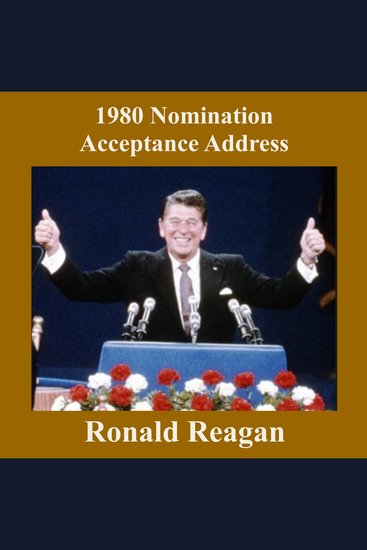
  • 1980 Nomination Acceptance Address - cover

    1980 Nomination Acceptance Address

    Ronald Reagan

    • 0
    • 0
    • 0
    Cover Art Photo: Ronald Reagan giving his acceptance speech at the Republican National Convention at Joe Louis Arena, Detroit, Michigan. July 17, 1980. 
    In his acceptance speech, Reagan envisioned “a new consensus with all those across the land who share a community of values embodied in these words: family, work, neighborhood, peace and freedom.” Reagan’s acceptance focuses on “three grave threats to our very existence, any one of which could destroy us. We face a disintegrating economy, a weakened defense and an energy policy based on the sharing of scarcity.” 
    Reagan places responsibility on the “Democratic party leadership-in the White House and in Congress-for this unprecedented calamity which has befallen us.” He says his first act will be “to impose an immediate and thorough freeze on federal hiring” and “to conduct a detailed review of every department, bureau and agency that lives by federal appropriation.” Reagan calls for “a 30 percent reduction in income tax rates over a period of three years” and reminds us that “every major tax cut in this century has strengthened the economy, generated renewed productivity and ended up yielding new revenues for the government”. 
    On the issue of national defense, Reagan asserts that we “know only too well that war comes not when the forces of freedom are strong, but when they are weak. It is then that tyrants are tempted.” While calling for a strong military, Reagan reiterates his long-held belief that government is too big and the “time is now to limit federal spending; to insist on a stable monetary reform and to free ourselves from imported oil.” 
    Search online for “Ronald Reagan major speeches” to see both a text version and a video version of this speech. Audio recording courtesy of the Ronald Reagan Presidential Library. AspenLeafMedia.com
    Show book
  • The US Supreme Court - A Very Short Introduction - cover

    The US Supreme Court - A Very...

    Linda Greenhouse

    • 0
    • 0
    • 0
    For thirty years, Pulitzer Prize-winning journalist Linda Greenhouse chronicled the activities of the U.S. Supreme Court and its justices as a correspondent for the New York Times. In this Very Short Introduction, she draws on her deep knowledge of the court's history and of its written and unwritten rules to show listeners how the Supreme Court really works. 


    Greenhouse offers a fascinating institutional biography of a place and its people—men and women who exercise great power but whose names and faces are unrecognized by many Americans and whose work often appears cloaked in mystery. How do cases get to the Supreme Court? How do the justices go about deciding them? What special role does the chief justice play? What do the law clerks do? How does the court relate to the other branches of government? Greenhouse answers these questions by depicting the justices as they confront deep constitutional issues or wrestle with the meaning of confusing federal statutes. Throughout, the author examines many individual Supreme Court cases to illustrate points under discussion. 


    The third edition of Greenhouse's Very Short Introduction tracks the changes in the Court's makeup over the past decade, including the landmark decisions of the Obama and Trump eras and the emergence of a conservative supermajority.
    Show book
  • Western Fundamentalism - Democracy Sex and the Liberation of Mankind - cover

    Western Fundamentalism -...

    Gordon Menzies

    • 0
    • 0
    • 0
    Gordon Menzies was in the room as bankers, economists and Cabinet members deregulated Australia’s economy. And he was personally shaped by a greater, cultural, deregulation — the sexual revolution. Menzies argues that both changes are part of the same hard-line movement: Western Fundamentalism. As our economies and families are in flux, it’s time to question the assumptions that got us here.  
    Are you prepared to challenge your fundamentals? 
    Show book
  • China - Fragile Superpower - cover

    China - Fragile Superpower

    Susan L. Shirk

    • 0
    • 0
    • 0
    Susan L. Shirk, a former Deputy Assistant Secretary of State responsible for China, knows many of today's Chinese rulers personally and has studied them for three decades. She offers invaluable insight into how they think—and what they fear. In this revealing book, you will see the world through the eyes of men like President Hu Jintao and former President Jiang Zemin. We discover a fragile communist regime desperate to survive in a society turned upside down by miraculous economic growth and a stunning new openness to the greater world. Theirs is a regime afraid of its own citizens, and this fear motivates many of their decisions when dealing with the US and other foreign nations. In particular, the fervent nationalism of the Chinese people, combined with their passionate resentment of Japan, and attachment to Taiwan, have made relations with these two regions a minefield. It is here, Shirk concludes, in the tangled interactions between Japan, Taiwan, China, and the United States, that the greatest danger lies. 


    Shirk argues that rising powers such as China tend to provoke wars in large part because other countries mishandle them. Unless we understand China's brittle internal politics and the fears that motivate its leaders, we face the very real possibility of avoidable conflict with China.
    Show book
  • Anarchism and Society - How Anarchism Proposes to Organize a Stateless Society - cover

    Anarchism and Society - How...

    Arlo Holders

    • 0
    • 0
    • 0
    Anarchism, as a political philosophy, is fundamentally concerned with the question of authority and its rightful place in society. The central tenet of anarchism is the belief that no individual or institution should have absolute power over others. This idea rejects hierarchical structures and the idea of the state as a necessary or legitimate institution. Anarchism calls for a society where individuals govern themselves through voluntary cooperation and mutual aid, without the need for a coercive state apparatus. 
    Historically, anarchism has evolved from a series of intellectual traditions and movements that have sought to challenge the dominant power structures in society. It draws heavily on the ideas of early political thinkers such as Pierre-Joseph Proudhon, who famously declared, "Property is theft!" and Mikhail Bakunin, who argued for the abolition of the state and the establishment of a society based on collective freedom and self-management. These thinkers were critical of the state, capitalism, and other forms of social hierarchy that limit human freedom. 
    Anarchism is often misunderstood or misrepresented as a chaotic or violent ideology. However, at its core, anarchism advocates for a peaceful and just society where individuals are free to govern themselves without external control. Anarchists argue that true freedom can only be achieved when people are no longer subject to the oppressive structures of the state, capitalism, or other forms of authoritarian control. They advocate for the dismantling of oppressive institutions and the creation of a more equitable and cooperative society.
    Show book