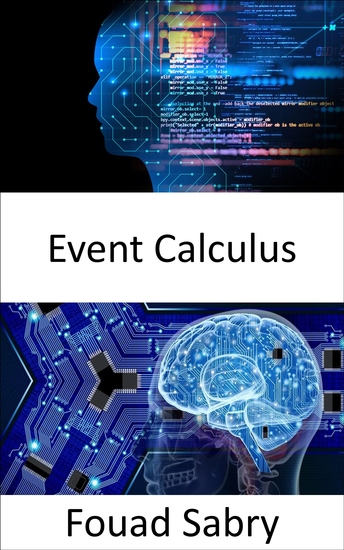
Event Calculus - Fundamentals and Applications
Fouad Sabry
Publisher: One Billion Knowledgeable
Summary
What Is Event Calculus

Robert Kowalski and Marek Sergot were the ones who initially developed the event calculus in 1986. It is a logical language for representing events and their effects as well as for thinking about those events and their effects. Murray Shanahan and Rob Miller were the ones responsible for its expansion in the 1990s. The event calculus describes the impacts of actions on fluents in a manner that is comparable to that of other languages for thinking about change. On the other hand, events are not always internal to the system. One is able to express the value of fluents at certain specified time points, as well as the events that take place at those time points, as well as the effects of those events, using the event calculus.

How You Will Benefit

(I) Insights, and validations about the following topics:

Chapter 1: Event calculus

Chapter 2: First-order logic

Chapter 3: Frame problem

Chapter 4: Natural deduction

Chapter 5: Open formula

Chapter 6: Method of analytic tableaux

Chapter 7: Situation calculus

Chapter 8: Fluent (artificial intelligence)

Chapter 9: Atomic formula

Chapter 10: Yale shooting problem

(II) Answering the public top questions about event calculus.

(III) Real world examples for the usage of event calculus in many fields.

(IV) 17 appendices to explain, briefly, 266 emerging technologies in each industry to have 360-degree full understanding of event calculus' technologies.

Who This Book Is For

Professionals, undergraduate and graduate students, enthusiasts, hobbyists, and those who want to go beyond basic knowledge or information for any kind of event calculus.
Available since: 06/30/2023.
Print length: 171 pages.