Join us on a literary world trip!
Add this book to bookshelf
Grey
Write a new comment Default profile 50px
Grey
Subscribe to read the full book or read the first pages for free!
All characters reduced
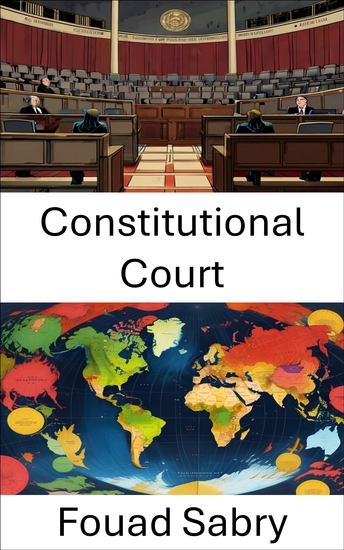
Constitutional Court - Guardians of Constitutional Balance Upholding Justice and Rights - cover

Constitutional Court - Guardians of Constitutional Balance Upholding Justice and Rights

Fouad Sabry

Publisher: One Billion Knowledgeable

  • 0
  • 0
  • 0

Summary

Dive into the essence of constitutional law with "Constitutional Court," an in-depth exploration of the crucial role constitutional courts play globally. Through this journey into political science, readers uncover how these courts shape legal frameworks, safeguard democracy, and protect fundamental rights.
 
Chapters Brief Overview:
 
1: Constitutional Court – Introduces the evolution and function of constitutional courts in safeguarding constitutions.
 
2: Constitution – Discusses the interaction between constitutions and the courts that interpret them.
 
3: Separation of Powers – Examines how courts maintain the balance between government branches.
 
4: Judicial Yuan – Explores Taiwan's Judicial Yuan and its role in governance.
 
5: Constitution of Lithuania – Looks at Lithuania’s constitutional court and its impact on rights protection.
 
6: Constitution of Austria – Investigates Austria’s constitutional court and its legal influence.
 
7: Constitution of South Korea – Reviews South Korea’s court in ensuring democracy and law compliance.
 
8: Constitutional Court of Korea – Delves into key decisions shaping South Korea’s legal landscape.
 
9: Supreme Court of Korea – Compares roles of South Korea’s supreme and constitutional courts.
 
10: Supreme Court – Contrasts supreme courts with constitutional courts worldwide.
 
11: Constitutional Court of the Czech Republic – Examines the court’s role in post-communist reforms in the Czech Republic.
 
12: Judiciary of Austria – Looks at Austria’s judicial system and the role of its constitutional court.
 
13: Judicial Review – Highlights judicial review as essential for accountability and rights protection.
 
14: Judicial Review in Denmark – Discusses Denmark's courts in upholding constitutional norms.
 
15: Worldwide Influence of the Constitution of the United States – Examines the U.S. Constitution's impact on global judicial systems.
 
16: Federal Constitutional Law – Discusses federal constitutional law and its governance role.
 
17: Judicial Review in Austria – Analyzes Austria’s judicial review mechanisms and court’s role in protecting rights.
 
18: Unconstitutional Constitutional Amendment – Examines global cases and controversies on unconstitutional amendments.
 
19: Judiciary of South Korea – Reviews the broader judicial system of South Korea.
 
20: Ordinary Court – Compares constitutional courts with ordinary courts in resolving legal disputes.
 
21: The Courts of Liechtenstein – Offers insights into Liechtenstein’s judicial system and its stability.
 
A must-read for professionals, students, and enthusiasts, "Constitutional Court" deepens understanding of constitutional law. With nuanced insights into each facet of constitutional jurisprudence, this work is essential for anyone invested in political science and legal studies.
Available since: 10/03/2024.
Print length: 346 pages.

Other books that might interest you

  • 1980 Nomination Acceptance Address - cover

    1980 Nomination Acceptance Address

    Ronald Reagan

    • 0
    • 0
    • 0
    Cover Art Photo: Ronald Reagan giving his acceptance speech at the Republican National Convention at Joe Louis Arena, Detroit, Michigan. July 17, 1980. 
    In his acceptance speech, Reagan envisioned “a new consensus with all those across the land who share a community of values embodied in these words: family, work, neighborhood, peace and freedom.” Reagan’s acceptance focuses on “three grave threats to our very existence, any one of which could destroy us. We face a disintegrating economy, a weakened defense and an energy policy based on the sharing of scarcity.” 
    Reagan places responsibility on the “Democratic party leadership-in the White House and in Congress-for this unprecedented calamity which has befallen us.” He says his first act will be “to impose an immediate and thorough freeze on federal hiring” and “to conduct a detailed review of every department, bureau and agency that lives by federal appropriation.” Reagan calls for “a 30 percent reduction in income tax rates over a period of three years” and reminds us that “every major tax cut in this century has strengthened the economy, generated renewed productivity and ended up yielding new revenues for the government”. 
    On the issue of national defense, Reagan asserts that we “know only too well that war comes not when the forces of freedom are strong, but when they are weak. It is then that tyrants are tempted.” While calling for a strong military, Reagan reiterates his long-held belief that government is too big and the “time is now to limit federal spending; to insist on a stable monetary reform and to free ourselves from imported oil.” 
    Search online for “Ronald Reagan major speeches” to see both a text version and a video version of this speech. Audio recording courtesy of the Ronald Reagan Presidential Library. AspenLeafMedia.com
    Show book
  • The Hard Road Out - cover

    The Hard Road Out

    Jihyun Park, Seh-lynn Chai

    • 0
    • 0
    • 0
    The harrowing story of a woman who escaped famine and terror in North Korea, not once but twice. 
    ‘A gripping, suspenseful and cathartic memoir that tells a story of pain and perseverance and makes the moral case for asylum.’ David Lammy MP 
    North Korea is an open-air prison from which there is no escape. Only a handful of men and women have succeeded. 
    Jihyun Park is one of these rare survivors. Twice she left the land of the ‘socialist miracle’ to flee famine and dictatorship. 
    By the age of 29 she had already witnessed a lifetime of suffering. Family members had died of starvation; her brother was beaten nearly to death by soldiers. Even smiling and laughing was discouraged. 
    The first time she ran, she was forced abandon her father on his deathbed – crossing the border under a hail of bullets. In China she was sold to a farmer, with whom she had a son, before being denounced and forcibly returned to North Korea. 
    Six months later guards abandoned her, injured, outside a prison camp. She recovered and returned China to seek her son, now six, before attempting to navigate the long, hard road through the Gobi Desert and into Mongolia. 
    Clear-eyed and resolute, Jihyun’s extraordinary story reveals a Korea far removed from the talk of nuclear weapons and economic sanctions. She remains sanguine despite the hardship. Recalling life’s tiny pleasures even at her darkest moments, she manages to instill her tale with incredible grace and humanity. 
    Beautifully written with South Korean compatriot Seh-lynn Chai, this compelling book offers a stark lesson in determination, and ultimately in the importance of asylum. 
    This best autobiography is a personal account of survival and political struggle. It's a top choice for those interested in history, rights, and the experiences of refugees in Asia. 
    For fans of Masaji Ishikawa (A River in Darkness), Catherine Belton (Putin's People), Bill Browder (Freezing Order), Hyeonseo Lee (The Girl with Seven Names), and Blaine Harden (Escape from Camp 14). 
    HarperCollins 2022
    Show book
  • Voices for the Future - 20 Years of the Trilogue Salzburg - cover

    Voices for the Future - 20 Years...

    Wolfgang Schüssel, Liz Mohn

    • 0
    • 0
    • 0
    How can culture, politics and business work together to meet the challenges of the future? Will united Europe fall victim to individual national interests? Is the economy the silver bullet when it comes to solving global challenges? Can policy makers still lead in an age of fake news and escalating expectations? What kind of support is needed – and from which culture – to shape a sustainable society?
    The book Voices for the Future documents the lively exchange between international thought leaders from the cultural, economic and political spheres on solutions to current and coming problems. Since 2002, they have been gathering at the Trilogue Salzburg to take a shared look at what the future holds. Where has the Trilogue been farsighted in terms of the issues that now dominate the policy agenda and our everyday lives? What must (still) happen if we are to respond effectively to future challenges? Voices for the Future essays answers to these questions, addressing the topics of Europe, the labor market, leadership, education and values.
    Show book
  • Rogue Elephant - How the Republicans Went from the Party of Business to the Party of Chaos - cover

    Rogue Elephant - How the...

    Paul Heideman

    • 0
    • 0
    • 0
    Rogue Elephant traces the radicalization of the Republican Party over the past fifty years, arguing that its subordination to Donald Trump was not an anomaly, but rather the culmination of processes at work for decades. 


    Providing a new perspective on figures from Newt Gingrich and George W. Bush to the Tea Party and Donald Trump, it shows that the party's lurch to the far right was the product of a volatile mix of a disorganized party structure and a divided and fractious class of American business owners. 


    These forces have propelled ever more reactionary leaders to the front of the party, setting up cycles where the insurgents of one period become the party establishment of the next, and find themselves confronted with a new batch of insurgents even farther to the right. 


    The result is that a party that was once seen as the handmaiden of American business has increasingly found itself in conflict with business groups like the Chamber of Commerce. 


    Considering the implications of these dynamics for American democracy, Heideman warns that there may be no going back to normal for the Republican Party without a much broader transformation of American society.
    Show book
  • A Real Right to Vote - How a Constitutional Amendment Can Safeguard American Democracy - cover

    A Real Right to Vote - How a...

    Richard L. Hasen

    • 0
    • 0
    • 0
    Throughout history, too many Americans have been disenfranchised or faced needless barriers to vote. Part of the blame falls on the Constitution, which does not contain an affirmative right to vote. The Supreme Court has made matters worse by failing to protect voting rights and limiting Congress's ability to do so. The time has come for voters to take action and push for an amendment to the Constitution that would guarantee this right for all. 


    Drawing on troubling stories of state attempts to disenfranchise military voters, women, African Americans, students, former felons, Native Americans, and others, Richard Hasen argues that American democracy can and should do better in assuring that all eligible voters can cast a meaningful vote that will be fairly counted. He shows how a constitutional right to vote can deescalate voting wars between political parties that lead to endless rounds of litigation and undermine voter confidence in elections, and can safeguard democracy against dangerous attempts at election subversion. 


    The path to a constitutional amendment is undoubtedly hard, especially in these polarized times. A Real Right to Vote explains what's in it for conservatives who have resisted voting reform, and reveals how the pursuit of an amendment can yield tangible dividends for democracy long before ratification.
    Show book
  • Shameless - The Fight for Adoption Disclosure and the Search for My Son - cover

    Shameless - The Fight for...

    Marilyn Churley

    • 0
    • 0
    • 0
    In the late 1960s, at the age of eighteen and living far from home amidst the thriving counterculture of Ottawa, Marilyn Churley got pregnant. Like thousands of other women of the time she kept the event a secret. Faced with few options, she gave the baby up for adoption.
    		 
    Over twenty years later, as the Ontario NDP government’s minister responsible for all birth, death, and adoption records, including those of her own child, Churley found herself in a surprising and powerful position – fully engaged in the long and difficult battle to reform adoption disclosure laws and find her son.
    		 
    Both a personal and political story, Shameless is a powerful memoir about a mother’s struggle with loss, love, secrets, and lies – and an adoption system shrouded in shame.
    Show book