Join us on a literary world trip!
Add this book to bookshelf
Grey
Write a new comment Default profile 50px
Grey
Subscribe to read the full book or read the first pages for free!
All characters reduced
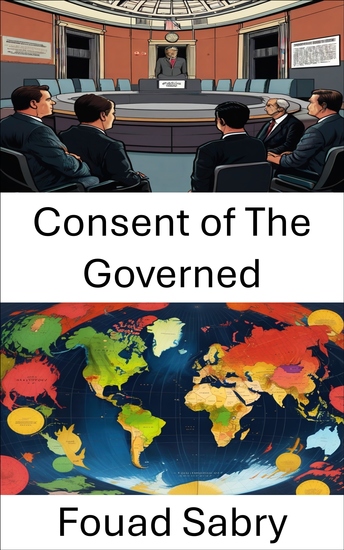
Consent of The Governed - Exploring Democratic Legitimacy and Civic Engagement in Modern Governance - cover

Consent of The Governed - Exploring Democratic Legitimacy and Civic Engagement in Modern Governance

Fouad Sabry

Publisher: One Billion Knowledgeable

  • 0
  • 0
  • 0

Summary

In modern governance, "Consent of The Governed" is a cornerstone of democracy and political philosophy. This book explores how governments derive their authority from the people's will, impacting governance, accountability, and political participation. It’s crucial for understanding democratic theory and its practical applications.
 
1-Consent of the Governed-The foundation of government legitimacy through people's consent.
 
2-John Locke-Locke’s theories on government and natural rights that shaped democratic thought.
 
3-Political Philosophy-Insights into political philosophy and its impact on democratic principles.
 
4-Sovereignty-The concept of sovereignty and its relation to consent in governance.
 
5-Social Contract-How social contract theory defines the relationship between the governed and rulers.
 
6-U.S. Constitution-The Constitution as a reflection of consent and democratic governance.
 
7-Declaration of Independence-The Declaration’s role in articulating consent and self-governance principles.
 
8-Authority-The nature of political authority and its legitimacy through consent.
 
9-Natural vs. Legal Rights-Differentiating natural and legal rights within democratic theory.
 
10-Popular Sovereignty-The concept of popular sovereignty and its modern democratic application.
 
11-Divine Right vs. Democratic Consent-Evolving notions of political legitimacy.
 
12-Virginia Declaration of Rights-Its influence on American political thought and consent principles.
 
13-State of Nature-Implications of the state of nature for consensual governments.
 
14-Political Legitimacy-Dependence on the consent of the governed.
 
15-Two Treatises of Government-Locke’s impact on political philosophy and democratic theory.
 
16-Limited Government-Alignment of limited government with the concept of consent.
 
17-Compact Theory-Emphasis on voluntary agreements among the governed.
 
18-Right of Revolution-Its implications for political change in response to breaches of consent.
 
19-Voluntary Taxation-Role of voluntary taxation in democratic governance.
 
20-Popular Sovereignty in the U.S.-Manifestation in U.S. political practices and institutions.
 
21-Philosophy of Human Rights-Connection between human rights philosophy and the principle of consent.
 
This book offers valuable insights into democratic principles and political philosophy, making it a vital addition to any political science library.
Available since: 09/04/2024.
Print length: 295 pages.

Other books that might interest you

  • A Truce That Is Not Peace - cover

    A Truce That Is Not Peace

    Miriam Toews

    • 0
    • 0
    • 0
    "Essential reading. A companion for turbulent times."—Laura van den Berg 
      
    Internationally bestselling author Miriam Toews' memoir of the will to write—a work of disobedient memory, humor, and exquisite craft set against a content-hungry, prose-stuffed society. 
      
    “Why do you write?” the organizer of a literary event in Mexico City asks Miriam Toews. Each attempted answer from Toews—all of them unsatisfactory to the organizer—surfaces new layers of grief, guilt, and futility connected to her sister's suicide. She has been keeping up, she realizes, a decades-old internal correspondence, filling a silence she barely understands. And we, her readers, come to see that the question is as impossible to answer as deciding whether to live life as a comedy or a tragedy. 
      
    Marking the first time Toews has written her own life in nonfiction, A Truce That Is Not Peace explores the uneasy pact a writer makes with memory. Wildly inventive yet masterfully controlled; slyly casual yet momentous; wrenching and joyful; hilarious and humane—this is Miriam Toews at her dazzling best, remaking her world and inventing an astonishing new literary form to contain it.
    Show book
  • Sam Lawson's Oldtown Fireside Stories - cover

    Sam Lawson's Oldtown Fireside...

    Harriet Beecher Stowe

    • 0
    • 0
    • 0
    Step into the heartwarming world of "Sam Lawson's Oldtown Fireside Stories" by Harriet Beecher Stowe. This delightful audiobook takes you on a journey to the charming New England town of Oldtown, where Sam Lawson, a lovable and charismatic storyteller, spins captivating tales by the fireside. With his unique blend of humor, wit, and wisdom, Sam transports listeners to a bygone era, sharing stories of local characters, legends, and life's valuable lessons. Each fireside narrative is rich with vivid imagery and cultural insights, offering a glimpse into the heart and soul of a close-knit community. From humorous anecdotes to poignant reflections, these stories resonate with timeless themes of friendship, family, and the power of storytelling. Prepare to be enchanted by Sam Lawson's colorful storytelling and embark on a journey of nostalgia and warm-hearted connection.
    Show book
  • Influence - The Psychology of Persuasion - cover

    Influence - The Psychology of...

    Robert Cialdini

    • 0
    • 0
    • 0
    This work provides a concise synthesis of the key insights and analysis from Influence by Robert Cialdini. It is an independent summary, not the original book, and has no affiliation with or endorsement from the original publication. Created for readers who want a clear, thought-provoking overview, it distills the central themes and ideas while preserving the depth and relevance of the work. 
    A classic study of why people say “yes,” this book explores six universal principles of persuasion—reciprocity, commitment and consistency, social proof, authority, liking, and scarcity. It reveals how these psychological triggers shape decisions, often unconsciously, and how they can be used ethically to guide behavior. At once scientific and practical, it equips readers to recognize when they are being influenced, and to apply the same principles responsibly in sales, leadership, and everyday interactions.
    Show book
  • How to Become a Public Speaker - cover

    How to Become a Public Speaker

    William Pittenger

    • 0
    • 0
    • 0
    How to Become a Public Speaker by William Pittenger is a comprehensive guide designed to equip aspiring speakers with the necessary tools to communicate effectively and persuasively. Written in an engaging and instructive style, the book explores the fundamental principles of oratory, from organizing thoughts with clarity to delivering speeches with confidence and passion.
     
    Pittenger debunks the myth that great speakers are simply born with talent, asserting that eloquence is a skill that can be cultivated through proper training and practice. He outlines various methods of speech delivery, discusses the importance of imagination and emotion in oratory, and provides practical exercises to enhance vocal strength and articulation. The book also addresses common obstacles such as stage fright and unstructured discourse, offering strategies to overcome these challenges.
     
    For those engaged in public speaking—whether as lecturers, debaters, politicians, clergy, or business professionals—this book remains a timeless and essential resource in the art of persuasive communication.
    Show book
  • Being Victorian - How it felt then Why it matters now - cover

    Being Victorian - How it felt...

    Jamie Camplin

    • 0
    • 0
    • 0
    Writers and poets, academics and art critics, mathematicians and experimental scientists, churchmen and politicians, women of strong opinions gather for a summer weekend in the 1870s. Is it real, or is it a fantasy? One thing's sure: their debates – about life's aims, rural and urban living, love and money, civilization and belief, the social framework, the past, the present and the future take us to the heart of the Victorian dream and its reality: the idea that their society exemplified 'Progress'. What did 'Progress' mean? Were things (and which things) getting better? What did 'better' mean? And for whom? The history of the world before the Victorians, from Aberdeen to Africa, showed a particular form of equality for almost everyone: an equality of poverty and no prospects, with kindness often in short supply. Victorians wanted to change that world, thought they were changing it, did change it. They did it in a human way: a melange of muddle, vision, certainty, doubt, too slow for many, too fast for some. Yet their changes were decisive both for creating the modern world, but also for revealing the dilemmas attached to mass living in urban, technological societies, as well as the moral flaws in imposing one civilization's or one person's beliefs on another. Most remarkably of all, the upheaval in making major transitions in every area of life, which produced revolutions and violence across Europe, in the Americas and in Asia, was carried out – at least in Britain itself – almost entirely peacefully. The past will always be a foreign country for those unwilling to engage with its people. Whether viewing the lives of rulers or the ruled, 'Being Victorian' corrects innumerable preconceptions.
    Show book
  • Power of Simplicity The: Secrets to Reimagine Your Life - "Revitalize your journey! Dive into impactful audio lessons that unveil the secrets of a simpler fulfilling life" - cover

    Power of Simplicity The: Secrets...

    Jareth Windermere

    • 0
    • 0
    • 0
    The Power of Simplicity: Secrets to Reimagine Your Life 
    Are you eager to advance in your career and enhance your knowledge by effectively transforming your thoughts into reality through the art of writing? 
    Searching for an all-inclusive guide that covers everything you need to turn your ideas into actionable steps? 
    Your quest ends here! 
    This guide is your ultimate resource for deepening your understanding, honing your skills, and engaging in practical exercises. With this, you're on the path to success. 
    Key features of this enriched guide: 
    - In-depth insights into transforming thoughts into reality through writing 
    - Comprehensive explanations on the craft of effective writing 
    - Proven strategies for preparation and execution 
    Our guide stands out for its thorough approach, integral to your success. Concepts are not just touched upon; they are explored with clarity and detail. 
    Please note that this guide is not associated with any official writing organization and serves as an independent resource for your benefit. 
    Designed with a straightforward structure and accessible language, our guide ensures smooth transitions between topics. Say goodbye to complex jargon and embrace clear, concise, and technically sound content. 
    So, why wait? Click the BUY NOW button, secure your guide, and embark on your journey to transforming your thoughts into reality through the art of writing! 
    Start your journey today!
    Show book