Join us on a literary world trip!
Add this book to bookshelf
Grey
Write a new comment Default profile 50px
Grey
Subscribe to read the full book or read the first pages for free!
All characters reduced
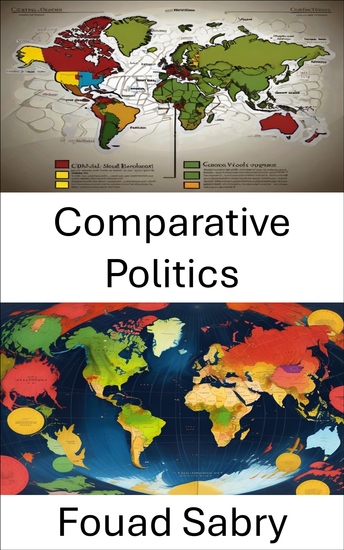
Comparative Politics - Understanding the Dynamics of Political Systems Worldwide - cover

Comparative Politics - Understanding the Dynamics of Political Systems Worldwide

Fouad Sabry

Publisher: One Billion Knowledgeable

  • 0
  • 0
  • 0

Summary

In an evolving global landscape, grasping political systems' nuances is essential. *Comparative Politics*, part of the *Political Science* series, delivers a thorough analysis of governance, power dynamics, and policy outcomes across varied contexts, making it a key resource for understanding global political structures.
 
Highlights:
 
- 1: Comparative Politics - Explore foundational concepts, methodologies, and the significance of comparative politics.- 2: Political Science - Deepen your understanding of political science and its link to comparative politics.- 3: Case Study - Learn how case studies illuminate broader political phenomena.- 4: Democratization - Examine the processes and challenges in transitioning to democratic systems.- 5: Arend Lijphart - Discover Lijphart's contributions to democracy and institutional design.- 6: Modernization Theory - Analyze how economic and social development affect political change.- 7: Barrington Moore Jr. - Study Moore's work on the social origins of dictatorship and democracy.- 8: Theda Skocpol - Understand Skocpol's theories on state structures and social revolutions.- 9: Neil Smelser - Delve into Smelser's research on social change and its relevance.- 10: Juan José Linz - Explore Linz's research on authoritarianism and democratic breakdowns.- 11: Adam Przeworski - Learn about Przeworski's insights on democracy and economic development.- 12: Historical Institutionalism - Investigate the role of historical institutionalism in shaping political outcomes.- 13: Guillermo O'Donnell - Examine O'Donnell's work on bureaucratic authoritarianism and democratic transitions.- 14: Gabriel Almond - Discover Almond's contributions to political culture.- 15: Gerardo L. Munck - Understand Munck's methodological rigor in comparative research.- 16: Alfred Stepan - Study Stepan's insights into the state, democracy, and religion.- 17: David Collier - Explore Collier's work on methodology and concept formation.- 18: Philippe C. Schmitter - Learn about Schmitter's theories on corporatism and democracy transitions.- 19: Critical Juncture Theory - Understand the significance of critical juncture theory in political transformations.- 20: Social Origins of Dictatorship and Democracy - Investigate the social roots of political regimes.- 21: Comparative Federalism - Explore variations and implications of federal systems.
 
This book offers structured insights into comparative politics, making it invaluable for professionals, students, and enthusiasts seeking to enhance their understanding of global political systems.
Available since: 08/01/2024.
Print length: 165 pages.


Other books that might interest you

  • The Brama Samhita - Brama's Prayers To Govinda - cover

    The Brama Samhita - Brama's...

    Bhaktisiddhanta Sarasvati Thakura

    • 0
    • 0
    • 0
    Lord Brahma saw Krsna directly and composed a prayer based on his realizations – a striking prayer by one who has seen the truth. 
      
    Krsna revealed himself to Brama, along with his spiritual planets. Overwhelmed by this transcendental revelation, Brama spoke these words glorifying Krsna. Brama’s awe and love permeate the text and reveal the workings of the cosmic creation. 
      
    The Brama Samhita teaches that transcendence, truth, and ultimate reality can be apprehended only by the mercy of the supreme transcendent entity, the Absolute Truth Himself, and that perception of ultimate reality is a function not of speculative reason but of direct spiritual cognition through divine revelation. This collection is taken from the fifth chapter of the Hymns of Brama, and includes verses 1 to 29.. There were 100 chapters in the Brama Samhita. This 5th chapter of the Brama Samhita was discovered by Lord Chaitanya. The other chapters have not yet been revealed. 
     
    The Brama-samhita clearly describes Brahman. Kṛṣṇa is the Supreme Brahman because of His unlimited knowledge, unlimited potencies, unlimited strength, unlimited influence, unlimited beauty, and unlimited renunciation. Ultimately, therefore, the word Brahman can be applied to Kṛṣṇa only.  
      
    Because the impersonal Brahman is the effulgence emanating as rays of Kṛṣṇa’s transcendental body, Kṛṣṇa is the Parabrahman. Everything rests on Brahman, but Brahman rests upon Kṛṣṇa. The material elements are accepted as the inferior energy of Kṛṣṇa. By their interaction, the cosmic manifestation takes place, rests on Kṛṣṇa, and after dissolution again enters into the body of Kṛṣṇa as His subtle energy. Kṛṣṇa is therefore the cause of both manifestation and dissolution. 
     
    Translator and commentator Bhaktisiddhanta Sarasvati was a Gaudīya Vaisnava Hindu guru, ācārya, and revivalist in early 20th century India. 
    Show book
  • Alphabet & Numbers - cover

    Alphabet & Numbers

    Philip Stanworth

    • 0
    • 0
    • 0
    This book is a learning book for children going over A-Z with Animals as an example great for children
    Show book
  • Democratic Delusions - How the Media Hollows Out Democracy and What We Can Do About It 1st Edition - cover

    Democratic Delusions - How the...

    Natalie Fenton

    • 0
    • 0
    • 0
    A free media is inextricably linked to a healthy democracy, but in many parts of the world liberal democracies are deemed to be dying or on the demise—a demise that many forms of media have enabled while heralding themselves as democracy's savior. The hollowing out of democracy in these ways has left many people questioning the value of (neo)liberal democratic societies. What can we do about it? 


    Democratic Delusions explores the potential of our media and tech systems to be democratic and contribute to a just and transformative democracy. This is only possible, Natalie Fenton argues, by first situating our political systems and mediated worlds within global capitalism. By interrogating different media and their relationship to seven key elements of democracy—power, participation, freedom, equality, public good, trust, and hope—the book asks: What is the response of society when the ability of news media to speak truth to power has been restricted by corporate logic? And, how do we tackle a deep-rooted market logic that shifts public debate towards private interest and marginalizes progressive perspectives? The book explores how these elements can be reimagined through newly conceived media and tech landscapes and, ultimately, what democracy might be in a future mediated world that places more power in the hands of more people.
    Show book
  • Mindful Healing: Mental Health Through Mindfulness - Cultivating Calm and Clarity - cover

    Mindful Healing: Mental Health...

    AHMED MUSA

    • 0
    • 0
    • 0
    "Mindful Healing: Mental Health Through Mindfulness: Cultivating Calm and Clarity" is a useful manual created to assist people in using the power of mindfulness to navigate the intricacies of mental health. In a time when stress, worry, and emotional overload are becoming more common, mindfulness provides a straightforward yet effective way to take back control of your mental health. 
    The relationship between mindfulness and mental health is examined in this book, which shows how present-moment awareness can improve mental clarity, foster emotional resilience, and lower stress. In order to foster a stronger sense of peace and clarity in day-to-day living, it exposes readers to evidence-based mindfulness practices like body scans, mindful breathing, and mindful conversation. 
    "Mindful Healing" enables readers to incorporate mindfulness into their daily routines, from managing stressful situations to developing emotional awareness and self-compassion, by providing them with concise explanations and useful exercises. This book provides clear, simple-to-follow instructions for anybody seeking mental equilibrium and emotional well-being, regardless of whether they are new to mindfulness or want to develop their practice. 
    With an emphasis on real-world implementation, "Mindful Healing" is not just a manual for stress reduction but also a route to sustained mental health. This book offers the resources you need to begin your journey if you're prepared to take charge of your mental health and discover serenity in the here and now.
    Show book
  • Good Grief: Embracing life at a time of death - cover

    Good Grief: Embracing life at a...

    Catherine Mayer, Anne Mayer-Bird

    • 0
    • 0
    • 0
    ‘The most life-affirming book ever written about death.’ Sandi Toksvig‘One of the most powerful and helpful books about grief that you will ever read.’ Anita Anand 
    ‘Grief is more than the price of love. It is love. We must learn not just to live with it, but to make it welcome.’ 
    Mother and daughter Anne Mayer Bird and Catherine Mayer were widowed within 41 days of each other on the eve of the pandemic, then locked down alone. Their profound isolation was broken just once a week, when Catherine visited Anne to care for her, at distance and in a mask. Together they found ways to navigate their loss and the startling questions and challenges that confronted them. 
    In this memoir, Catherine also investigates the possibility that her husband, renowned musician Andy Gill, contracted Covid-19 when his band, Gang of Four, toured China in late 2019. Her main focus, however, is not on death, but on life and love. This is a captivating account of lives well lived, moving and spiked with black humour. It is interwoven with letters Anne wrote to her husband John to tell him of the astonishing and heartrending events since his death and her small triumphs in living independently. 
    In sharing their insights and experiences, Catherine and Anne aim to help those who have lost or will lose people or who wish to know how best to support others in such circumstances. They also celebrate love—for John and Andy and each other. 
    ‘We are extraordinarily lucky, my mother and I. We have each other and we have this room. 
    ‘In this living room, we are learning to embrace the things we can’t touch, each other and the lovely dead.’ 
    Catherine Mayer's Good Grief is a top-rated autobiography that explores the psychology of grief and bereavement. It is a profound exploration of relationships, marriage, and family, providing a long-term perspective on dealing with loss. 
    For fans of Angela Levin (Harry), Robert Jobson (Diana), Rachel Clarke (Your Life In My Hands), Richard Coles (The Madness of Grief), and Donna Ashworth (Loss). 
    HarperCollins 2022
    Show book
  • No Excuses - Turning around one of Britain's toughest schools - cover

    No Excuses - Turning around one...

    Alison Colwell

    • 0
    • 0
    • 0
    "Eye-popping" – Sunday Times
    "Brilliant" – Iain Dale
    ***
    An unputdownable true account of how a tenacious head teacher led one of the most challenging schools in the country to excellence.
    No Excuses charts an extraordinary principal's journey from the moment she took over at a failing secondary school in a deprived area, where less than a quarter of children attained five or more A*–C GCSEs, and how she set about the gruelling task of transforming its reputation using her zero-tolerance, tough-love approach.
    Armed only with a wicked sense of humour, fearless energy and a powerful vision, Alison Colwell put in place a stringent set of rules, including a strict uniform policy and a complete ban on mobile phones, provoking resistance and hostility from some parents, the wider community and on social media.
    This is the darkly funny, moving story of how, together, teachers and their – often troubled – pupils rebuilt a school and community, with an inspirational head at the helm.
    Charming, touching and full of brilliant leadership advice, this is the diary of the woman the Daily Mail labelled Britain's strictest head teacher.
    Show book