Join us on a literary world trip!
Add this book to bookshelf
Grey
Write a new comment Default profile 50px
Grey
Subscribe to read the full book or read the first pages for free!
All characters reduced
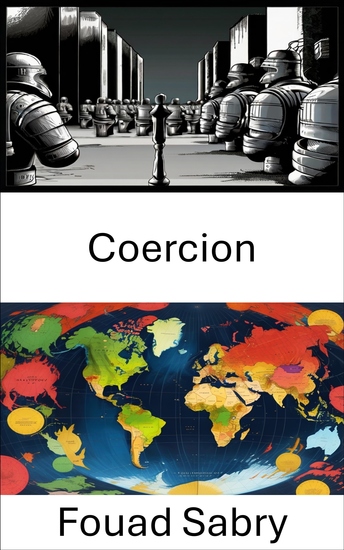
Coercion - Power Dynamics and Influence in Modern Governance - cover

Coercion - Power Dynamics and Influence in Modern Governance

Fouad Sabry

Publisher: One Billion Knowledgeable

  • 0
  • 0
  • 0

Summary

What is Coercion?
 
This book explores power dynamics and coercion mechanisms in political contexts, addressing ethical implications and strategic applications.
 
Why Read about Coercion in Political Science?
 
Understanding coercion is vital for comprehending power in politics. This book offers insights into coercive tactics shaping political outcomes, international relations, and personal freedoms. Readers will discover the methods of control and their profound societal impacts.
 
Chapters Overview:
 
1: Coercion: Introduces coercion's definitions and forms, laying the groundwork for exploration.
 
2: Power (Social and Political): Examines social and political power, exploring their intersection with coercion.
 
3: Extortion: Analyzes extortion as a coercive practice, its legal implications, and political use.
 
4: Duress in American Law: Explores duress in American law through case studies and legal precedents.
 
5: Blackmail: Investigates blackmail's mechanics, ethical dimensions, and political prevalence.
 
6: Intimidation: Discusses intimidation as a coercive tactic and its psychological impact in politics.
 
7: Duress in English Law: Compares duress treatment in English and American law, providing case examples.
 
8: Abusive Power and Control: Explores abusive power dynamics in relationships and resistance strategies.
 
9: Compellence: Examines compellence's strategic use in international relations as a coercive tool.
 
10: Coercion (International Relations): Delves into state coercion to influence others, with historical and contemporary examples.
 
11: Right of Self-Defense: Examines legal and moral justifications for self-defense against coercion.
 
12: Ultimatum: Analyzes the ultimatum as a coercive strategy in political negotiations.
 
13: Monopoly on Violence: Discusses the state's monopoly on violence and its role in political authority.
 
14: Coercive Monopoly: Investigates coercive monopolies, their formation, and impact on power dynamics.
 
15: Hobbs Act: Explores the Hobbs Act's role in addressing extortion and coercion.
 
16: Anarchist Law: Examines anarchist legal theories on coercion and authority.
 
17: Marital Coercion: Discusses coercion in marriages, its legal recognition, and protections.
 
18: Sextortion: Addresses the rise of sextortion, its mechanisms, and legal responses.
 
19: Reproductive Coercion: Explores how coercion impacts reproductive choices and rights.
 
20: Throffer: Analyzes throffers (threats and offers) in coercion and ethical debates.
 
21: Sexual Consent in Law: Examines sexual consent legal standards and how coercion complicates them.
 
How Will You Benefit?: This book answers key questions about coercion, offering insights beyond basic knowledge. It’s ideal for professionals, students, enthusiasts, and anyone seeking a deeper understanding of coercion in political science.
Available since: 10/07/2024.
Print length: 208 pages.

Other books that might interest you

  • Criminal Fraud and Election Disinformation - Law and Politics - cover

    Criminal Fraud and Election...

    Jeremy Horder

    • 0
    • 0
    • 0
    Deliberate mischaracterization of political opponents and their policies has always been a part of politics; however, lying, dishonesty, and distortion of the facts remain morally wrong and have the potential to obstruct important political interests. For example, a false or misleading claim publicized about an election candidate may lead someone to lose an election that they might otherwise have won. So, does—and should—the law seek to provide protection from the risk of this happening? 


    In attempting to answer this question, Jeremy Horder draws a key distinction between what is called "political viewpoint" fraud and "electoral participation" fraud. In the interests of protecting freedom of speech, false or misleading claims (disinformation) involving political viewpoint content should be tolerated, not only by the criminal law but also by the internet platforms which host political content. By contrast, in the interests of preserving the integrity of democratic electoral processes, disinformation involving electoral participation information should be prohibited by the criminal law and censored by internet platforms. This book explains how the criminal law in various jurisdictions frequently prohibits false or misleading political claims falling into both categories of disinformation, instead of concentrating on electoral participation fraud.
    Show book
  • Mind Control - Inside the Mechanics of Mental Domination (3 in 1) - cover

    Mind Control - Inside the...

    Cito Harder

    • 0
    • 0
    • 0
    This book uncovers the powerful and often hidden tactics of manipulating the human mind. In this 3-in-1 collection, Mind Control, Brainwashing, and Psychological Coercion, we explore how thoughts, beliefs, and behaviors can be reshaped, directed, and controlled by powerful psychological techniques. 
    This book delves deep into the psychology behind mental domination, from the subtle art of brainwashing to the more overt methods of coercive persuasion. It reveals how individuals can be manipulated into adopting new beliefs, abandoning their own values, and following commands they would otherwise never consider. Understanding these techniques is crucial for recognizing when your thoughts and actions are being influenced without your consent, whether by individuals, organizations, or governments. 
    With real-world examples, in-depth psychological analysis, and strategies for resisting mental manipulation, Mind Control empowers you to protect your mental autonomy and free will. Learn how to defend against brainwashing, resist coercive influence, and maintain control over your own mind in an increasingly manipulative world. This book is a critical resource for understanding how mental domination works and how you can safeguard your own psychological freedom.
    Show book
  • The City Is Up for Grabs - How Chicago Mayor Lori Lightfoot Led and Lost a City in Crisis - cover

    The City Is Up for Grabs - How...

    Gregory Royal Pratt

    • 0
    • 0
    • 0
    Chicago is a world-class city, but it is also a city in crisis. 


    Crime is up, schools have repeatedly shut down due to conflict between City Hall and the powerful teachers' union, and COVID-19 only deepened the entrenched poverty, institutional racism, and endless tug of war between the city's haves and have nots. 


    For four years, the person at the center of this storm was Lori Lightfoot. A groundbreaking figure—the first Black, gay woman to be elected mayor of a major city and only the second female mayor of Chicago—she knew the city was at a critical turning point when she took office in 2019. But the once-in-a-lifetime challenges she ended up facing were beyond anything she or anyone else saw coming. 


    Chicago Tribune reporter Gregory Royal Pratt offers the first comprehensive behind-the-scenes look at the tumultuous single term of Mayor Lightfoot and the chaos that roiled the city and City Hall as she fought to live up to her promises to change the city's culture of corruption and villainy, reform its long-troubled police department, and make Chicago the safest big city in America.
    Show book
  • Human Intelligence Collector Operations - cover

    Human Intelligence Collector...

    Department of the Army Headquarters

    • 0
    • 3
    • 0
    This is an official work by the US Department of the Army Headquarters. It gives information on what Human Intelligence is and what role the department has in the US army. A reader learns the structure of Human Intelligence and gets an insight into their operations. Mainly, the book presents information about the planning and management of operations, their collection process, analytics, and tools.
    Show book
  • Who Owns The Moon? - In Defence of Humanity's Common Interests in Space - cover

    Who Owns The Moon? - In Defence...

    A. C. Grayling

    • 0
    • 0
    • 0
    Silicon for microchips; manganese for batteries; titanium for missiles. 
     
    The moon contains a wealth of natural resources. So, as the Earth’s supplies have begun to dwindle, it is no surprise that the world’s superpowers and wealthiest corporations have turned their eyes to the stars. As this new Space Race begins, A.C. Grayling asks: who, if anyone, owns the moon? Or Mars? Or other bodies in near space? And what do those superpowers and corporations owe to Planet Earth and its inhabitants as a whole? 
     
    From feudal common land, through the rules of the sea, to the vast, nationless expanse of Antarctica, Grayling explores the history of the places which no one, and therefore everyone, owns. Examining the many ways this so-called terra nullius has fallen victim to ‘the tragedy of the commons’ – the tendency for communal resources to be exploited by a few individuals for personal gain at the expense of everyone else – Who Owns the Moon? puts forward a compelling argument for a bold new global consensus, one which recognises and defends the rights of everyone who lives on this planet.
    Show book
  • Combing Through the White House - Hair and Its Shocking Impact on the Politics Private Lives and Legacies of the Presidents - cover

    Combing Through the White House...

    Theodore Pappas

    • 0
    • 0
    • 0
    Read by the author. 
    Discover a fascinating and novel look at the U.S. presidents, the first families, and American history—all through the lens of hair. With meticulous detail and engaging storytelling, encyclopedia editor Theodore Pappas combs through American history, teasing out long-forgotten and little-known ways that hair has influenced the presidency and the public and private lives, personal scandals, and tragedies of the men and women who have occupied the White House. 
    Go deep into the history of such topics as:Abraham Lincoln's famously ridiculed appearance and the surprising role hair played in both his presidency and assassinationJohn F. Kennedy's connection to James Bond and how hair factored into his vast image-making and infidelitiesThe lush tradition of collecting hair as a way of honoring leaders, remembering our loved ones, and preserving their memoriesScientific hair analysis and how DNA has been used to solve long-standing presidential mysteriesThe connection of hair to the lives, loves, scandals, and tragedies that shaped presidents, first ladies, and the nation at large 
      
    This unique window into the past shines entertaining new light on the decisions, relationships, and tragedies that have shaped the role of the president and the place of the U.S. in the world. Whether you're interested in presidential trivia or historical mysteries, Combing Through the White House personalizes the past through an element of life we can all relate to—hair—giving us new glimpses into our country and even ourselves. 
    The images can be found in the audiobook companion PDF download.
    Show book