Join us on a literary world trip!
Add this book to bookshelf
Grey
Write a new comment Default profile 50px
Grey
Subscribe to read the full book or read the first pages for free!
All characters reduced
Citizens Assembly - Democratic Innovation and Collective Decision Making - cover

Citizens Assembly - Democratic Innovation and Collective Decision Making

Fouad Sabry

Publisher: One Billion Knowledgeable

  • 0
  • 0
  • 0

Summary

Explore the transformative power of Citizens Assemblies with "Citizens Assembly," part of the "Political Science" series. This work unveils how these assemblies rejuvenate democratic decision-making and civic participation, making it a must-read for professionals, students, and enthusiasts.
 
1: Citizens' Assembly – Learn the core principles and evolution of Citizens Assemblies that reshape global democracy.
 
2: Direct Democracy – Investigate how Citizens Assemblies empower citizens to impact policies.
 
3: Deliberative Democracy – Delve into how public discourse in Citizens Assemblies drives collective decision-making.
 
4: Participatory Democracy – Discover the role of Citizens Assemblies in expanding inclusive decision-making.
 
5: Electoral Reform (British Columbia) – Explore how Citizens Assemblies have transformed electoral systems.
 
6: Deliberative Opinion Poll – Understand the distinctions between Citizens Assemblies and deliberative opinion polls.
 
7: Sortition – Examine how sortition guarantees representative participation in Citizens Assemblies.
 
8: Types of Democracy – Survey various democratic forms and their relation to Citizens Assemblies.
 
9: Epistemic Democracy – Investigate the impact of informed expertise in shaping assembly decisions.
 
10: Hélène Landemore – Appreciate Hélène Landemore’s contributions to deliberative democratic processes.
 
11: Election – Compare elections and the deliberative practices of Citizens Assemblies.
 
12: Noocracy – Explore the idea of noocracy and its connection to Citizens Assemblies.
 
13: James S. Fishkin – Highlight Fishkin's pivotal role in advancing deliberative democracy.
 
14: Radical Democracy – Investigate how radical democracy aligns with Citizens Assemblies' participatory approach.
 
15: Civic Lottery – Learn about civic lotteries and their use in ensuring broad assembly participation.
 
16: Citizens Convention for Climate – See how Citizens Assemblies tackle global climate challenges.
 
17: Oral Democracy – Evaluate the significance of dialogue in policy-making within assemblies.
 
18: America in One Room – Analyze large-scale deliberative events informing public policy.
 
19: Global Assembly – Consider the role of Global Assemblies in addressing international issues.
 
20: Mongolia's Law on Deliberative Polling – Discover Mongolia’s legislative innovation in participatory democracy.
 
21: Citizens’ Initiative Review – Explore how Citizens Assemblies shape public opinion on policy.
 
"Citizens Assembly" offers essential insights into modern governance, revealing how Citizens Assemblies can reshape democracy. By engaging with this book, you gain the tools to influence democratic futures and participate in the ongoing evolution of civic decision-making.
Available since: 09/21/2024.
Print length: 223 pages.


Other books that might interest you

  • A Space for Us - A Guide for Leading Black Indigenous and People of Color Affinity Groups - cover

    A Space for Us - A Guide for...

    Michelle Cassandra Johnson

    • 0
    • 0
    • 0
    The first comprehensive guide for leading BIPOC affinity groups for challenging white supremacy, healing racial trauma, and taking collective action 


    Meeting in racial affinity groups is a common practice in anti-racist, social justice, diversity, and similar educational endeavors. These groups provide a structured space in which participants can explore how racism personally impacts them, process specific experiences of racism, receive validation and support from their peers, heal, and strategize next steps for challenging racism, white supremacy, and internalized racial oppression. 


    In A Space for Us, Michelle Cassandra Johnson brings her over twenty years of experience leading dismantling-racism work to provide the first affinity-group guide made for BIPOC communities. This essential guide will: provide an understanding of the racial hierarchy and how it has impacted Black people, Indigenous people, and People of Color differently; define and share common manifestations of internalized racial oppression; define anti-Blackness and provide skills to interrupt and address it; share rituals, practices, and sample agendas for affinity groups; provide rituals and tools for healing in BIPOC affinity groups; and provide information about how to come back together as BIPOC and white people to strategize and take collective action.
    Show book
  • Edge of Armageddon - The Imminent Nuclear Consequence - cover

    Edge of Armageddon - The...

    Robert Enochs

    • 0
    • 0
    • 0
    Edge of Armageddon: The Imminent Nuclear Consequence is a gripping nonfiction political thriller exploring the intricate dance of dominance and diplomacy surrounding nuclear war on the global stage. Delve into the heart of US hegemony, tracing the history from World War II to the present, revealing the evolution of nuclear diplomacy and the challenges to American supremacy.  
    Through insightful analysis, it explores the decline of the US Dollar and the rise of multipolar currency dynamics. Timely and sobering, it challenges readers to ponder the consequences of America's decline and offers hope for humanity amidst the foreboding, urging action to steer away from a nuclear war precipice. 
    This book is a must-read (a call to action) for anyone who dares to understand the fragility of our current geopolitical landscape and the ray of light needed to steer us away from a nuclear war precipice. Step to the Edge of Armageddon, and arm yourself with knowledge to envision a future of cooperation over annihilation.
    Show book
  • Our Enemy the State: Book Summary & Analysis - cover

    Our Enemy the State: Book...

    Briefly Summaries

    • 0
    • 0
    • 0
    This is a concise summary and analysis of Our Enemy, the State, by Albert Jay Nock.
     
    It is not the original book and is not affiliated with or endorsed by Albert Jay Nock.
    Ideal those seeking a quick and insightful overview.
     
    Our Enemy, the State offers a compelling critique of modern government, challenging the conventional understanding of the state as a benevolent force for societal good. With razor-sharp analysis, this thought-provoking work examines the historical evolution of the state, exposing its inherent tendency to prioritize power over individual liberty and economic freedom. Combining philosophical insights with incisive commentary, it invites readers to question the role of the state in their lives and consider alternatives that uphold the principles of self-reliance and voluntary cooperation.
    Show book
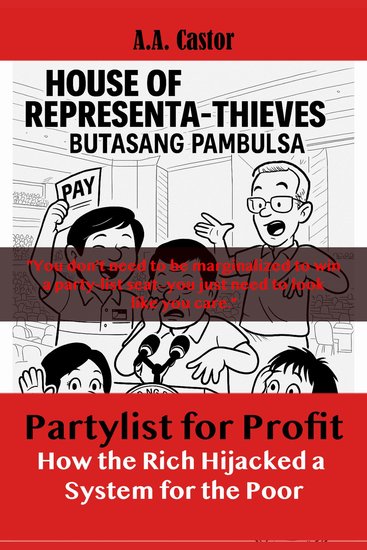
  • Partylist for Profit: How the Rich Hijacked a System for the Poor - cover

    Partylist for Profit: How the...

    A.A. Castor

    • 0
    • 0
    • 0
    Once designed to amplify the voices of farmers, laborers, and the underrepresented, the Philippine party-list system has now become the ultimate low-risk, high-reward investment for the well-connected. In Partylist for Profit: How the Rich Hijacked a System for the Poor, A.A. Castor peels back the glossy surface of legislative charity to expose the machinery of legalized profiteering, dynastic expansion, and quiet political laundering. 
    With deadpan seriousness and a dose of dark humor, this book walks readers through the insider's playbook of how to build, fund, and quietly control a party-list with as little accountability—and as much profit—as possible. From choosing a vague advocacy ("OFWs" or "transport workers," anyone?) to securing alphabet-friendly names for ballot advantage, to recycling nominees across election cycles and repackaging greed as governance, this is not a how-to—this is a how-it's-done. 
    Perfect for political junkies, aspiring operators, or just disillusioned citizens looking to finally understand why nothing ever changes, Partylist for Profit isn't just a book—it's a public service announcement disguised as satire. 
    Learn how power is bought, maintained, and quietly passed down—not through revolution, but registration. After all, in today's politics, you don't need a platform. You just need a seat.
    Show book
  • I Am the Law - How Judge Dredd Predicted Our Future - cover

    I Am the Law - How Judge Dredd...

    Michael Molcher

    • 0
    • 0
    • 0
    He is the law—and you better believe it! 


    Judge, jury, and executioner, Judge Dredd is the brutal comic book cop policing the chaotic future urban jungle of Mega-City One, created by John Wagner and Carlos Ezquerra and launching in the pages of 2000 AD in 1977. 


    But what began as a sci-fi action comic quickly evolved into a searing satire on hardline, militarized policing and "law and order" politics, its endless inventiveness and ironic humor acting as a prophetic warning about our world today—and with important lessons for our future. 


    Blending comic book history with contemporary radical theories on policing, I Am The Law takes key Dredd stories from the last forty-five years and demonstrates how they provide a unique wake up call about our gradual, and not so gradual, slide towards authoritarian policing. 


    From the politicization of policing to "zero tolerance," from violent suppression of protest to the rise of the surveillance state, I Am The Law examines how a comic book warned us about the chilling endgame of today's "law and order" politics.
    Show book
  • Communist Manifesto The - Karl Marx - cover

    Communist Manifesto The - Karl Marx

    Karl Marx

    • 0
    • 0
    • 0
    The Communist Manifesto (German: Kommunistisches Manifest), originally the Manifesto of the Communist Party (German: Manifest der Kommunistischen Partei), is a political pamphlet written by German philosophers Karl Marx and Friedrich Engels. Commissioned by the Communist League and originally published in London in 1848, the Manifesto remains one of the world's most influential political documents. It presents an analytical approach to class struggle and criticizes capitalism and the capitalist mode of production, without attempting to predict communism's potential future forms. 
    The Communist Manifesto summarises Marx and Engels' theories concerning the nature of society and politics, namely that, in their own words, "[t]he history of all hitherto existing society is the history of class struggles". It also briefly features their ideas for how the capitalist society of the time would eventually be replaced by socialism. In the last paragraph of the Manifesto, the authors call for a "forcible overthrow of all existing social conditions", which served as a call for communist revolutions around the world. 
    In 2013, The Communist Manifesto was registered to UNESCO's Memory of the World Programme along with Marx's Capital.
    Show book